
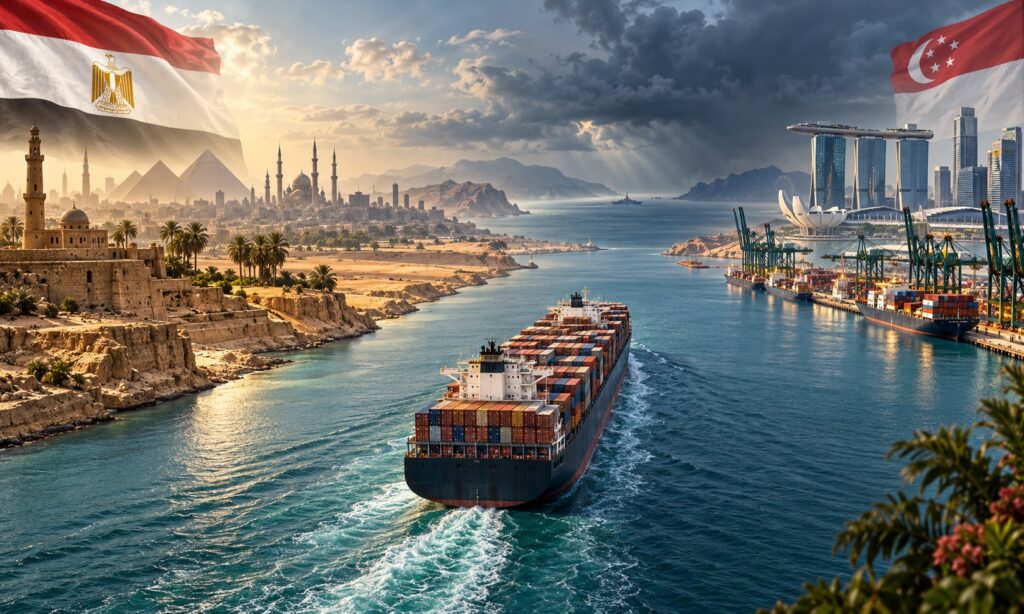
CAIRO, Egypt – Egypt’s push for closer ties with Southeast Asia reflects a central challenge for Cairo: attracting investment to a country whose commercial advantages depend heavily on stability beyond its borders.
Foreign Minister Badr Abdelatty’s recent discussions with Singapore, the United Arab Emirates and the United Nations suggest a connected strategy — expanding economic partnerships while trying to contain conflicts affecting maritime trade, Gaza and Sudan. The diplomatic activity is substantial; concrete breakthroughs remain harder to identify.
An Asian Opening, With Investment at Its Core
In talks with Singapore’s minister of state, Zhulkarnain Abdul Rahim, Abdelatty sought support for Egypt’s ambition to become an ASEAN sectoral dialogue partner and promoted investment in priority industries through the Suez Canal Economic Zone. The reported discussions contained no announcement that ASEAN had approved the proposed status.
The initiative builds on President Tharman Shanmugaratnam’s September 2025 visit, when Singapore and Egypt agreed to explore a possible free-trade agreement and expanded cooperation in maritime transport, technology and other sectors. Their 60th anniversary of diplomatic relations falls in 2026, correcting the supplied report’s reference to “next year.”
The economic logic is clear: closer institutional relationships could help Egypt convert its location into manufacturing and logistics investment. But diplomatic recognition alone cannot guarantee capital flows or commercially viable projects.
Maritime Security Is an Economic Priority
Abdelatty’s separate call with Emirati Foreign Minister Sheikh Abdullah bin Zayed Al Nahyan addressed Hormuz, Yemen and the security of the Red Sea and Bab al-Mandab. According to Egypt’s Foreign Ministry, both sides urged respect for international law, freedom of navigation and stronger efforts to prevent escalation.
For Egypt, those appeals carry an immediate domestic significance. The IMF’s latest published review reported average Suez Canal traffic of about 39 vessels a day in the 2025–26 fiscal year, compared with 73 in 2023. Canal receipts had improved but remained below half their 2023 monthly level. The fund also identified high public debt and the state’s extensive economic role as continuing vulnerabilities.
These figures suggest that regional de-escalation and domestic reform are complementary requirements for recovery. Investment incentives have greater value when businesses can rely on shipping routes and predictable operating conditions.
Gaza and Sudan Test Cairo’s Influence
On Gaza, Abdelatty called for advancing the second phase of President Trump’s peace plan, Israeli withdrawal, sustained humanitarian access and reconstruction. He also advocated empowering the territory’s administrative committee ahead of the Palestinian Authority resuming its responsibilities in Gaza and the West Bank.
Singapore offered a supportive response: Zhulkarnain praised Egypt’s cease-fire and humanitarian efforts, according to a September 16 account citing Singapore’s Foreign Ministry. That appreciation strengthens Cairo’s diplomatic standing, although it does not establish progress on the disputed arrangements for Gaza’s future.
On Sudan, Abdelatty reiterated support for national unity and institutions in talks with U.N. envoy Pekka Haavisto, who affirmed continued coordination with Egypt, according to Cairo’s account. Egypt and Saudi Arabia subsequently rejected treating Sudan’s army and rival militias as equivalent, underscoring Cairo’s preference for preserving the existing state institutions.
International mediators are emphasizing a broader political requirement. In a September 14 statement, the African Union, United Nations and their Quintet partners called for an inclusive transition to civilian government, civilian protection and an end to hostilities, while rejecting Sudan’s fragmentation.
The challenge for Cairo is to translate its access to competing diplomatic partners into outcomes: safer trade routes, investable projects and political settlements that can survive beyond the negotiating room.
Sources: Daily News Egypt, Singapore Foreign Ministry, IMF,