
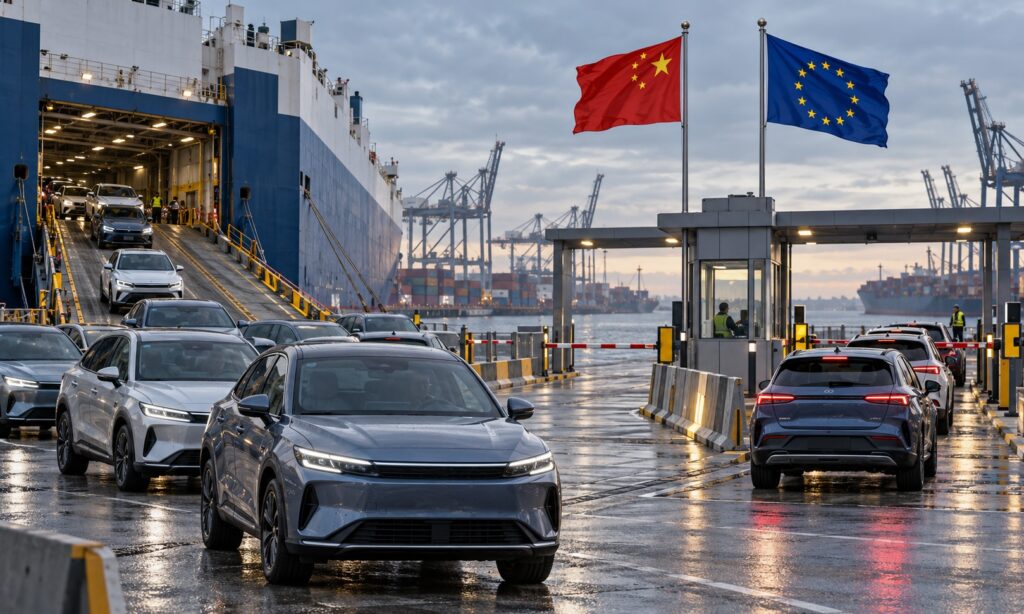
BEIJING, China — China and the European Union have reached a preliminary understanding on Chinese hybrid-car exports, easing immediate trade tensions while leaving unresolved how the arrangement would work. European trade commissioner Maroš Šefčovič announced the breakthrough after two days of negotiations with Commerce Minister Wang Wentao.
The headline requires qualification. According to the Financial Times, the proposed restraint would hold shipments to half or less of the level Brussels projects over the next four years. Actual exports could therefore continue rising. The announcement does not establish an immediate 50 percent reduction from today’s volumes.
A Diplomatic Opening With Few Published Details
The 16-point statement published by Beijing confirms an understanding on hybrid trade consistent with World Trade Organization rules. It specifies no numerical ceiling, baseline, enforcement mechanism or starting date. Separately, it preserves negotiations over company price commitments in the existing battery-electric vehicle dispute.
That distinction matters because hybrids became an increasingly important route into Europe after the bloc imposed additional duties on Chinese battery-electric cars in 2024. Those duties did not cover hybrids, helping shift competitive pressure toward a different vehicle category.
The broader package also addresses market access and strategic supplies. Šefčovič described potential tariff reductions affecting European exports worth almost €4 billion, including car parts, olive oil and footwear. The joint text, however, commits to continued exploration of tariff reductions. China also pledged to facilitate rare-earth and permanent-magnet export licensing through a “green channel,” without promising unrestricted supplies or a delivery timetable.
Different Accounts of the Same Breakthrough
Beijing’s emphasis remained cooperation. Wang challenged the premise that China was responsible for Europe’s economic difficulties and expressed concern about European trade restrictions. An October 10 Commerce Ministry assessment stressed reciprocal negotiations and supply-chain stability.
European business responded cautiously. Germany’s automotive association, VDA, welcomed progress but said its competitive implications remained uncertain; Mercedes-Benz emphasized predictability. European Parliament trade committee chair Bernd Lange urged broader sectoral agreements and stronger use of trade defenses.
France and Germany’s push for a new last-resort trade instrument underscores the political pressure behind Brussels’ negotiations.
The emerging picture is a pause in escalation, with the substance still to be tested. EU leaders are expected to assess the outcome on October 15–16. A ministerial video conference in January and another negotiating session in March 2027 provide the next opportunities to turn diplomatic language into measurable commitments.