
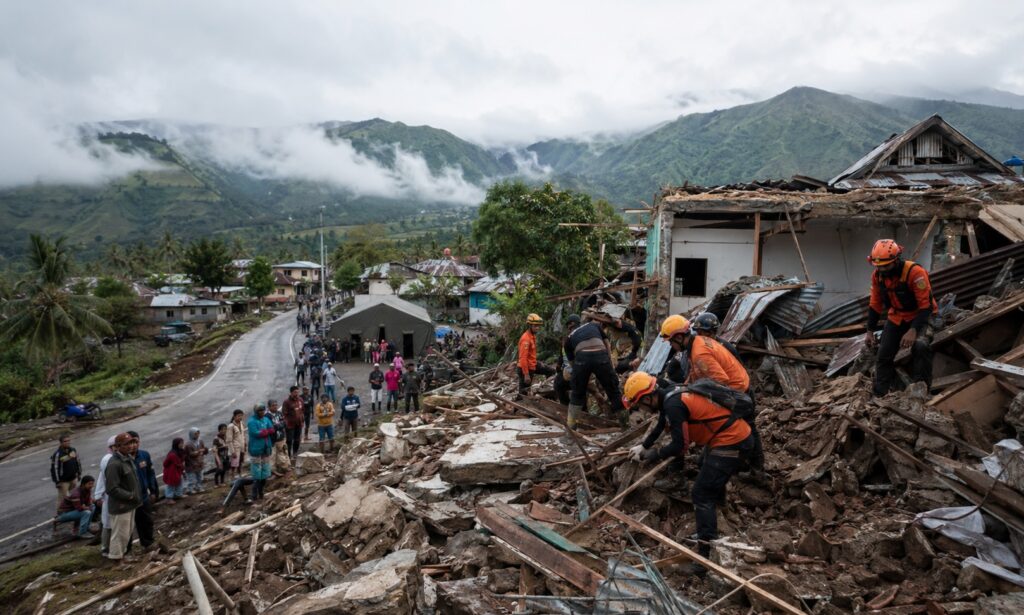
RUTENG, Indonesia — Rescue crews worked through collapsed buildings and landslide debris across Indonesia’s Flores Island on Sunday, searching for survivors of a powerful earthquake that killed at least 53 people and forced thousands from their homes.
The earthquake struck at 5:58 a.m. Saturday in Flores — 4:58 a.m. in Jakarta and 9:58 p.m. Friday GMT — when many residents were still asleep. Indonesia’s meteorological agency placed the offshore epicenter about 30 kilometers, or 19 miles, northeast of Mbay in Nagekeo Regency and estimated its depth at 15 kilometers, making it a relatively shallow and potentially destructive event. BMKG said the quake was generated by movement along the Flores Back-Arc Thrust.
By Sunday afternoon, Indonesia’s National Disaster Management Agency, known as BNPB, had recorded 25 deaths in Manggarai Regency, 20 in East Manggarai, four in Sikka, two in Ende and one each in Nagekeo and West Manggarai. The agency said 137 people had been injured.
The latest BNPB assessment counted 1,543 homes with severe damage, 328 with moderate damage and 532 with lighter damage — 2,403 homes in all. Eighty-seven educational facilities, 50 houses of worship and 76 government buildings were also damaged. The agency reported 5,488 people in organized shelters and another 171 sheltering independently. Those figures were released at 4 p.m. Sunday and remained subject to revision.
Evacuation estimates varied during the day. An earlier BNPB briefing reported by Indonesia’s Antara news agency placed the displaced population at 9,290 across Flores and several places outside the island where residents had also fled. The later national bulletin gave the lower figure of 5,659, illustrating the difficulty of assembling reliable information from communities with damaged roads, electricity and telecommunications.
Remote Terrain and a Damaged Hospital Complicate Relief
Flores is mountainous, and the Trans-Flores Highway — the island’s principal overland route — was blocked in several places by landslides. Rescue officials said most obstructions had been cleared by Sunday, but some villages remained difficult to reach and communications were still unreliable.
Authorities had not received formal reports of missing people, but search teams continued inspecting rubble in Manggarai, East Manggarai and Nagekeo. Nearly 1,000 aftershocks had been detected by Sunday afternoon, 46 of them felt by residents, according to BNPB. The continuing tremors kept many families outdoors and slowed work around unstable structures. Reuters reported that more than 3,500 police and military personnel had been deployed.
Medical services were themselves among the casualties. Parts of Ruteng Regional Hospital in Manggarai were damaged, forcing treatment and administrative work into tents and open areas. The government said it would establish a field hospital at Golo Dukal Stadium while engineers examined the existing building and emergency teams restored services. BNPB said the temporary hospital would be coordinated with the Health Ministry and local authorities.
Survivors in temporary camps reported shortages of clean water, blankets, food, medicine and supplies for children. Electricity had been restored across most of the island by Sunday, officials said, though repairs to local distribution networks were continuing.
A Tsunami Warning — and a Familiar Seismic Threat
The quake initially prompted a tsunami warning for parts of East and West Nusa Tenggara, South Sulawesi and Southeast Sulawesi. Coastal residents moved to higher ground before the warning was lifted at 7:30 a.m. Jakarta time, about two and a half hours after the earthquake.
Although the warning ended, monitoring stations detected small tsunami waves at 10 coastal locations, ranging from 0.17 to 0.94 meters, according to BMKG and the ASEAN Coordinating Centre for Humanitarian Assistance. No continuing rise in sea level was considered dangerous.
The earthquake was Indonesia’s deadliest since the 2022 Cianjur disaster in West Java. It also revived memories of the destructive Flores earthquake and tsunami of 1992.
Irwan Meilano, an earthquake specialist at the Bandung Institute of Technology, said the 2026 event occurred close to the source area of the 1992 disaster. Its destructiveness reflected not only its magnitude but also its shallow depth, proximity to settlements, local soil conditions and the resilience of buildings. He warned that strong aftershocks could still damage structures already weakened by the main quake. His analysis placed particular emphasis on schools, hospitals and government facilities.
That assessment points to a challenge extending beyond the immediate rescue: strengthening construction and essential infrastructure in communities located close to active faults. The collapse or closure of hospitals, schools and transport links can magnify a disaster by disabling the institutions needed to respond to it.
A separate magnitude-6.9 earthquake struck near Pematangsiantar in North Sumatra later Saturday. The United States Geological Survey measured that event at a depth of about 183 kilometers. Its location and depth show that it was a separate earthquake, not an aftershock of the Flores event. No major damage was initially reported in North Sumatra.
Indonesia Mobilizes Aid as Foreign Support Takes Shape
East Nusa Tenggara’s governor declared a 14-day emergency, running through Aug. 28, to accelerate spending, coordination and infrastructure repairs. President Prabowo Subianto ordered 50,000 food and emergency-supply packages sent to the region; BNPB said 4,925 had reached distribution hubs in Maumere and Labuan Bajo by Sunday evening.
The Indonesian Air Force established an air bridge using Hercules transport planes and helicopters, delivering 13 tons of aid and preparing to reach communities cut off by road. Police sent search teams, 10 detection dogs, communications equipment and helicopters, while the Social Affairs Ministry prepared compensation for bereaved families and mobilized rice, tents and other supplies.
The international response remained largely supportive of the Indonesian-led operation. The Indonesian Red Cross deployed assessment teams and relief supplies, with the International Federation of Red Cross and Red Crescent Societies providing technical and coordination assistance. The IFRC said assessments were continuing as the scale of humanitarian needs became clearer.
The ASEAN humanitarian center said it was monitoring the disaster with BNPB and stood ready to assist. European Commission President Ursula von der Leyen offered access to the European Union’s Copernicus satellite-mapping system for damage assessment and search operations, according to Channel News Asia and Agence France-Presse. Türkiye’s Foreign Ministry issued condolences over the deaths in Flores and the separate North Sumatra earthquake.
For residents sleeping under tarpaulins or in crowded shelters, however, the most pressing questions remained local and immediate: when the aftershocks would subside, whether their homes were safe to enter and how quickly food, water and medical care would reach the island’s most isolated communities.
Sources: BNPB, Reuters, AFP