
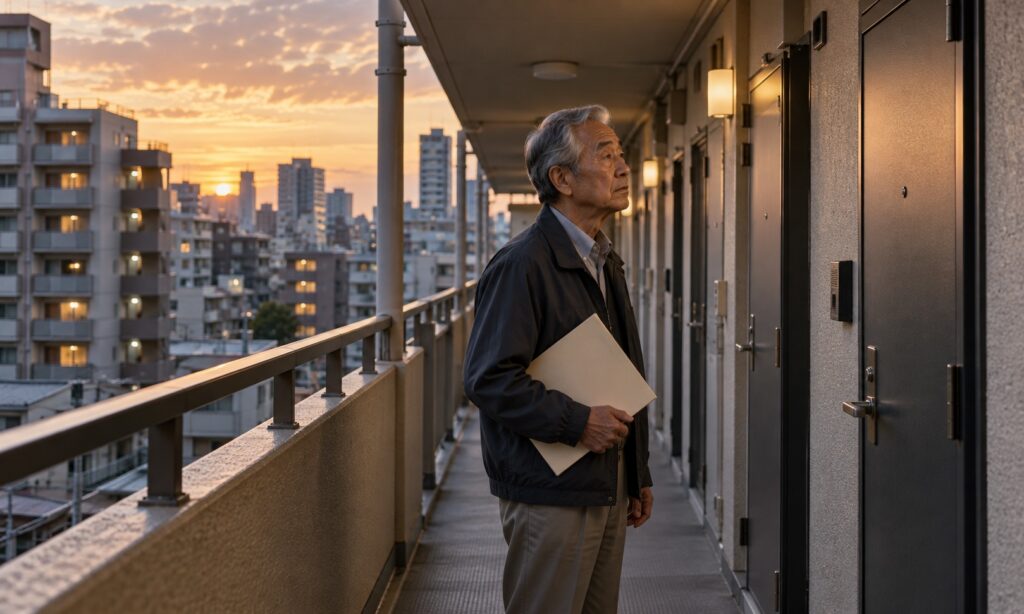
TOKYO, Japan – In Japan, having enough money to pay the rent does not always secure an apartment. For some middle-aged and older applicants, the missing qualification is a relative willing to help if something goes wrong.
That dilemma sits at the heart of NHK World-Japan’s October program, “No Family, No Home: Single People Struggle to Rent.” NHK’s accompanying Japanese coverage describes people rejected despite having adequate finances and good health. Living alone itself becomes a perceived liability, exposing the distance between Japan’s changing households and the expectations of its rental market.
When Age Becomes a Rental Risk
Recent industry research shows how widely those concerns shape decisions. In a survey published in June, property information company At Home found that 49.2 percent of 632 responding rental management companies had rejected an applicant because of advanced age during the previous year. The figure measures companies reporting such cases, rather than the proportion of older applicants refused housing.
The strongest concern was an unnoticed death, cited by 84 percent of respondents. Cleaning costs, belongings left behind and difficulty finding another tenant compound the perceived risk. Reuters reporting has documented how properties associated with deaths discovered late can acquire a stigma that affects their marketability.
The demographic pressure is substantial. Japan’s National Institute of Population and Social Security Research projects that people living alone will account for 44.3 percent of households by 2050, up from 38 percent in 2020. These figures include younger adults, but they underline the growing inadequacy of arrangements that assume family members will always be available.
A Safety Net Still Taking Shape
Japan’s revised housing safety-net legislation, effective since October 1, 2025, attempts to address those practical fears. A new certified housing framework connects landlords with organizations providing welfare checks, visits and referrals to social services. Separate provisions allow designated support organizations to handle belongings after death under agreements made with tenants.
Its expansion has been modest. On October 8, the nonprofit Kurashi Shuro Shien Kyokai reported that the government’s public database listed 465 certified homes nationwide. That count concerns the new supported-housing category, rather than Japan’s entire stock of housing available to vulnerable renters. The organization also reports frequent requests for help from people unable to provide guarantors or emergency contacts.
Industry participants say the economics must work. In a September interview with the property newspaper Jutaku Shimpo, a Home Net executive argued that the program needed a financially sustainable operating model and greater awareness among landlords and managers. The company also identified securing suitable properties for applicants as a continuing obstacle.
Taken together, these findings suggest that legislation has created a framework faster than the market has developed the services and incentives needed to use it widely.
A Challenge Beyond Japan
International research places the issue within a broader shift toward smaller households and aging populations. The OECD’s 2025 work on community care describes shared and intergenerational housing in countries including Germany and the Netherlands, designed to combine independence with practical support and social contact. It also identifies limits: privacy concerns, complex management and care needs that can eventually exceed what neighbors can provide.
Those approaches offer useful comparisons rather than a direct remedy for Japan’s rental exclusions. They point toward the same policy challenge: making dependable support available outside the family.
Japan’s reforms will ultimately be judged by whether an older person without relatives can obtain a suitable home—and remain there safely. That requires arrangements tenants can afford, landlords can trust and support organizations can sustain.