
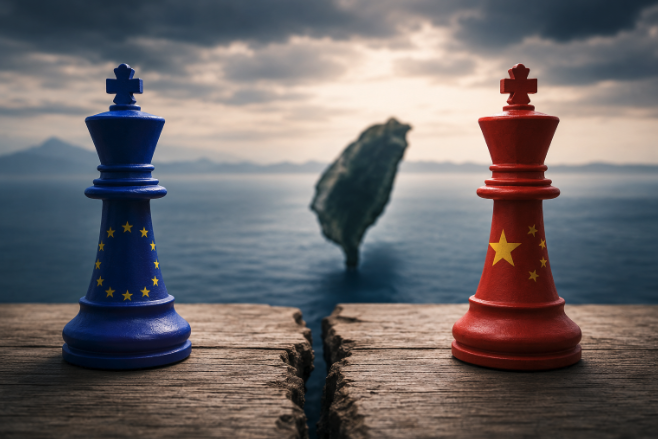
Taipei Says Europe’s Economic Security Is Tied to Taiwan’s Semiconductors, Trade Routes and Strategic Stability
TAIPEI, Taiwan — Taiwan’s deputy foreign minister, Wu Chih-chung, has issued a stark warning to Europe: a military conflict in the Taiwan Strait would not remain a regional crisis but would rapidly become a global economic and security emergency, affecting Europe, the United States, Japan and international markets alike.
In an interview with Euronews, Wu argued that Europe can no longer view Taiwan as a distant geopolitical issue. Instead, he described the island as a critical pillar of the global technology supply chain and international trade network, whose stability directly affects European prosperity and industrial competitiveness.
The ‘Silicon Shield’ and Europe’s Dependence
At the center of Taiwan’s strategic importance is its dominance in semiconductor manufacturing. Taiwan remains the world’s leading producer of advanced chips used in artificial intelligence, high-performance computing, telecommunications, consumer electronics and defense systems. According to Wu, Taiwan manufactures roughly 70 percent of global semiconductors and the overwhelming majority of the world’s most advanced chips.
Analysts increasingly describe this technological dominance as Taiwan’s “silicon shield” — a form of strategic deterrence rooted in the world’s dependence on Taiwanese semiconductor production. Any disruption to these supply chains would likely trigger severe consequences for European industries ranging from automotive manufacturing and aerospace to artificial intelligence and defense technologies.
Yet the relationship is deeply interdependent. Taiwan relies on European partners for advanced lithography systems, precision optics, industrial gases and semiconductor research capabilities. This interconnected ecosystem has led policymakers in Brussels to view stability in the Taiwan Strait as increasingly relevant to Europe’s own economic security.
Global Shipping at Risk
Beyond technology, Taiwan occupies a strategic position along one of the world’s most important maritime corridors. Wu warned that a conflict or blockade in the Taiwan Strait could disrupt global trade flows on a scale exceeding recent crises in the Suez Canal and Red Sea.
The Taiwan Strait serves as a critical route for international shipping linking East Asia with Europe and North America. A prolonged disruption could affect supply chains, energy shipments and manufacturing networks worldwide, creating inflationary pressures and economic instability across major economies.
“Regional stability is a global responsibility,” Wu said, arguing that freedom of navigation and uninterrupted trade through the Indo-Pacific are interests shared by Europe as much as by countries in Asia.
Europe’s Growing Strategic Concern
European policymakers have increasingly recognized the risks associated with heightened tensions between Beijing and Taipei. Concerns extend beyond semiconductors to broader questions of economic resilience, strategic autonomy and dependence on Chinese supply chains.
Recent cooperation between Taiwanese and European companies—including partnerships in semiconductor development, aerospace technologies and data infrastructure—reflects a growing alignment of economic interests. At the same time, security experts warn that Taiwan remains a potential blind spot in European strategic planning despite its central role in global supply chains.
The China–Taiwan Dispute
The dispute traces its origins to the Chinese Civil War, which ended in 1949 when the government of the Republic of China relocated to Taiwan after the Communist Party established the People’s Republic of China on the mainland. Beijing continues to regard Taiwan as part of its territory and has not ruled out the use of force to achieve unification. Taiwan, meanwhile, operates as a self-governing democracy with its own military, government and economic system.
Chinese military pressure around Taiwan has intensified in recent years, including large-scale military exercises and frequent air and naval operations near the island. These developments have heightened concerns among Western governments about the possibility of miscalculation or escalation.
Questions Over U.S. Policy and Regional Deterrence
Wu’s remarks come amid ongoing debate over the future of U.S.-China relations and the credibility of deterrence in the Indo-Pacific. While Washington maintains a policy of supporting Taiwan’s self-defense capabilities, analysts continue to assess how future U.S. administrations might respond in the event of a crisis.
Taiwanese officials insist that international engagement and economic cooperation are essential to preserving stability. Rather than seeking military commitments from European nations, Wu emphasized the importance of deeper political, economic and technological ties between Taiwan and democratic partners.
Outlook
As geopolitical competition between China and the West intensifies, Taiwan’s role has expanded far beyond its geographic size. Once viewed primarily as a regional issue, the island is increasingly regarded as a critical node in the global economy, with implications for technological innovation, trade security and international stability.
For Europe, the message from Taipei is clear: developments in the Taiwan Strait are no longer distant events but matters with direct consequences for economic growth, industrial resilience and strategic security. A crisis in the region, officials and analysts warn, would be felt far beyond East Asia.