
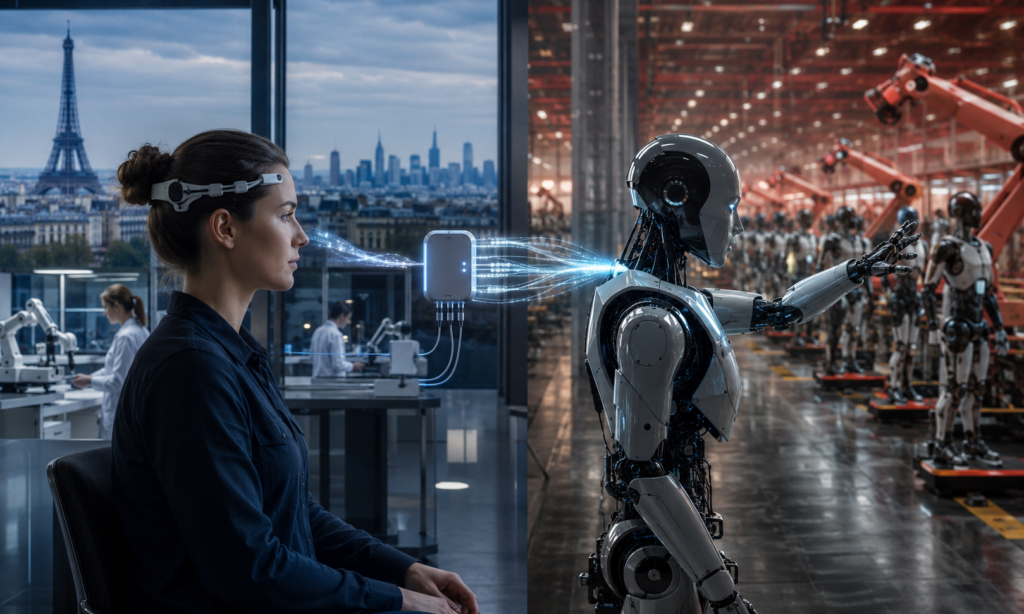
PARIS, France — A visitor wearing a lightweight EEG headband closed their eyes and concentrated on one of three subjects: a loved one, a favorite song or a mathematical calculation. Seconds later, a humanoid robot raised its arm and pointed toward the corresponding card.
The demonstration at the VivaTech technology show in Paris in June was presented as communication between the human brain and a robot. The brain-decoding technology came from HABS, a young French neurotechnology company. The humanoid was the G1, produced by Unitree Robotics, one of China’s most prominent and fastest-growing robotics manufacturers.
Between them stood Innov8 Group, a French distributor and technology integrator that represents Unitree in Europe.
The performance lasted only a few moments. But behind the spectacle was a question with consequences far beyond the exhibition hall: Could valuable European neurotechnology help Chinese robot manufacturers extend an already considerable advantage over their American and European competitors?
The answer depends on what HABS has shared — and what it has not.
An impressive experiment, but not unrestricted mind reading
HABS, formally Human Augmented Brain System, was established in France in 2023 by Olivier Locufier. The company develops noninvasive systems that use artificial intelligence to identify patterns in electroencephalography, or EEG, signals.
HABS says its technology can derive indicators associated with attention, cognitive workload, fatigue, pain and emotional reactions. It calls the identifiable patterns within these signals “NeuroMarkers.”
At VivaTech, however, the Unitree robot was not reading a visitor’s unrestricted thoughts or understanding the content of a song. Each participant first completed a brief individual calibration. The system then attempted to distinguish among three predefined categories of mental activity.
French technology publication Maddyness, which tested the installation, reported that the calibration took approximately one minute.
The likely process was relatively straightforward: HABS classified the EEG pattern, converted the result into a digital instruction and transmitted that instruction through an interface developed with Innov8. The Unitree robot then executed a programmed movement.
That remains a technically interesting demonstration of brain-computer interaction. But it demonstrated successful integration, not independent robotic reasoning — and certainly not a machine freely reading the human mind.
Three names on the booth, but three different roles
The booth displayed the names HABS, Unitree and Innov8. Their roles were distinct.
HABS supplied the brain-computer interface. Innov8 connected that interface to the robot. Unitree supplied the physical platform.
Innov8 said its engineers connected signals captured by the HABS system to software embedded in the robot. VivaTech advertised the installation as a “Unitree × HABS” brain-machine interface and described it as a world-exclusive demonstration.
But exhibition branding is not the same as a technology-transfer agreement.
No publicly available document reviewed for this article establishes that HABS gave Unitree access to its source code, complete AI models or EEG training data. Nor is there public evidence that Unitree received an exclusive robotics license, permission to reproduce the technology in China or the right to develop derivative systems independently.
It is entirely possible that the Unitree G1 received only a simple command from a closed HABS system. Under such an arrangement, Unitree would gain publicity and proof that its robots can accommodate outside technologies, but it would not necessarily gain possession of the French company’s intellectual property.
That distinction is essential. The Paris demonstration proves that HABS technology can control a Unitree robot. It does not prove that Unitree now controls HABS technology.
Why Microsoft was not displayed
The absence of Microsoft’s name from the booth may appear striking because HABS had announced a separate collaboration with the American company in March.
That agreement was intended to help HABS train and deploy neurocognitive AI models using Microsoft’s cloud and computing infrastructure. French reporting said the arrangement included access to 80 Nvidia H200 graphics processors, engineering assistance and possible integration of HABS technology into parts of Microsoft’s ecosystem.
But Microsoft did not manufacture the robot. It did not operate the robotic interface and apparently did not participate directly in the VivaTech installation. Although Microsoft was a gold partner of VivaTech 2026, its logo therefore had no obvious reason to appear beside HABS, Innov8 and Unitree.
The distinction suggests that HABS is pursuing a platform strategy rather than choosing one exclusive technological bloc. Microsoft can provide computing power and AI infrastructure; hardware manufacturers and integrators can provide the machines through which HABS technology is demonstrated or commercialized.
Such a strategy would allow HABS to remain hardware-neutral. But it also places the French company in a delicate strategic position: its models may be trained with American computing infrastructure while its most visible robotic demonstration is built on Chinese hardware.
Why Unitree changes the calculation
If HABS had connected its system to an obscure laboratory robot, the experiment might have attracted little geopolitical attention. Unitree is different.
The Hangzhou company is rapidly expanding from quadruped robots and research products into mass-produced humanoids. Its Shanghai stock-market filing showed that humanoid robots generated more than half its revenue during the first nine months of 2025. Unitree reported shipping approximately 5,500 humanoids that year and has announced much larger production ambitions.
TrendForce expects Unitree and Chinese rival AgiBot to account for nearly 80 percent of China’s humanoid-robot shipments in 2026. It forecasts that Chinese humanoid production will increase by 94 percent this year.
China’s advantage is not limited to a handful of companies. According to the International Federation of Robotics, approximately 54 percent of all industrial robots installed worldwide are now deployed in China, which operates a stock of roughly two million industrial robots. Robotics and “physical AI” have also become explicit priorities in China’s 2026–2030 Five-Year Plan.
This scale creates a powerful cycle. Higher production volumes reduce hardware costs. Lower costs encourage wider deployment. Wider deployment generates more operational data. Those data can then be used to improve robot-control systems and AI models.
In that context, even a limited partnership with a foreign technology company may carry greater strategic weight when the technology is attached to a Chinese platform capable of rapid mass deployment.
The decisive dividing line: Interface or transfer?
The strategic consequences depend on the depth of the cooperation.
If HABS operates its system as a protected black box, the benefit to Unitree may remain limited. The robot could receive a categorized instruction — “point left,” for example — without learning how the EEG signal was analyzed.
A deeper arrangement would be considerably more consequential. The risk would rise if Unitree received access to HABS’s trained neurocognitive models, underlying EEG databases, signal-filtering methods, calibration procedures or continuous user data generated by deployed robots.
It would become more significant still if Unitree gained the right to retrain or optimize the technology, reproduce it independently or serve as HABS’s exclusive humanoid platform.
Such access could eventually help Unitree build machines that respond not only to speech and physical gestures but also to attention, stress, hesitation or inferred intent. In factories, hospitals, care facilities and private homes, those abilities could become commercially valuable.
There is currently no public evidence that a transfer of this depth has occurred. It would therefore be premature — and inaccurate — to claim that HABS has simply handed its technology to China.
But the absence of public information is itself important. Neither HABS nor the exhibition announcements appear to have explained who owns the data generated by the integration, where the EEG information is processed, whether Unitree can retain interaction data, or whether the cooperation includes future commercial development.
The unanswered questions matter more than the names printed on the booth.
Europe’s familiar problem: It invents, but others scale
The larger concern for Europe is painfully familiar.
Europe produces significant research in neuroscience, artificial intelligence, sensors and industrial engineering. What it repeatedly struggles to build are complete technology platforms capable of scaling quickly and competing globally.
China combines a vast domestic market, coordinated industrial policy, sophisticated component suppliers and manufacturers able to produce robots at comparatively low cost. The United States has leading AI and semiconductor companies, deeper private capital markets and strong industrial customers. Yet many American humanoid manufacturers still operate pilot projects or manufacture relatively small numbers of machines.
At VivaTech, humanoids from Unitree and AgiBot attracted much of the public attention. Maddyness reported that Chinese companies accounted for 87 percent of the approximately 13,000 humanoids deployed globally in 2025, while European manufacturers were still attempting to establish a meaningful market presence.
If European inventions are repeatedly commercialized first on Chinese hardware, Europe risks becoming a supplier of specialized technologies while foreign companies control the customer relationship, operating systems, manufacturing capacity and data.
The most valuable asset may ultimately be neither the robot nor the EEG decoder in isolation. It may be the integrated platform that continuously collects data from real human-robot interactions.
Whoever controls that platform can improve the product, attract developers and build an ecosystem around it. The component supplier may contribute an important invention while capturing only a limited share of the long-term value.
What the demonstration could mean for American robotics
American companies including Tesla, Figure AI, Apptronik, Agility Robotics and Boston Dynamics retain important advantages in AI research, software, financing and relationships with major industrial customers.
But Unitree’s comparatively inexpensive and readily available machines make it an attractive platform for universities, software developers and outside technology companies.
If innovative European companies repeatedly choose Unitree because its robots are available, affordable and relatively easy to integrate, American manufacturers could lose more than immediate equipment sales. They could lose developers, research projects, software integrations and the operational data generated during the first years of humanoid deployment.
That is how a manufacturing advantage can become a platform advantage — and how a platform advantage can become difficult to reverse.
The risk is not that one French experiment will suddenly transform Unitree’s robots. It is that hundreds of similar decisions by start-ups, universities and technology suppliers could gradually make Chinese hardware the default platform on which the next generation of robotics applications is developed.
The West still has choices
A blanket attempt to prevent every cross-border experiment would be counterproductive. Scientific progress depends on interoperability, international research and access to capable equipment.
But Europe and the United States can reasonably demand greater transparency when strategically important technologies are integrated with foreign robotic platforms.
The relevant questions are concrete:
Where are the EEG signals processed and stored? Who owns the calibration and interaction data? Can the robot manufacturer use those data to train other models? Is the HABS system supplied through a protected API, executable software or source code? Does Unitree receive any exclusive rights? Can the same system be integrated with European and American robots? What cybersecurity protections prevent the extraction of models or neural data?
There is also a regulatory issue. Neural information is among the most sensitive categories of personal data. Systems that claim to detect fatigue, pain, attention or emotional reactions require not only commercial safeguards but also independent scientific validation and clear rules governing how those inferences may be used.
Western governments could support shared robotics testing centers where European neurotechnology companies can integrate their systems with European and American machines without having to bear the entire cost of acquiring and adapting hardware.
Without such infrastructure, start-ups will naturally select the platforms that are affordable, available and technically accessible. Increasingly, those platforms may be Chinese.
More than exhibition theater
The HABS–Unitree experiment should not be exaggerated. It involved a calibrated classification task among three predefined mental activities, not a robot freely interpreting human thoughts. The available evidence does not prove that HABS transferred its intellectual property to Unitree.
Yet dismissing the demonstration as mere exhibition entertainment would be equally shortsighted.
It placed an emerging French brain-computer interface on one of China’s most visible humanoid platforms at the precise moment China is converting manufacturing scale into broader technological influence. It showed how easily a European software innovation and a Chinese industrial platform can become mutually reinforcing.
For HABS, Unitree offered an impressive and immediately available physical showcase. For Unitree, HABS offered a glimpse of a more intuitive form of communication between people and machines.
The real strategic question is therefore not whether a robot pointed to the correct card in Paris.
It is who will own the models, the neural data, the developer ecosystem and the commercial relationship when demonstrations like this become real products — and whether Europe will still be building those products, or merely supplying the inventions inside them. (AT/hz)