
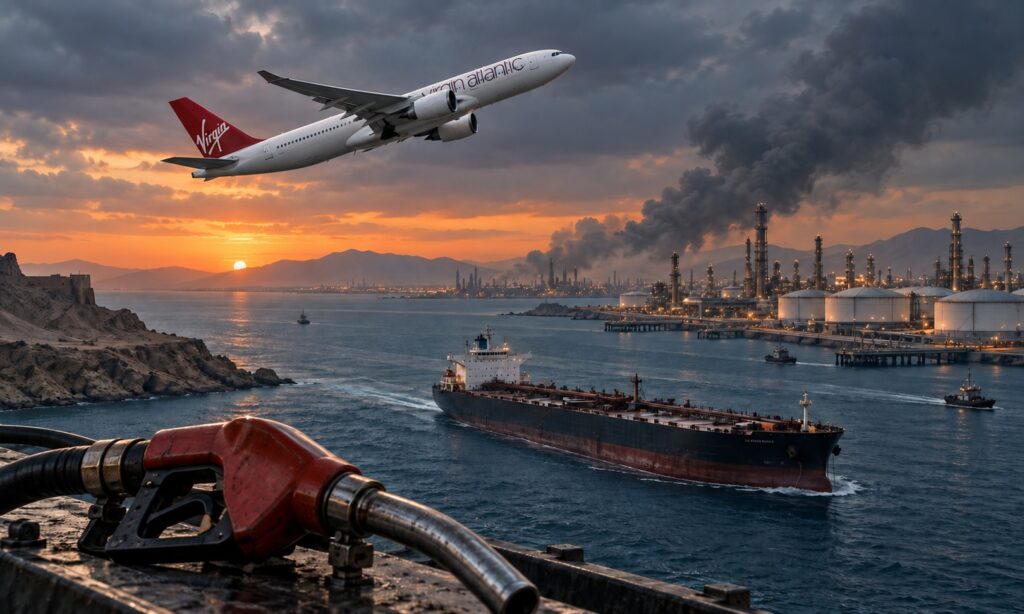
LONDON, United Kingdom — Richard Branson, the founder of the Virgin Group, has sharply criticized the leaders behind the war with Iran, arguing that an avoidable conflict has left airline passengers paying the price through higher fares.
Calling the war “completely unnecessary,” Mr. Branson linked the fighting to the collapse of oil supplies, renewed inflation and the surcharges imposed by Virgin Atlantic. His remarks amounted to a thinly veiled rebuke of President Donald Trump, who has defended American military action as necessary to prevent Iran from acquiring a nuclear weapon and to secure the region over the longer term.
The White House did not immediately respond to a request for comment from the BBC.
A War Transmitted Through Fuel Prices
The economic chain described by Mr. Branson is broadly supported by energy-market data. Disruptions around the Strait of Hormuz — which carried roughly one-fifth of the world’s oil before the war — have constrained Gulf production, tanker movements and supplies of refined fuels.
The International Energy Agency estimated in August that global oil supply remained 6.3 million barrels a day below its level a year earlier. Jet-fuel exports from Russia, the Middle East and Asia had fallen by approximately 670,000 barrels a day, equivalent to 34 percent of global seaborne trade in the product. The agency warned that depleted inventories and renewed hostilities had left the market unusually vulnerable to further disruption.
The aviation industry’s own figures tell a similar story. Global jet-fuel prices rose 121 percent between April 2025 and their April 2026 peak, according to the International Air Transport Association. Although prices have retreated, IATA’s latest monitor still placed the global average at $156.85 a barrel.
The danger remains immediate. On Saturday, American and Iranian forces attacked vessels near Iran, including oil carriers, in a fresh escalation that pushed Brent crude futures to $96.28 a barrel.
Airlines Pass On the Cost — Unevenly
Virgin Atlantic has added £50 to economy fares, £180 to premium tickets and £360 to Upper Class bookings. Chief executive Corneel Koster has said those charges do not fully compensate for the airline’s increased expenses. Virgin is reportedly hedged for about 60 percent of its fuel needs, leaving the remainder exposed to market prices.
The carrier nevertheless expects to operate roughly 95 percent of its normal winter schedule. Any reductions are likely to be selective and concentrated on weaker routes rather than imposed across the network.
Ryanair is taking a more defensive position. The airline has lowered its annual passenger target from 216 million to 214 million and plans to keep winter capacity broadly flat. Even though it has hedged 80 percent of its fuel through March 2027 at about $67 a barrel, it warned that less-protected competitors might have to cut flights — or struggle to survive — if elevated prices persist.
That distinction matters. Airfares do not move mechanically with oil. Hedging contracts can delay the impact; reduced capacity can magnify it; weak demand can restrain it. Longer routes also face heavier fuel burdens and, in some cases, costly diversions around restricted airspace.
British inflation data illustrate the uneven result. In July, long-haul fares rose 31.7 percent from the previous month, while prices on European routes fell 4.3 percent. The Office for National Statistics said conflict-related capacity reductions, rerouting and fuel costs were likely factors, but the figures caution against treating a reported 25 percent increase in fares as universal across every market.
A Political Argument With an Economic Core
Mr. Branson’s broader contention — that the war could have been avoided by preserving the 2015 nuclear agreement — is more contested.
The United States withdrew from the accord in 2018 and restored sanctions. European governments continued trying to preserve it, but Iran began reducing its commitments in 2019, and later negotiations failed to restore full compliance. The European Union’s own account therefore supports Mr. Branson’s criticism of the American withdrawal while also showing that the original agreement had ceased to function fully long before the current war.
What is less disputed is the economic consequence of the fighting. Airlines are paying more for fuel, operating longer routes and limiting capacity. Europe’s dependence is especially acute: an analysis by Transport & Environment estimates that about 30 percent of the region’s jet-fuel supply had relied on imports moving through Hormuz.
For passengers, that leaves an uncomfortable conclusion. Even if oil prices ease, surcharges may not disappear quickly. Airlines tend to restore capacity cautiously, fuel hedges reset gradually and geopolitical risk remains embedded in prices. Mr. Branson’s language was political, but the burden he described is already visible at the booking screen.
Sources: EEAS, Reuters