
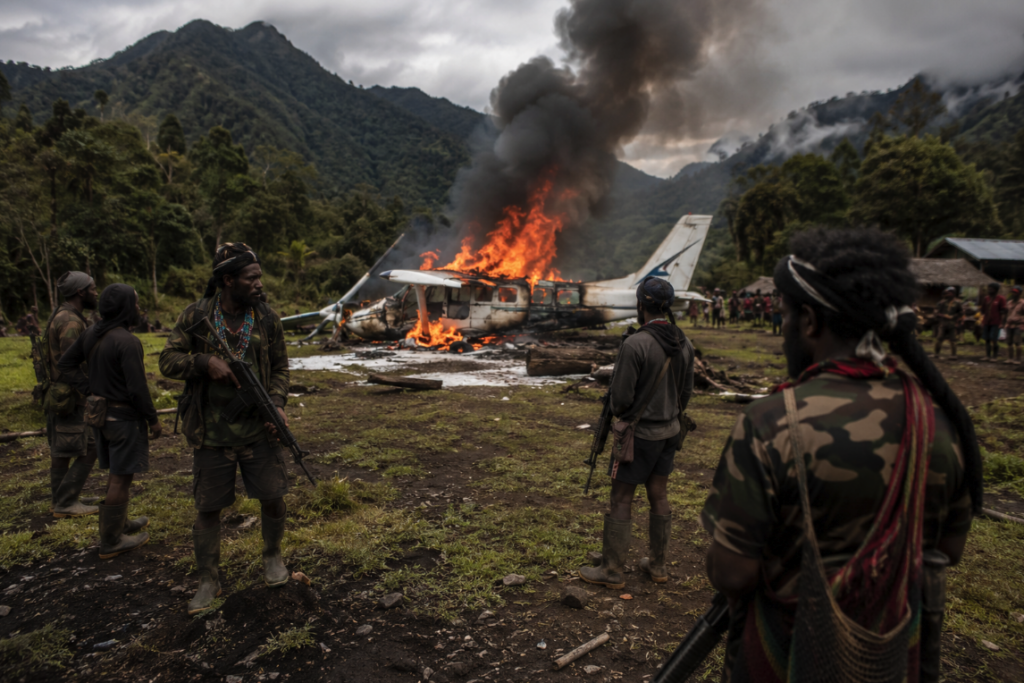
JAKARTA, Indonesia — A decades-long separatist conflict in Indonesia’s easternmost region has entered a more volatile stage after armed West Papuan rebels killed an American pilot and burned his aircraft, in what the insurgent group described as a deliberate political message to both the United States and Indonesia.
Nicholas F. Goselin, an American pilot flying for Indonesian aviation operator PT AMA, was shot shortly after landing at the remote Ipdeheik airstrip in Balinggama, Yahukimo Regency, in Papua Highlands on July 2. Indonesian military forces recovered his body the following day after securing the isolated airstrip. Seven Indigenous Papuan passengers aboard the aircraft survived the attack without injury.
The West Papua National Liberation Army (TPNPB), the armed wing of the Free Papua Movement, claimed responsibility for the attack. Rebel spokesman Sebby Sambom said the aircraft had violated a separatist ban on civilian flights into areas controlled by the insurgency, alleging that civilian aircraft had repeatedly been used to transport Indonesian troops and military supplies. Indonesian authorities firmly denied those accusations, maintaining that the flight was a civilian humanitarian service supporting isolated communities. Independent verification of either claim has not been possible.
A Conflict Rooted in Decades of Disputed Sovereignty
The attack highlights the unresolved political tensions surrounding Papua, where armed resistance against Indonesian rule has persisted for more than six decades.
The separatists linked the killing directly to the 1962 New York Agreement, brokered with U.S. involvement, which transferred administration of the former Dutch New Guinea to Indonesia before the controversial 1969 “Act of Free Choice.” Many Indigenous Papuans and international human rights advocates have long argued that the referendum lacked legitimacy because only a small, government-selected group of representatives participated under significant pressure.
In a statement following the attack, the TPNPB described the shooting as “payment” for what it called the historical failures of Indonesia, the United States, the Netherlands and the United Nations to resolve the underlying political conflict.
Violence Against Aviation Continues to Escalate
Security analysts note that civil aviation has increasingly become a strategic target in Papua’s rugged interior, where aircraft often serve as the only transportation link for remote mountain communities.
The latest killing follows several high-profile incidents:
- New Zealand pilot Phillip Mehrtens was kidnapped by the same separatist group in 2023 and released after 19 months in captivity in 2024.
- Foreign and Indonesian pilots have faced repeated attacks as rebels attempt to isolate government-controlled areas.
- Indonesian authorities have expanded military operations throughout Papua in response to increasingly sophisticated rebel attacks.
Military officials have since advised pilots to avoid designated “red zones” where separatist groups maintain operational control.
Growing Humanitarian Concerns
Local church leaders and human rights organizations warn that civilians are likely to bear the greatest burden of the latest escalation.
Reports indicate that residents of Balinggama have already begun fleeing surrounding villages out of fear that Indonesian security forces will launch retaliatory military operations. Human rights advocates continue to argue that Papua remains one of Indonesia’s most heavily militarized regions, with security deployments expanding substantially over recent years.
Limited U.S. Response
The U.S. State Department has confirmed it is in contact with Indonesian authorities and the pilot’s family but has so far declined to comment on the political claims made by the separatists, saying only that it is closely monitoring developments.
Latest Analysis: A Turning Point for the Papua Conflict
The killing represents more than another violent episode in Papua’s long-running insurgency. Regional security experts increasingly view the attack as evidence that the TPNPB is broadening its strategy by deliberately targeting foreign nationals to internationalize a conflict that has historically received limited global attention.
Several trends are emerging:
- Internationalization of the conflict. By explicitly framing the killing as a message to Washington, the rebels are attempting to draw international attention to Papua’s political status rather than limiting the conflict to a domestic Indonesian issue.
- Higher risks for civilian aviation. Small aircraft remain essential for delivering food, medicine and transportation across Papua’s mountainous terrain. Continued attacks could significantly disrupt humanitarian access and economic activity.
- Expanding security operations. Indonesia is expected to increase military deployments and intelligence operations throughout Highland Papua, potentially leading to further displacement of civilians.
- Limited diplomatic momentum. Despite repeated calls from separatists for internationally mediated negotiations, Jakarta continues to reject independence talks, insisting Papua is an integral part of Indonesia.
For now, the incident underscores how one of Southeast Asia’s longest-running and least-publicized conflicts is becoming increasingly international in both its symbolism and its potential geopolitical consequences.
Photo: AI generated