
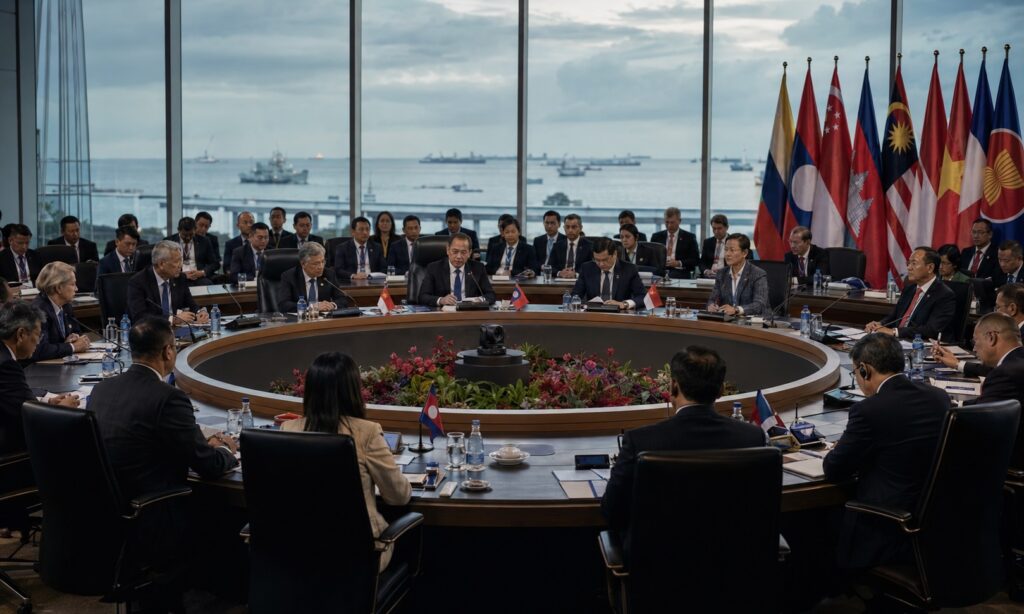
MANILA, Philippines – Foreign ministers from Southeast Asia and the region’s leading powers have gathered in Manila for five days of diplomacy at a moment when several distant conflicts are bearing directly on ASEAN’s security and economic stability.
The 59th ASEAN Foreign Ministers’ Meeting and Related Meetings, running from July 20 to 24, brings together the bloc’s members and 11 dialogue partners, including the United States, Russia, China, the European Union, India, Japan and Australia. The wider program includes bilateral ministerial sessions, the ASEAN Plus Three meeting, the East Asia Summit foreign ministers’ meeting and the ASEAN Regional Forum.
Although the gathering is sometimes described as an ASEAN summit, it is principally a ministerial conference rather than a meeting of heads of government.
Early Statements, but No Final Settlement
With the conference still underway, its final communiqué and several related documents have not yet been released. The clearest collective result so far is an ASEAN foreign ministers’ statement addressing renewed hostilities between the United States and Iran.
The ministers expressed “serious concern” about the conflict, called for an immediate cessation of hostilities and urged all sides to exercise restraint. They also emphasized the need to restore safe and uninterrupted passage through the Strait of Hormuz. For Southeast Asian governments, the issue is not geographically remote: disruption of the waterway threatens regional fuel supplies, shipping costs and inflation.
The declaration illustrates both ASEAN’s usefulness and its limitations. The organization provides a forum in which smaller and middle-ranking countries can formulate a collective position. But its consensus-based diplomacy generally produces appeals for dialogue rather than measures capable of compelling the parties to change course.
Ministers have also discussed regional trade, food and energy security, digital development and the transition to cleaner energy. These economic subjects remain central to the Philippines’ 2026 chairmanship theme, “Navigating Our Future, Together,” but they have been overshadowed by immediate security crises.
The South China Sea Dispute Arrives at the Conference Door
For the Philippines, the most sensitive issue is the South China Sea. A recent confrontation near Second Thomas Shoal led Manila and Beijing to trade formal protests during the conference.
Philippine Foreign Secretary Maria Theresa Lazaro objected to what Manila characterized as unacceptable conduct toward Filipino personnel. Chinese Foreign Minister Wang Yi rejected that account, accused Philippine vessels of provoking the encounter and warned that relations between the two countries had reached a consequential juncture.
The confrontation has intensified calls for ASEAN and China to complete negotiations on a long-discussed Code of Conduct for the South China Sea. Yet there is still no indication that the Manila meetings have resolved the central disagreements over whether such a code would be legally binding, how violations would be addressed or how it would relate to international maritime law.
Australia and Canada have publicly supported freedom of navigation and expressed concern over coercive behavior. China, in response, has urged countries that are not parties to the territorial disputes to avoid escalating them. The competing reactions demonstrate why ASEAN consensus remains difficult: several members have maritime claims against China, while others are reluctant to jeopardize substantial economic ties with Beijing.
Myanmar Remains ASEAN’s Unfinished Crisis
The ministers reaffirmed ASEAN’s Five-Point Consensus on Myanmar, calling for measurable progress, an end to violence, the release of political prisoners, humanitarian access and dialogue among the country’s principal stakeholders.
Philippine officials have presented continued engagement as necessary to prevent Myanmar’s isolation from becoming permanent. Thailand has promoted what it describes as calibrated re-engagement and a more effective role for ASEAN’s special envoy.
But the discussion has not yet produced evidence of a breakthrough. The military authorities in Myanmar have repeatedly failed to implement the consensus, leaving ASEAN with few enforcement tools beyond limiting Myanmar’s political representation at senior meetings.
Why Washington and Moscow Are in Manila
The presence of Secretary of State Marco Rubio and Russian Foreign Minister Sergei Lavrov is part of ASEAN’s established diplomatic structure, not an exceptional invitation connected solely to Ukraine.
Russia and the United States are official ASEAN dialogue partners. Both participate in separate ASEAN ministerial consultations and in the ASEAN Regional Forum, a wider security forum designed to include major powers whose policies directly affect the Indo-Pacific.
That arrangement allows ASEAN to preserve what it calls its “centrality”: the ambition to remain the convening institution around which regional diplomacy is organized, even when the most powerful participants are discussing conflicts outside Southeast Asia. The Manila schedule includes separate ASEAN meetings with the United States and Russia on July 22, followed by the ASEAN Regional Forum on July 23.
Rubio and Lavrov Plan Separate Ukraine Talks
Rubio and Lavrov have confirmed that they intend to meet on the morning of July 23. Their encounter will take place on the conference’s sidelines and should not be interpreted as an ASEAN-sponsored peace negotiation.
Both officials have indicated that Ukraine will be a principal subject. Rubio has said the war has impeded wider American-Russian cooperation and that he wants to examine possible paths toward ending it. Lavrov has said he intends to ask about President Trump’s assertion that a settlement may be closer than generally believed. Arms control and other bilateral questions may also be discussed.
Expectations should remain guarded. Ukraine will not be represented in the bilateral conversation, and neither side has announced a new negotiating framework or draft agreement. Disputes also persist over what, if anything, was agreed during earlier American-Russian discussions in Anchorage.
The most plausible immediate result is therefore renewed diplomatic contact: an exchange of proposals, clarification of positions and possibly preparation for subsequent negotiations involving Ukraine. A durable settlement negotiated by Washington and Moscow alone would face fundamental questions of legitimacy as well as resistance from Kyiv and its European partners.
A Test of ASEAN’s Relevance
Domestic Philippine coverage has emphasized the prestige of hosting the gathering and Manila’s opportunity to place maritime security at the center of regional diplomacy. International attention, however, has concentrated increasingly on meetings among the major powers: Rubio with Wang Yi, Rubio with Lavrov and consultations among the United States, Japan, India and Australia.
That imbalance captures the challenge facing ASEAN. Its value lies less in imposing settlements than in keeping rival governments at the same table. Manila has become a venue where adversaries can communicate without formally reopening stalled bilateral processes.
Whether that role amounts to genuine influence will depend on what follows: progress on the South China Sea code, measurable action in Myanmar, protection of energy routes and a final communiqué strong enough to demonstrate unity. Until the meetings conclude on July 24, the emerging picture is one of active diplomacy—but few definitive resolutions.
Sources: Reuters, Thai government