
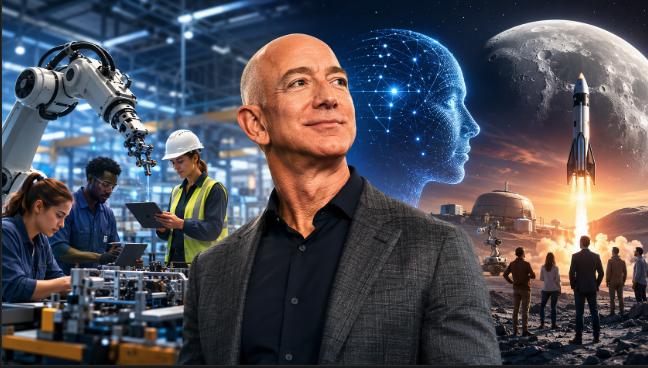
Amazon founder challenges growing fears of technological unemployment, arguing that artificial intelligence will increase demand for workers and accelerate economic growth
PARIS, France — As governments, economists and business leaders debate the impact of artificial intelligence on the future of work, Amazon founder Jeff Bezos has offered a sharply different prediction: AI will create more jobs than it eliminates.
Speaking at the VivaTech technology conference in Paris, Bezos dismissed concerns that automation will render large segments of the workforce obsolete. Instead, he argued that AI will unlock new industries, boost productivity and ultimately increase the need for human labor.
“I think AI is going to create a labor shortage,” Bezos said, suggesting that the technology will expand economic activity faster than existing workforces can support.
Growing Anxiety Over AI’s Impact on Workers
Bezos’s comments come amid rising concerns about the effect of AI on employment, particularly among younger workers and those in entry-level positions.
A number of political and business leaders have warned that rapid advances in generative AI could disrupt labor markets. Former British Prime Minister Rishi Sunak, now an adviser to Microsoft and Anthropic, recently suggested that AI is already influencing job prospects for younger generations.
Labor organizations have voiced similar concerns. The UK’s Trades Union Congress has warned that AI could repeat some of the social consequences of deindustrialization if productivity gains primarily benefit shareholders while workers face displacement or deteriorating job quality.
At the same time, many economists argue that the long-term outcome will depend on how governments, businesses and educational institutions manage the transition.
Historical Lessons From Previous Technological Revolutions
Supporters of AI adoption often point to earlier waves of technological change that initially disrupted labor markets but eventually created new industries and occupations.
From the Industrial Revolution to the rise of the internet, advances in technology have frequently reduced demand for some jobs while generating entirely new categories of work. Advocates of AI believe the technology could follow a similar pattern by augmenting human capabilities rather than replacing them outright.
Critics, however, argue that AI differs from previous innovations because it can perform a growing range of cognitive tasks traditionally reserved for educated professionals.
The question facing policymakers is whether new opportunities will emerge quickly enough to offset job losses during the transition.
Prometheus and the Future of Manufacturing
Bezos’s optimism reflects the ambitions behind his latest venture, Prometheus, an artificial intelligence company focused on accelerating physical manufacturing and engineering.
The project aims to use advanced AI systems to shorten development cycles, improve industrial productivity and help companies bring products to market faster.
The initiative highlights a broader shift in the AI sector away from consumer-facing chatbots and toward industrial applications that promise to transform manufacturing, logistics and engineering.
Supporters argue that such technologies could strengthen industrial competitiveness, while critics warn that they may further automate sectors that have traditionally provided large numbers of middle-income jobs.
Europe’s Race to Compete in AI
The debate unfolded at VivaTech against a backdrop of growing competition over global AI leadership.
European governments are investing heavily in domestic AI capabilities while seeking to reduce dependence on American technology platforms. Policymakers increasingly view AI as both an economic opportunity and a strategic necessity.
The conference reflected a broader concern across Europe: how to capture the benefits of AI innovation while protecting workers and preserving social stability.
Bezos’s remarks offered a distinctly optimistic vision at a moment when many governments are struggling to balance technological progress with public concerns about employment.
Looking Beyond Earth
Beyond artificial intelligence, Bezos also outlined his long-term vision for space exploration through his aerospace company Blue Origin.
He argued that humanity’s expansion into space is limited not by demand but by access, describing the Moon as the most practical starting point for a permanent human presence beyond Earth.
According to Bezos, future technologies could enable lunar resources to be used for fuel production and support long-term settlements, helping establish what he sees as the next stage of human development.
“We’re going to the Moon to stay, not just to visit,” he said.
The Defining Economic Question of the AI Era
Whether AI ultimately creates a labor shortage, as Bezos predicts, or causes significant workforce disruption remains one of the defining economic questions of the coming decade.
What is increasingly clear is that the debate has moved beyond the technology itself. The central challenge now is determining how societies can harness AI-driven productivity while ensuring that workers share in its benefits.
For supporters, artificial intelligence represents a new engine of growth and innovation. For skeptics, it raises profound questions about inequality, economic security and the future role of human labor.
The outcome may shape not only the next generation of jobs, but also the broader relationship between technology and society in the decades ahead.