
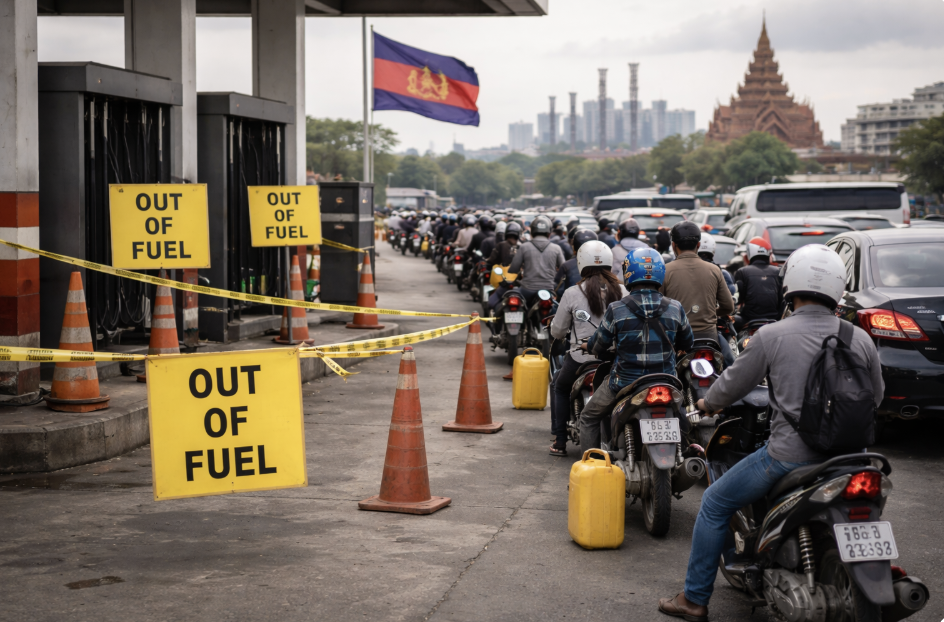
PHNOM PENH, Cambodia – Cambodia is rapidly diversifying its fuel supply chain, turning to Singapore and Malaysia to offset dwindling imports from traditional partners Vietnam, China and Thailand, as geopolitical tensions and export curbs ripple across global energy markets.
The shift comes amid mounting disruptions tied to the intensifying U.S.-Israeli conflict with Iran, which has strained oil flows and heightened volatility in international fuel supply. Cambodian officials say the combined impact of regional export restrictions and global instability has exposed the country’s structural dependence on imported petroleum.
Energy Minister Keo Rottanak said the government was working with multinational suppliers including TotalEnergies and Chevron to stabilize inflows. While shipments from Singapore and Malaysia have increased, he acknowledged that supply remains fragile. “We are not yet fully insulated,” he said, noting that inflows are holding “for the time being.”
Regional Export Curbs Deepen Supply Crunch
Cambodia’s fuel shortages have been exacerbated by a wave of export controls across Southeast Asia. Vietnam and China have limited outbound fuel shipments through at least the end of March to safeguard domestic supply, while Thailand — once a major supplier — has maintained a ban on exports since mid-2025 following armed tensions with Cambodia.
Together, Thailand and Vietnam accounted for more than 60 percent of Cambodia’s petroleum imports in 2024, according to data from the International Trade Centre. Singapore and Malaysia supplied nearly one-third, while China contributed a smaller share.
Recent shipping data reflects the strain: exports of gasoline and diesel from Singapore and Malaysia to Cambodia rose 25 percent compared with the same period last year, but fell sharply from late February levels, suggesting uneven recovery in supply flows.
Domestic Disruptions and Market Concerns
The supply squeeze has begun to affect Cambodia’s domestic fuel market. Authorities report that roughly one-third of the country’s 6,300 petrol stations have temporarily shut down, prompting investigations into possible hoarding amid expectations of rising prices.
Cambodia, which lacks domestic refining capacity, typically maintains less than one month of fuel reserves under normal conditions — a vulnerability that analysts say leaves it highly exposed to external shocks.
International energy analysts note that smaller import-dependent economies are particularly at risk during periods of geopolitical disruption. The current crisis, they say, mirrors earlier supply shocks following sanctions and conflicts affecting major oil-producing regions, where supply chain bottlenecks quickly translated into local shortages.
Renewables Offer Partial Cushion
Despite the disruptions, officials say Cambodia’s expanding renewable energy sector has softened the impact. Over the past several years, hydropower, solar and other clean energy sources have reduced the country’s reliance on imported fuel for electricity generation.
As a result, overall fuel import volumes have remained broadly stable since 2022, even as demand for electricity has grown.
Still, analysts caution that renewables cannot fully offset vulnerabilities in transportation and industrial fuel use, where petroleum remains essential.
Push for ASEAN Energy Integration
The crisis has renewed calls within Southeast Asia for deeper regional energy cooperation. Rottanak emphasized the urgency of accelerating plans for an integrated ASEAN power grid, which proponents argue would allow countries to share electricity and reduce reliance on imported fossil fuels.
Energy policy experts across the region echo this view, noting that interconnected grids could improve resilience against both geopolitical shocks and climate-related disruptions. Recent discussions within ASEAN forums have highlighted cross-border electricity trading as a strategic priority, though implementation has been slow.
“The lesson from this crisis is clear,” Rottanak said. “Regional integration is not optional — it is essential for energy security.”
As global tensions continue to reshape fuel markets, Cambodia’s experience underscores the broader challenges facing emerging economies navigating an increasingly uncertain energy landscape.