
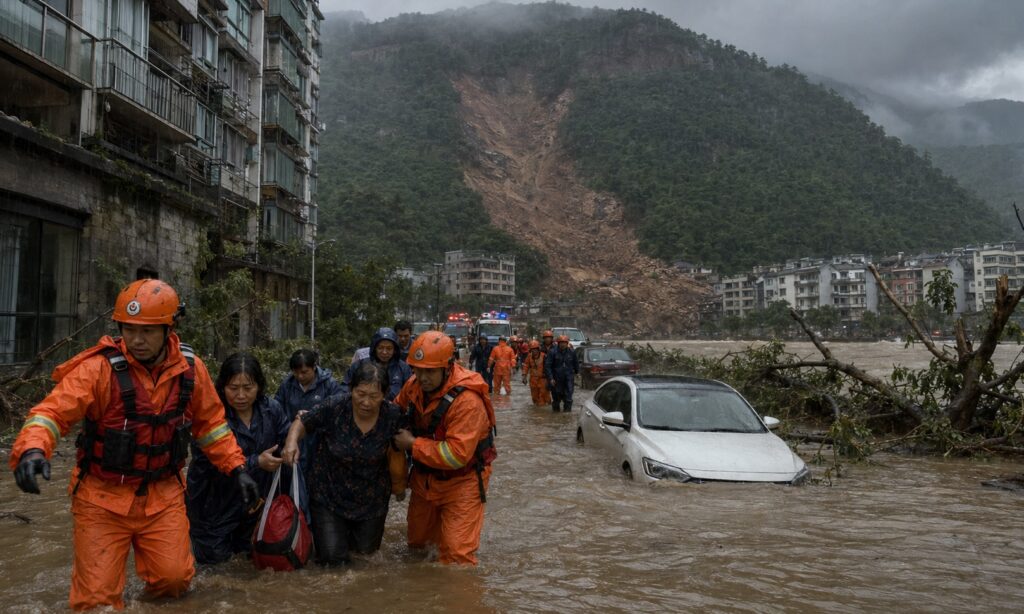
BEIJING, China — A broad stretch of China is confronting the consequences of an unusually destructive period of summer weather, as emergency workers search for dozens of people missing after a landslide in the southwest and communities farther east and north begin recovering from Typhoon Bavi.
The disasters have unfolded across regions separated by more than 1,000 miles. But together they reveal a common vulnerability: saturated mountainsides, swollen rivers and heavily populated cities facing successive rounds of extreme rainfall.
Bavi, the strongest typhoon to strike mainland China so far this year, made landfall in Zhejiang Province late on July 11 with sustained winds of about 144 kilometers, or 90 miles, an hour. Authorities moved more than 2.8 million people from exposed areas nationwide, including over 2.2 million in Zhejiang, according to figures compiled from Chinese state media.
Although the storm weakened after coming ashore, its enormous circulation continued to draw tropical moisture northward. Flooding subsequently spread into Hebei, Liaoning and Jilin Provinces, extending Bavi’s impact far beyond the Zhejiang coastline.
No deaths or injuries on the Chinese mainland were officially attributed to Bavi in the first national reports after landfall. But authorities have not yet issued a comprehensive accounting of damaged homes, inundated farmland, power failures or economic losses, meaning the full cost remains unclear.
A landslide buries homes in Chongqing
The most urgent rescue operation is now underway in Pengshui County, part of the southwestern municipality of Chongqing.
A section of mountainside collapsed in Hanjia Subdistrict on the morning of July 17, striking residential buildings and burying people beneath earth and debris. By early Saturday, local authorities had confirmed eight deaths, 34 people missing and 10 injured people taken to hospitals.
More than 800 emergency workers and over 1,100 pieces of equipment were deployed, according to Chinese state media. Rescue teams divided the site into three operating areas, using life-detection equipment, search dogs, excavation machinery and hand tools.
The authorities evacuated approximately 1,100 people from nearby locations because of the danger of further slope failure. Monitoring instruments were installed to detect movement in the unstable mountainside above the rescue area.
President Xi Jinping ordered an intensive search for the missing and called for an investigation into the disaster’s cause. Chongqing activated its highest local emergency response for geological disasters.
Officials had not announced a definitive cause by Saturday. Heavy rain and prolonged soil saturation are important risk factors, but attributing the collapse directly to a single storm would be premature before the geological investigation is completed.
The landslide follows deadly flooding in Chongqing’s Yongchuan District in May, when torrential overnight rain generated flash floods and slope failures. At least nine people died, 11 were reported missing and more than 2,000 residents were relocated in that earlier disaster.
Bavi’s danger persisted after landfall
Typhoon Bavi reached Yuhuan, a coastal city in Zhejiang, at about 11:20 p.m. on July 11. It made another landfall near Yueqing shortly afterward before weakening as it moved inland.
Its immediate effects included flooded streets, coastal inundation, power failures, fallen trees and transportation shutdowns. In Yueqing, state broadcaster CCTV reported that more than 1,300 trees were knocked down, including at least 700 that were uprooted.
Shanghai relocated more than 290,000 people from vulnerable areas, while Fujian Province evacuated over 180,000. Roughly 653 flights were expected to be cancelled at Shanghai’s Pudong and Hongqiao airports, in addition to extensive suspensions of trains, ferries and local transportation.
But Bavi’s defining feature was its persistence. Even after weakening below typhoon strength, the storm retained a large, moisture-rich circulation comparable in area to France. Its rain bands moved through eastern and northern China, where saturated ground and elevated rivers increased the danger of flash flooding and landslides.
In Kuancheng County, Hebei Province, water reportedly rose above two meters on some roads, carrying away vehicles and stranding about 1,800 residents. The Ministry of Water Resources said 46 rivers had exceeded official flood-warning levels.
In Liaoning Province, more than 260,000 people were evacuated. Floodwaters in Shenyang swept a large structure through city streets and damaged a high-voltage power line. Schools and training institutions suspended operations, while rail and road transportation were disrupted across parts of Liaoning and neighboring Jilin.
China’s central government allocated 100 million yuan in emergency investment for recovery work in Zhejiang. Central reserves of folding beds, quilts and family emergency packages were also dispatched. The allocation is relief funding, however, and should not be interpreted as an estimate of total storm damage.
Disasters compound one another
Bavi was only one part of a larger sequence of weather emergencies.
Typhoon Maysak struck southern China earlier in July and brought record rainfall to Guangxi. Sixty-one meteorological stations there reportedly broke historical rainfall records. Reservoir emergencies, widespread flooding and infrastructure failures isolated communities and submerged farmland.
In Zhenlong Township, approximately 8,000 people were temporarily cut off after roads, electricity and communications failed. Severe flooding around Hengzhou was particularly destructive, with deaths, missing residents and reservoir failures reported by national and international media.
Central China was also struck by rare tornadoes. Storms tore through several cities in Hubei Province, including Huangshi, Huanggang, Ezhou and Xianning. Authorities reported at least 11 deaths and one person missing, while winds approaching 149 kilometers an hour damaged buildings, overturned vehicles and disrupted essential services.
In Gansu Province, a July 7 landslide in Rencang village trapped 33 people, prompting another major search-and-rescue operation.
By July 9, insurers in nine affected provincial-level regions—including Guangxi, Hubei, Gansu, Chongqing and Anhui—had received approximately 320,000 claims related to rain and flooding. Payments and provisional payments exceeded 2.2 billion yuan. Those figures cover several disasters and represent insurance disbursements, not the country’s overall economic losses.
An above-average typhoon outlook
China’s National Climate Center expects four to six tropical cyclones to form over the northwestern Pacific and South China Sea during July. Two or three are forecast to make landfall or otherwise affect the Chinese coast, compared with a historical July average of approximately 1.8.
That forecast has sometimes been described as six strong typhoons expected to strike China. The official assessment is more limited: six is the upper estimate for storms forming across the broader ocean basin, not the number expected to hit China. Still, forecasters have warned that relatively powerful storms may travel farther north than usual.
International reporting has emphasized the cumulative nature of this summer’s disasters. Researchers and climate specialists cited by Reuters and the Financial Times have pointed to warming oceans, a changing climate and the developing El Niño pattern as conditions that can intensify rainfall, strengthen tropical cyclones or alter their tracks.
Individual disasters cannot automatically be attributed to climate change without detailed analysis. But the wider trend is well established: warmer air can retain more water vapor, increasing the potential for intense rainfall, while warmer ocean surfaces can provide additional energy and moisture to tropical storms.
A test of China’s disaster defenses
China’s large-scale evacuations appear to have reduced casualties from Bavi’s direct landfall. Weather warnings, fishing-port closures, transport suspensions and the movement of millions of residents occurred before the strongest winds reached Zhejiang.
But the subsequent northern floods and Chongqing landslide illustrate the limits of a response focused primarily on the point of landfall. A weakening cyclone may remain dangerous for days, particularly when its moisture encounters mountains, saturated soil and already swollen river systems.
The immediate priorities are finding the missing in Chongqing, monitoring unstable slopes, resettling displaced residents and restoring transport and power services. A reliable national damage total will require further assessments of homes, roads, water infrastructure, agriculture and industry.
For now, the clearest conclusion is not that China has endured a single typhoon disaster, but that it is moving through a compound emergency—one in which storms, floods, tornadoes and landslides are arriving faster than many communities can fully recover.
Sources: AP, Reuters, Xinhua, China Daily