
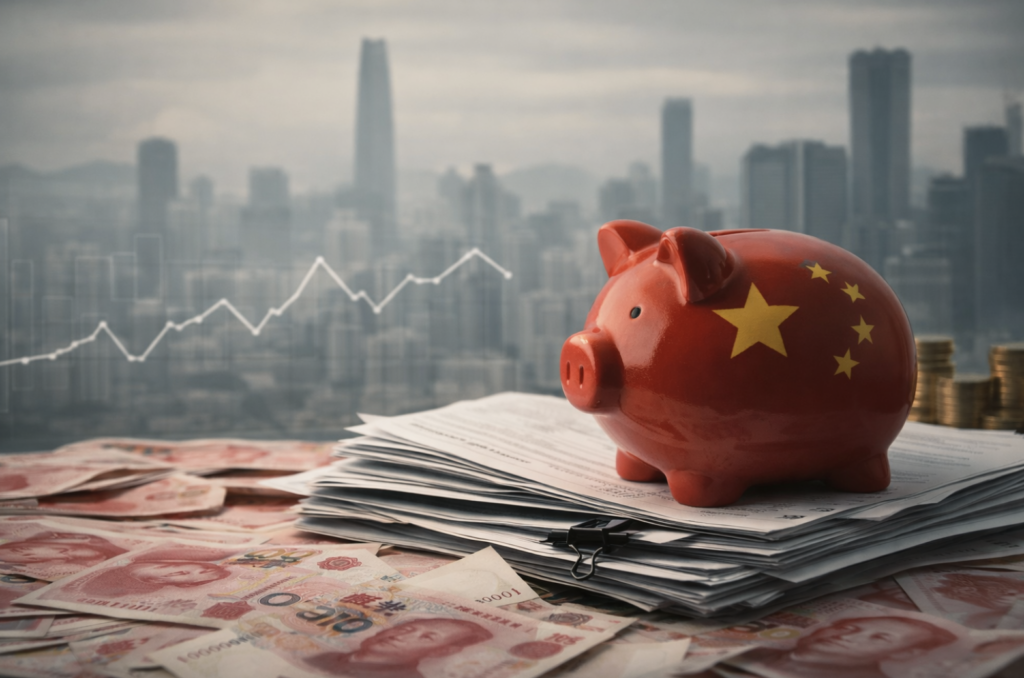
BEIJING, China – China’s government is confronting a quiet but consequential shift: the country is no longer generating enough public revenue to match the scale of its economic ambitions.
In 2025, fiscal revenues fell by 1.7 percent — the first decline since the pandemic — even as the economy officially expanded by about 5 percent. At the same time, government spending continued to rise, widening the gap between income and obligations.
Recent policy plans suggest the imbalance is becoming entrenched. Beijing is targeting a deficit of roughly 4 percent of gross domestic product, equivalent to nearly 6 trillion yuan, while broader estimates that include local government financing push the real deficit closer to 8–10 percent of GDP. (
The result is a growing fiscal strain beneath the surface of headline growth.
A Structural Revenue Problem
At the core of the issue is not tax evasion on a massive scale, but a system that captures relatively little revenue from a rapidly expanding economy.
China’s tax intake amounts to roughly 20 percent of GDP — far below the average of advanced economies, which collect closer to one-third.
By some measures, core tax revenue has slipped to around 14 percent of GDP in recent years, reflecting prolonged tax cuts and weak domestic demand.
Economists point to several structural drivers:
- Weak domestic consumption: Sluggish household spending and deflationary pressures have reduced taxable activity.
- Reliance on investment and exports: Key sectors benefit from subsidies and lower effective taxation.
- A narrow tax base: Personal income and property taxes remain underdeveloped.
- Local government constraints: Regions lack independent taxation powers and depend heavily on volatile land sales.
As the property market contracts, that last pillar has weakened sharply. Land-sale revenues — once a cornerstone of local finance — have declined for several consecutive years.
Debt Filling the Gap
With revenues under pressure, borrowing has become the primary tool for sustaining growth.
China’s total non-financial debt has surged to nearly 290 percent of GDP, driven largely by local governments and state-linked entities.
According to the International Monetary Fund, the country’s broad fiscal deficit remains persistently elevated, even as authorities attempt to balance stimulus with financial risk.
This model — growth financed by credit rather than tax income — is increasingly viewed as unsustainable by international analysts.
Economic Consequences at Home
The fiscal imbalance is reshaping China’s domestic economy in subtle but significant ways.
For businesses, state-led credit allocation and implicit subsidies distort competition, favoring large or politically connected firms.
For households, limited public spending on welfare reinforces high precautionary savings, further weakening consumption.
Meanwhile, the government faces difficult trade-offs:
- stimulate growth through spending, or
- contain rising debt and financial risk.
The dilemma has contributed to a lowering of growth expectations, with Beijing setting its 2026 target at just 4.5 to 5 percent — among the lowest in decades.
Policy Response: Stimulus Without Structural Reform
Beijing has responded with a mix of targeted stimulus and cautious reforms.
Measures include increased infrastructure spending, consumer subsidies and expanded bond issuance to support local governments.
Financial institutions expect further easing, including potential rate cuts and additional fiscal expansion to offset external pressures such as trade tensions.
Yet deeper reforms — such as introducing property taxes or significantly expanding income taxation — remain politically sensitive and largely absent.
Even recent tax changes, like the reintroduction of value-added taxes on certain goods, are seen as symbolic rather than transformative.
A System at a Crossroads
China’s fiscal challenge reflects a broader transition: from a high-growth, investment-driven model to a more mature economy that must rely on stable domestic demand and sustainable public finances.
For now, the country continues to grow. But the widening gap between what the state earns and what it spends underscores a deeper question facing policymakers:
Can China rebalance its economy without fundamentally reshaping how it raises revenue?
The answer may determine not only the country’s fiscal future, but the trajectory of the global economy itself.