
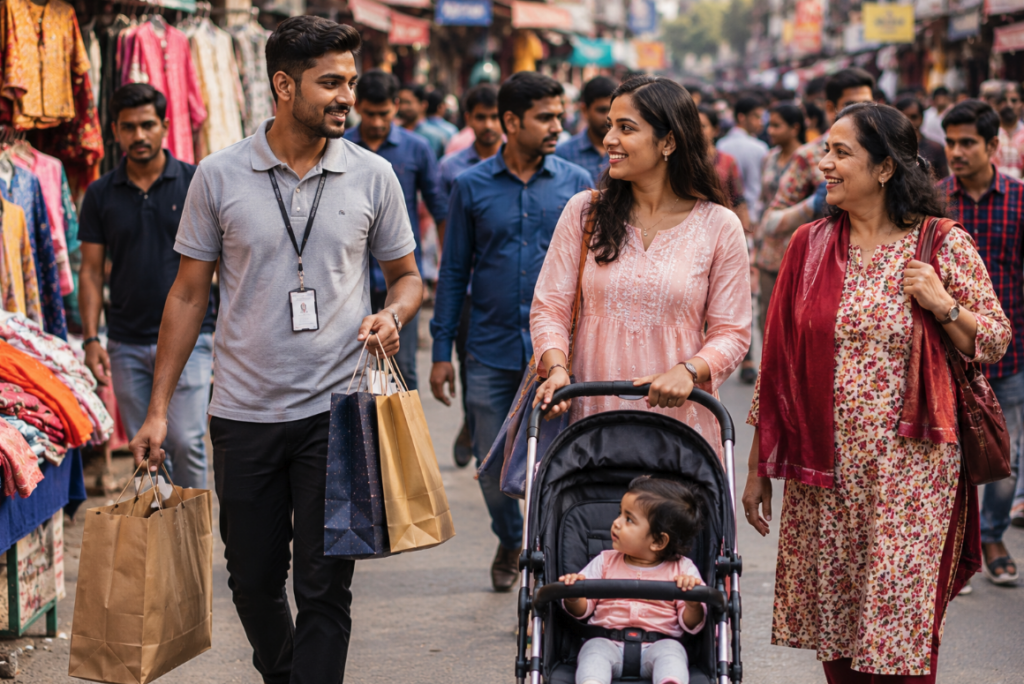
A start-up offering personal shopping aides in one of India’s busiest markets has become a symbol of urban innovation
NEW DELHI — In the crowded lanes of Delhi’s bustling Lajpat Nagar market, shoppers are being offered a service once associated with luxury retail experiences: personal assistants who carry shopping bags, accompany customers from store to store, and even help push baby strollers while families browse.
The service, launched in April by the start-up CarryMen, allows customers to hire male or female assistants for periods ranging from 30 minutes to four hours. Prices begin at 79 rupees (approximately $0.83) for half an hour and 149 rupees for one hour, positioning the offering as an affordable convenience for India’s expanding urban middle class.
The company says the idea was inspired by the challenges faced by shoppers navigating crowded markets, particularly elderly customers, parents with young children, and individuals carrying multiple purchases. Early customer response has been positive, with many users describing the service as a practical solution that makes shopping less physically demanding.
A Reflection of India’s Changing Consumer Economy
The emergence of CarryMen reflects broader changes in India’s economy, where rising incomes, rapid urbanization and the growth of app-based services have transformed consumer expectations. From food delivery and ride-hailing platforms to home maintenance and personal concierge services, convenience has become a major driver of spending among middle-class households.
Market analysts note that India’s service economy is increasingly creating micro-jobs tailored to specific consumer needs. Similar trends have been observed internationally, where consumers routinely pay for grocery delivery, personal shoppers, pet care, childcare assistance and other convenience-oriented services.
Supporters argue that CarryMen is simply another example of the gig economy adapting to local market conditions while generating employment opportunities for workers who may otherwise face limited job prospects.
Critics Raise Concerns About Dignity and Labor Rights
The service has nevertheless sparked an intense debate on social media and among labor observers.
Critics question whether carrying shopping bags for relatively affluent customers represents meaningful economic progress or merely repackages traditional forms of manual labor under a modern brand. Some commentators have compared the assistants to the “coolies” historically employed to transport goods and luggage across South Asia, raising concerns about dignity, social hierarchy and economic inequality.
Labor-rights advocates also point to broader questions facing gig-economy workers worldwide: wage protection, employment benefits, workplace safety and long-term career advancement. Similar debates have accompanied the rise of app-based delivery drivers, ride-hailing operators and freelance service workers across Asia, Europe and North America.
The Global Context
Internationally, demand for convenience services continues to expand as urban populations grow and consumers seek to save time. Yet governments and labor organizations increasingly face pressure to balance innovation with worker protections.
The discussion surrounding CarryMen mirrors larger global questions: When does convenience become dependence on low-paid labor? And how should societies value work that makes everyday life easier for others?
More Than a Shopping Service
For now, CarryMen’s assistants continue to accompany shoppers through one of Delhi’s busiest commercial districts, carrying bags and helping families navigate crowded streets. But the company’s rapid visibility suggests that it has become more than a retail convenience.
It has emerged as a test case for modern India’s evolving relationship with service work, consumer culture and social mobility — highlighting both the opportunities created by economic growth and the uncomfortable questions that often accompany it.
As India’s urban economy continues to modernize, the debate is unlikely to fade. Instead, it may offer an early glimpse into how one of the world’s fastest-growing consumer markets defines the balance between innovation, dignity and labor in the years ahead.