
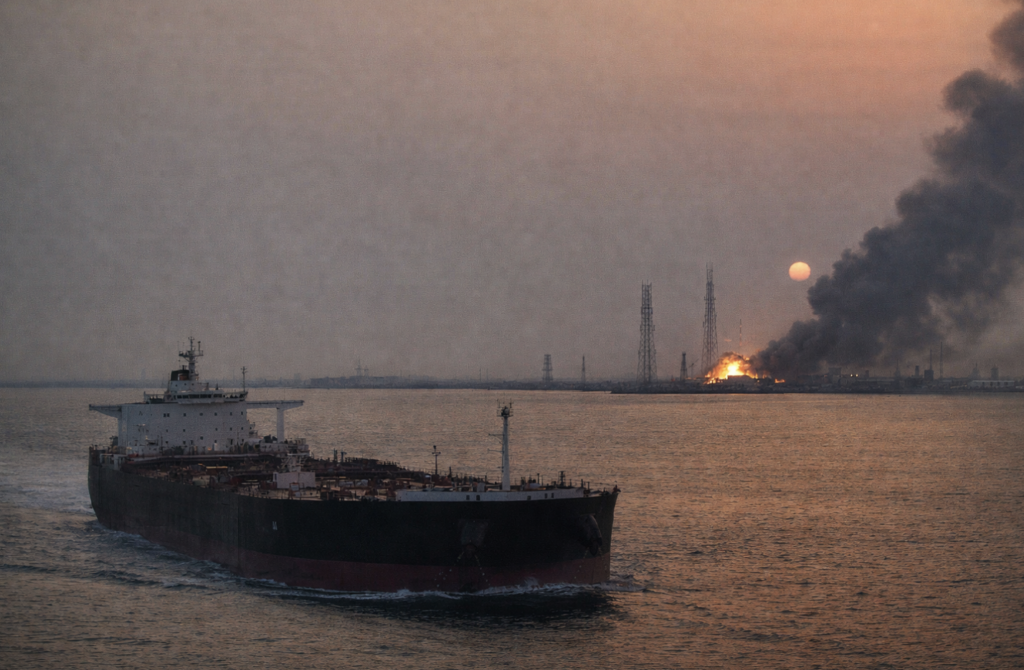
SINGAPORE — The war involving Iran, Israel and the United States has sharpened into a test of Asia’s economic resilience, with Singapore’s foreign minister warning that a prolonged shutdown of the Strait of Hormuz could tip the region into a broader crisis. Vivian Balakrishnan said the disruption had exposed a longstanding vulnerability: Asia’s dependence on Middle Eastern oil and gas, and its limited room for error when global energy flows are interrupted.
The warning comes as the Strait of Hormuz — the narrow waterway that normally carries about one-fifth of the world’s oil and seaborne liquefied natural gas — remains the central pressure point of the conflict. The International Monetary Fund said the closure had already cut off access to roughly 20 percent of global oil and seaborne LNG supplies, while the International Energy Agency called the resulting market disruption the largest in its history and confirmed a record emergency stock release by its member countries.
A Regional Threat With Asian Consequences
For Asia, the danger is not abstract. Reuters reported that about 80 percent of the oil shipped through Hormuz is bound for Asian buyers, while the IMF said the route normally carries nearly half of Asia’s oil imports and about one-quarter of its LNG imports. In Singapore, Mr. Balakrishnan said the crisis could raise inflation, strain supply chains and, if energy infrastructure is damaged more broadly, leave a lasting scar on exports from the Middle East.
The first signs of that strain are already visible in regional markets and procurement plans. In India, the rupee fell to a record low on Monday, with investors reacting to higher oil costs, risk aversion and heavy foreign outflows. In Japan, refiners said they were examining supply alternatives from North America and Latin America and weighing the possibility of further strategic stockpile releases if the disruption persists. South Korea, another major importer, said more than two dozen of its vessels remained stranded in the Gulf, prompting a direct appeal to Tehran for safe passage.
Governments Move to Contain the Fallout
Singapore has begun working through contingency plans built around several time horizons — the coming hours, the next three months and the next three years — in an effort to preserve stability while adapting to shifts in trade and energy routes. Mr. Balakrishnan said the city-state intended to lean on fiscal discipline, international coordination and supply-chain flexibility, while urging Asian economies to accelerate renewable energy investment, strengthen power grids and prepare labor markets for deeper structural change.
International institutions and foreign capitals have begun assembling their own responses. The IEA said member countries had agreed to release 400 million barrels from emergency reserves, later detailing contributions totaling 426 million barrels once production increases were included. The IMF, for its part, warned that higher energy costs could spill into food prices, headline inflation and inflation expectations if the conflict drags on.
Diplomatically, the pressure is broadening. China urged the United States and Israel to halt military action and warned that a prolonged conflict could damage global growth and weaken demand in key export markets. The European Union said its top diplomat, Kaja Kallas, had spoken with Iran as well as officials from Turkey, Qatar and South Korea, calling the reopening of Hormuz urgent and warning against further attacks on civilian infrastructure. South Korea also pressed Iran directly to safeguard shipping and stop strikes on Gulf civilian facilities.
Markets Watch for a Diplomatic Off-Ramp
The latest turn in the crisis came when President Trump postponed threatened strikes on Iranian power infrastructure for five days, saying there had been progress in talks, though Iran denied negotiations were underway. Markets initially took the delay as a sign of possible de-escalation, but analysts cautioned that the underlying problem remained unresolved because shipping through the strait had not returned to normal.
That uncertainty is what now defines the outlook. The immediate threat is a supply shock; the deeper fear is that repeated attacks on energy, port or power infrastructure could turn a temporary disruption into a multi-year drag on trade, prices and industrial output. Singapore’s assessment is that the danger extends beyond fuel markets. It is also a test of whether Asia’s most exposed economies can withstand a geopolitical rupture without sliding into a wider financial and inflationary crisis.