
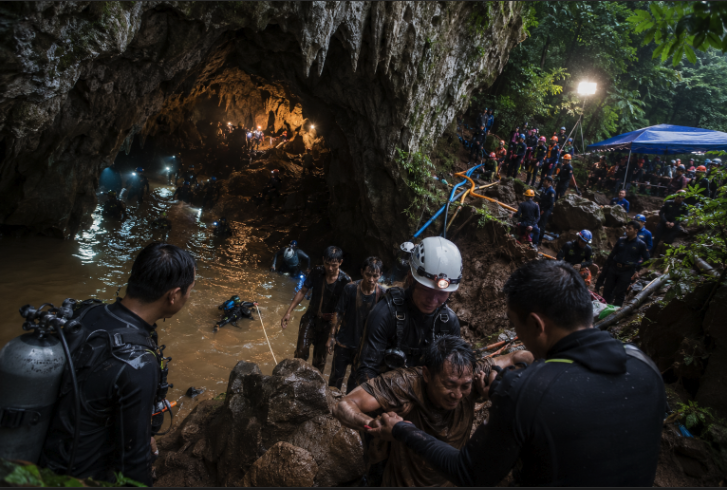
Heavy Rains and Equipment Failures Complicate International Rescue Effort
XAYSOMBOUN PROVINCE, Laos — A dramatic rescue operation in central Laos entered a critical phase on Sunday after five of seven villagers trapped for nearly two weeks inside a flooded cave system were brought to safety, while efforts continued to locate two men believed to be stranded deeper underground.
The group, all residents of a rural community in the mountainous Xaysomboun Province, entered the cave on May 20 in search of gold deposits when sudden flash floods inundated the narrow tunnel network, cutting off their escape and triggering a complex multinational rescue mission.
Rescued Men Become Key Source of Information
Rescuers reported that several of the men already freed are now providing valuable information from their hospital beds, offering detailed descriptions of the cave’s deeper sections and possible routes to the remaining survivors.
Officials involved in the operation said the testimony is proving instrumental in refining search plans for a cave system that extends deep underground and narrows to passages as little as 50 centimeters wide. Rescue coordinators described the survivors’ knowledge of the cave as “substantial” and potentially critical to locating the final two missing men.
The first survivor was extracted on Friday, followed by four others who emerged on Saturday. According to preliminary reports, those four men may have escaped part of the flooded cave system on their own after water levels temporarily receded.
International Rescue Teams Join Growing Operation
The rescue effort has evolved into a multinational operation involving specialist cave divers and emergency responders from Thailand, Indonesia, Australia, France and Japan.
Japanese cave diver Yoshitaka Isaji told reporters that water had been actively drained from sections of the cave, helping create access routes for rescuers. However, he also noted that a key drainage pump suffered a mechanical failure, temporarily limiting rescue access and forcing teams to carry out urgent repairs.
The participation of international experts reflects the increasing regional cooperation seen in complex disaster-response missions across Southeast Asia.
Weather Remains the Greatest Threat
Despite recent progress, rescue officials warned that the operation remains extremely vulnerable to weather conditions.
Heavy rain on Sunday forced authorities to suspend search activities after fresh water surged into the cave entrance. Rescue teams feared that rising water levels could erase hard-won gains and further complicate access to deeper chambers where the remaining men may be sheltering.
Meteorological forecasts, however, suggested that conditions could improve in the coming days, offering rescuers a potentially critical window to resume full-scale operations.
Echoes of Southeast Asia’s Previous Cave Rescue Dramas
The incident has drawn comparisons to the 2018 rescue of a youth football team trapped inside Thailand’s Tham Luang cave, one of the most complex rescue missions in modern history.
Experts note that flooded cave rescues remain among the most dangerous emergency operations in the world because of rapidly changing water levels, limited visibility, narrow passages and the constant threat of further flooding.
While every cave system presents unique challenges, specialists say successful rescues increasingly depend on advanced diving techniques, real-time mapping technologies and international cooperation.
Economic Pressures Behind the Incident
The accident has also drawn attention to the economic realities facing many rural communities in Laos.
Small-scale gold prospecting remains a source of supplemental income in some remote regions where employment opportunities are limited. Analysts say such activities often take place in hazardous environments with little formal oversight, exposing local residents to significant risks.
The cave tragedy has renewed discussion about mining safety, rural development and the need for alternative economic opportunities in isolated areas of the country.
Hope Remains for the Final Two Men
As rescue teams prepare to resume operations, officials say the combination of survivor intelligence, improving weather forecasts and international expertise offers the best chance yet of locating the final two missing villagers.
For now, families continue to wait anxiously outside the rescue zone, hoping the operation’s next chapter will bring another successful outcome in what has already become one of Laos’s most closely watched rescue missions in recent years.