
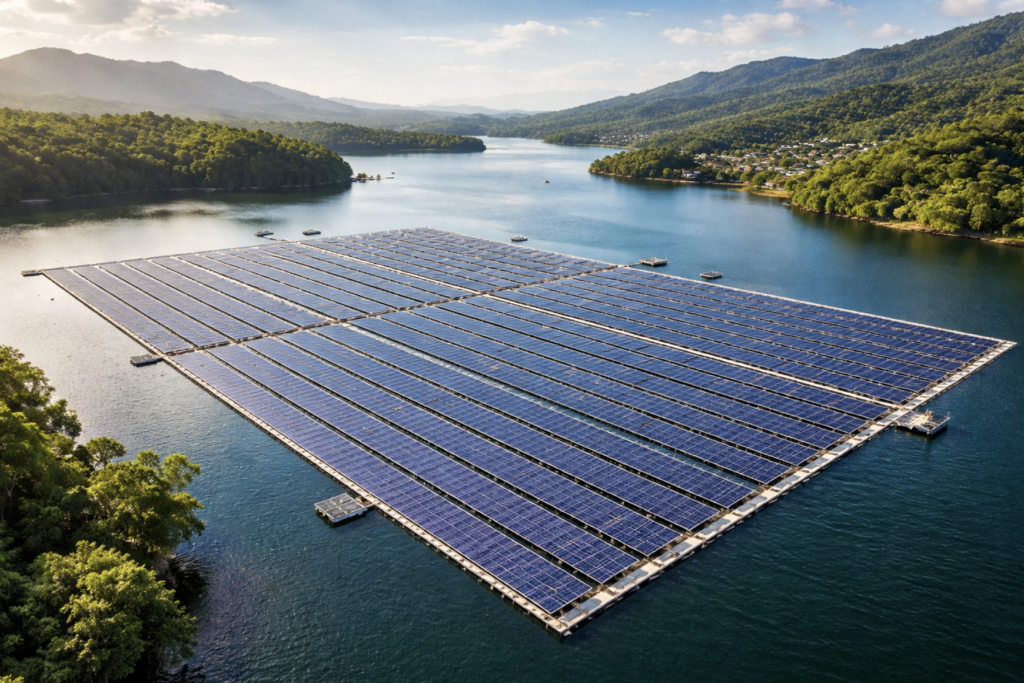
MANILA, Philippines – The Philippines is accelerating its shift toward renewable energy by deploying large-scale floating solar farms across lakes and reservoirs, a strategy designed to address land constraints while strengthening energy security across its island grid system.
Government planners and energy developers say the technology—solar panels mounted atop bodies of water—offers a practical solution for an archipelago where available land is limited and electricity demand continues to rise. By placing photovoltaic arrays on reservoirs, the country avoids competing land uses while tapping underutilized aquatic spaces.
Efficiency Gains and Environmental Benefits
Floating solar installations, often referred to as “floatovoltaics,” provide measurable performance advantages over traditional ground-mounted systems. The natural cooling effect of water helps maintain lower panel temperatures, improving energy output in tropical climates.
In addition to generating electricity, the installations reduce water evaporation and can limit algae growth, offering secondary environmental benefits—an increasingly relevant factor as climate variability affects water resources across Southeast Asia.
Powering Local Grids in a Fragmented Geography
Electricity generated by these floating systems is being integrated into local grids, supplying nearby communities and reducing dependence on imported fossil fuels. This is particularly significant in remote and island regions, where diesel generation has historically dominated and driven up energy costs.
Energy analysts note that decentralized renewable systems like floating solar could play a critical role in stabilizing the Philippines’ fragmented grid infrastructure, which spans more than 7,000 islands.
Regional Context and Global Momentum
The Philippines’ push aligns with a broader international trend. Countries including China, India and Singapore have invested heavily in floating solar as part of their clean energy strategies. Globally, analysts project strong growth for the sector as nations seek scalable, land-efficient renewable solutions.
International energy agencies have highlighted Southeast Asia as a particularly promising region for floatovoltaics, citing abundant सूर्य exposure and extensive inland water surfaces.
Positioning for Leadership in Clean Energy Innovation
Officials in Manila view floating solar as a cornerstone of the country’s broader renewable transition, which aims to significantly increase the share of clean energy in the national mix over the coming decade. By leveraging its unique geography, the Philippines is positioning itself as a regional leader in innovative solar deployment.
While challenges remain—including regulatory coordination, grid integration and environmental oversight—industry observers say the country’s early investments could establish a model for other island nations navigating similar constraints.
As global demand for clean, reliable power intensifies, the Philippines’ experiment with water-based solar infrastructure may offer a glimpse of how geography can shape the future of energy.