
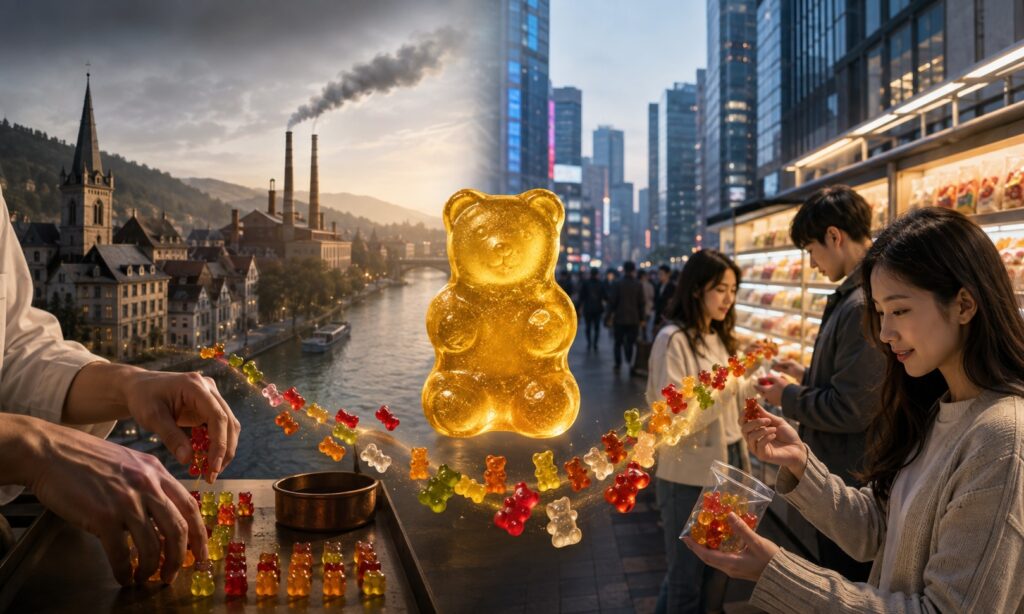
SEOUL, South Korea — On shelves across South Korea, Japan, Singapore, China and Thailand, Haribo no longer looks especially foreign. The brightly colored bags are displayed alongside domestic snacks, sold in convenience-sized portions and promoted through locally tailored advertising.
Yet many consumers may not immediately recognize what they are buying: a product of one of Germany’s most enduring family businesses.
Haribo was founded in Bonn in 1920 by Hans Riegel, whose name and hometown formed the abbreviation HAns RIegel BOnn. The privately held company moved its international headquarters to nearby Grafschaft in 2018, but its identity remains tied to Bonn and to the Goldbear created a century ago.
The company now sells in nearly 200 countries and operates 16 production sites in 11 countries. It reported record global volume in 2025, with sales quantities rising 4.5 percent as consumers increasingly chose fruit gummies over more expensive chocolate.
Korea, Haribo’s Unlikely Asian Capital
The most striking expression of Haribo’s Asian success is not in China or Japan, but in South Korea.
Haribo’s estimated Korean retail sales increased from $56.1 million in 2020 to $87.2 million in 2024—a rise of roughly 55 percent in four years. By 2024, Haribo was the country’s largest individual confectionery brand by retail value, ahead of Lotte Xylitol and Ferrero Rocher. These figures represent estimated consumer sales, rather than the revenue booked by Haribo’s Korean subsidiary.
In the narrower gummy category, Haribo’s reported market share reached 43.4 percent in 2022, more than three times that of its nearest competitor. The broader Korean gummy market had expanded from 69.3 billion won in 2013 to about 300 billion won by 2021.
Haribo entered the market through its Singapore-based Asia-Pacific operation in 2012 and appointed Samkyoung Plaza as its official Korean importer in 2016. It established Haribo Korea in January 2023, by which time the company said more than 85 percent of Koreans recognized the brand and 55 percent had recently purchased one of its products.
In July 2025, South Korea became the location of Haribo’s first permanent standalone store in Asia. The company has since expanded experiential pop-ups and family-oriented “Sweet Town” events, turning the Goldbear from a packaged snack into a recognizable cultural character.
A Familiar Brand With an Almost Invisible Passport
Haribo’s success reflects a wider change in Asian confectionery. Gummies have moved beyond children’s candy to become portable, social-media-friendly snacks consumed by adults as well. In Korean convenience stores, gummies have gained shelf space as traditional chewing gum has declined.
Japan followed a different path. Haribo products have been sold there since about 1985, but for decades they remained largely an imported European specialty. A decisive shift came with smaller 80-gram packages, wider convenience-store distribution and localized television advertising featuring sumo wrestlers and later Samurai.
During the first nine months of 2021, Japanese sales rose 23.9 percent and Haribo reached a 7.4 percent share of the gummy market, ranking third. From 2021 through 2023, its measured manufacturer sales through supermarkets, drugstores and convenience stores increased 44 percent. Japanese market reporting Haribo established a Japanese subsidiary in 2023.
China offers a much larger theoretical market but a more difficult competitive landscape. Haribo formed a Shanghai trading company in 2014 and introduced localized Chinese product names in 2017. It now sells through major online channels, including JD and an official Taobao store, but neither the company nor independent retail trackers disclose comparable country sales.
Singapore, meanwhile, is more important as Haribo’s Asia-Pacific headquarters than as a consumer market. The company established its regional organization there in 2012 and expanded distribution through DKSH in 2013. Thailand has developed broad availability through chains including 7-Eleven, Big C, Tops and Gourmet Market, particularly with small impulse packages, but reliable national sales figures are also unavailable.
For that reason, only South Korea can be confidently identified as Haribo’s No. 1 Asian market. Japan is probably the region’s next most mature consumer business, while Singapore, China and Thailand cannot be ranked reliably from public information.
German in Origin, Local in Practice
Haribo has no factory in East or Southeast Asia. Many products sold in the region are imported from the company’s Turkish plant, which produces halal-certified gummies using beef gelatin. In 2025, Haribo’s Chinese subsidiary said all products officially imported into mainland China were manufactured in Turkey.
The company’s Asian expansion has therefore depended less on regional manufacturing than on distribution, packaging and cultural adaptation. Goldbears remain the anchor, but Happy-Cola, Starmix, Happy Grapes, sour varieties and small multipacks allow the brand to fit different tastes, price points and retail environments.
This may be the clearest measure of Haribo’s achievement in Asia. Its products have become so familiar that their foreignness no longer defines them. A shopper in Seoul or Singapore may reach for a packet because it is colorful, chewy and recognizable—not because it comes from Germany.
Behind that ordinary purchase, however, is a century-old German company whose name still carries the initials of one man and one city: Hans Riegel, Bonn.
Sources: Haribo, Welt, Korea JoongAng Daily, Yonhap News Agency,