
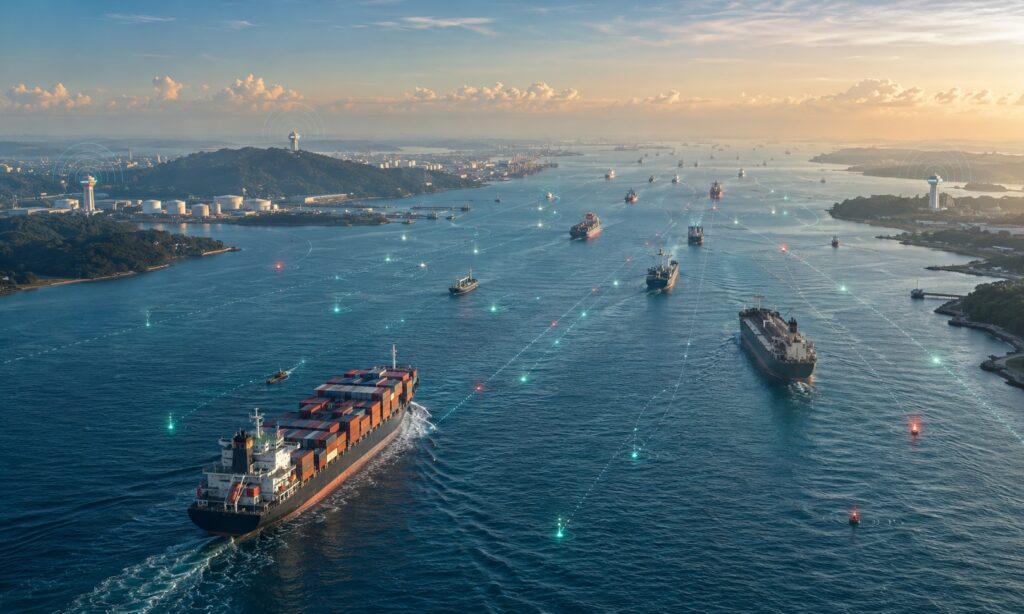
SINGAPORE — Indonesia, Malaysia and Singapore reaffirmed their commitment on Tuesday to keep the Straits of Malacca and Singapore open and safe, casting their decades-old maritime partnership as a rules-based alternative to the confrontation now disrupting shipping in the Middle East.
The declaration, issued at the 17th Co-operation Forum in Singapore, was more than a familiar diplomatic pledge. It came as the collapse of normal traffic through the Strait of Hormuz has exposed how quickly geopolitical conflict can disable a maritime chokepoint—and how few substitutes exist when it does.
More than 100,000 vessels travel through the Malacca and Singapore straits annually, carrying nearly one-quarter of global seaborne trade and close to one-third of the world’s oil and gas supplies, according to Singapore’s transport minister, Jeffrey Siow. At their narrowest, the waters are less than two nautical miles wide.
Hormuz Sharpens the Warning
Mr. Siow said the Middle East conflict had demonstrated that open sea lanes could not be assumed. S&P Global shipping data showed an average of 23 daily crossings through Hormuz from Aug. 21 to 23, compared with more than 110 before the war. On Tuesday, only five commodity vessels were recorded transiting the passage, according to preliminary Kpler data cited by Reuters.
Against that backdrop, the three Southeast Asian states explicitly reaffirmed the straits’ status as waterways used for international navigation. Their joint statement said the right of transit passage must be protected under the United Nations Convention on the Law of the Sea and customary international law—not merely recognized in theory, but respected in practice.
The wording carries strategic weight. The straits sit beside the contested South China Sea and connect the energy-producing Middle East with the manufacturing centers of East Asia. Yet the three governments have continued to manage them through a sovereignty-conscious cooperative framework rather than through a foreign-led security arrangement.
From Diplomacy to Digital Navigation
The emerging model is increasingly technological. Officials are expanding data-sharing systems and examining the use of artificial intelligence to identify congestion, anticipate traffic hot spots and warn ships of possible collisions.
More than 50 navigational aids already operate along the route. A recently completed project allows virtual aids to transmit navigational information when physical buoys or markers are unavailable or undergoing maintenance.
The forum is also considering very-high-frequency data-exchange systems, satellite-based augmentation, near-miss detection and simulation technology. Indonesia has called for better coordination among existing maritime reporting systems and for a dedicated project examining autonomous vessels and future regulatory requirements. Malaysia emphasized that reliable passage is inseparable from regional economic and energy security.
Technology, however, cannot remove the need for political coordination. AI may predict a collision, but governments must still agree on who responds, where a damaged vessel may shelter and how pollution or hazardous cargo will be contained.
New Guidelines for Ships in Distress
The three countries expect to finalize regional guidelines this year for vessels requiring a place of refuge. Singapore is separately proposing trilateral procedures for container-ship fires, including common rules for notification, incident management and the recovery of containers or wreckage.
The measures draw on a historical lesson. In 1975, the Japanese tanker Showa Maru grounded near Singapore’s Pulau Sebarok and discharged more than 3,300 tonnes of crude oil. The joint cleanup helped establish the habit of operational cooperation that eventually produced the formal Co-operative Mechanism in 2007.
The next generation of risks may be more complex. Ammonia, methanol, battery-electric vessels and other lower-carbon technologies present unfamiliar fire, toxicity and spill hazards. Larger ships, changing cargoes and autonomous navigation will require not only new equipment, but compatible regulations and jointly trained crews.
Maritime crime also remains a concern. ReCAAP recorded 21 armed-robbery incidents in the straits during the first half of 2026—74 percent fewer than a year earlier, but still 60 percent of all reported incidents in Asia. The decline suggests that enforcement and preventive measures are working, while the remaining cases show why sustained patrols and information-sharing are necessary.
A Regional Model Under Pressure
International Maritime Organization Secretary-General Arsenio Dominguez described the cooperative arrangement as a proven method for building trust between coastal and user states. More than 300 delegates representing over 125 countries and organizations attended the two-day meeting; governments including China, the United States, India, Japan and several European states have contributed expertise or funding over time. Since 2007, international partners have supplied about $26 million to maintain navigational infrastructure.
The system’s strength is its practicality: voluntary financing, common technical standards and quiet coordination among neighbors with different political interests. Its vulnerability is much the same. It depends on continued trust, interoperable systems and governments acting before an emergency becomes a geopolitical crisis.
Hormuz has supplied the warning. The Malacca and Singapore straits are now attempting to demonstrate the alternative: that one of the world’s most indispensable waterways can remain open not through military dominance, but through law, preparation and shared responsibility.
Sources: Singapore Ministry of Transport