
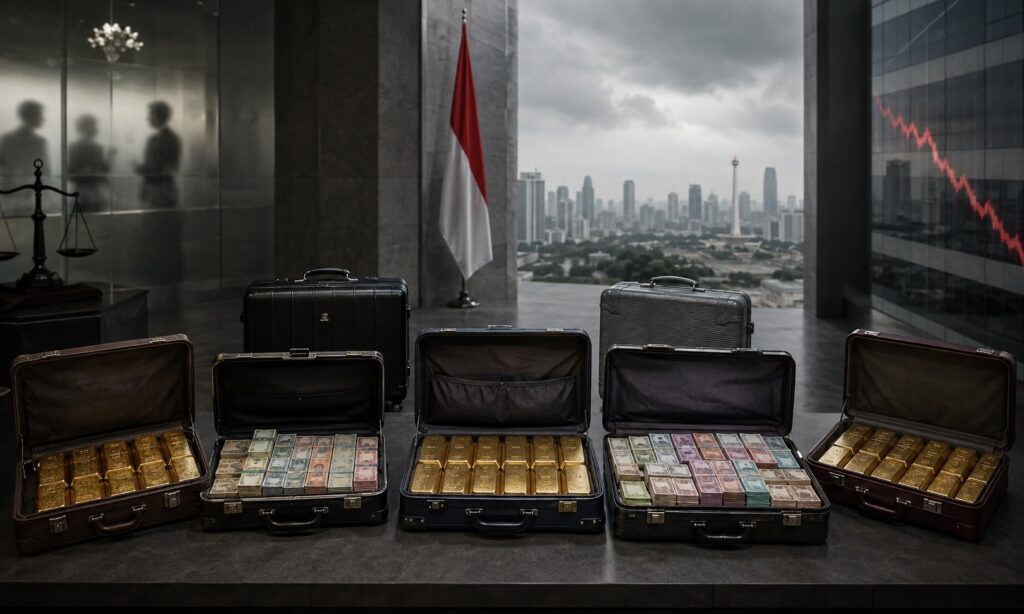
JAKARTA, Indonesia — The discovery had all the elements of a national morality play: seven suitcases, 74 kilograms of gold bullion and stacks of cash in several currencies, together valued at roughly $26 million.
The assets were seized in July from a residence linked to Febrie Adriansyah, one of Indonesia’s most powerful anti-corruption prosecutors. Mr. Adriansyah subsequently resigned and became a suspect in several investigations. He has denied wrongdoing, and his criminal responsibility has not been established.
The case is still unfolding. But to many Indonesians, the images of gold and cash were more than evidence in a corruption investigation. They appeared to confirm a deeper suspicion: that the institutions charged with policing the system may themselves have become entangled in it.
The Indonesian National Police confirmed the seizure of 74 kilograms of gold and about 476 billion rupiah in cash. The scandal arrived as President Prabowo Subianto’s government was already struggling with a falling currency, a battered stock market and growing questions about the direction of Southeast Asia’s largest economy.
Indonesia is not in a conventional economic collapse. Its banks remain functional, its foreign-exchange reserves are substantial and the economy continues to expand. Yet the country is confronting something potentially more difficult to measure: a crisis of confidence in the quality, predictability and independence of its institutions.
A Success Story Begins to Fray
For most of the past two decades, Indonesia was one of Asia’s quieter economic successes.
Growth averaged close to 5 percent, supported by domestic consumption, prudent fiscal management and a young population of more than 280 million. Successive governments maintained a legal ceiling on the budget deficit and avoided the recurring sovereign crises that destabilized several other emerging markets.
The legacy of the 1997-98 Asian financial crisis remained central to economic policy. Indonesia’s traumatic experience with currency collapse, banking failures and an International Monetary Fund rescue encouraged later governments to emphasize central-bank credibility, manageable public debt and fiscal restraint.
That reputation has not disappeared. But it is being tested.
The rupiah weakened to around 18,000 against the dollar in June 2026, touching levels not seen since the Asian financial crisis. The Jakarta Composite Index has fallen by roughly 25 to 26 percent during parts of the year, though the precise decline varies according to the chosen starting date.
A Financial Times report described how market pressure forced Mr. Prabowo to retreat from parts of a plan to place commodity exports under a state-controlled intermediary. The agency will now monitor transactions rather than directly conduct them, although the government still plans to establish a national commodity exchange.
The distinction matters. Indonesia has not closed its economy. But investors increasingly perceive its policymaking as abrupt, centralized and difficult to predict.
Capital Is Sending a Warning
Indonesia’s balance of payments recorded a deficit of $9.1 billion in the first quarter of 2026, compared with a surplus in the preceding quarter. The capital and financial account swung from a $9 billion surplus to a $4.9 billion deficit.
Bank Indonesia said reserves remained high at $148.2 billion at the end of March — sufficient to cover approximately 5.8 months of imports and government external-debt payments. That was still comfortably above the international adequacy benchmark of around three months. But the direction of travel has unsettled investors. Bank Indonesia’s figures also show that residents increased their holdings of cash, deposits and other assets abroad.
Independent estimates cited by regional analysts suggest that foreign investors withdrew about $8.9 billion from Indonesian assets during 2025 and 2026, while Indonesian residents transferred approximately $28.2 billion abroad. Those numbers should not all be described as illegal capital flight: they include legitimate portfolio decisions, debt repayments, deposits and international investments.
Their significance lies elsewhere. Foreign and domestic investors appear to be responding to the same concern.
Thailand’s Krungsri Research describes the situation not as a banking or balance-of-payments collapse, but as a “confidence crisis” rooted in declining policy credibility and concern over governance. Its economists argue that market losses and rating warnings are symptoms rather than the underlying disease.
So far, the damage has been concentrated in financial markets. The greater risk is that prolonged uncertainty eventually reduces business investment, job creation and household consumption.
The Cost of an Eight-Percent Ambition
Mr. Prabowo entered office promising to lift growth from its long-standing rate of around 5 percent to 8 percent by 2029. The ambition is politically understandable. Indonesia must create millions of jobs, reduce regional inequality and provide opportunities for a large, young labor force.
But the programs intended to produce that acceleration are expensive.
The most prominent is the Free Nutritious Meals program, intended eventually to serve more than 80 million schoolchildren, pregnant women and other recipients. Supporters say it can reduce malnutrition, improve educational outcomes and generate demand for local agricultural products.
Its implementation has been troubled by food-safety incidents, reimbursement disputes and allegations of corruption and waste. The government has repeatedly reduced its budget, most recently to approximately 229 trillion rupiah, or $12.8 billion, from substantially higher initial projections. Reuters reported that further cuts remained possible.
The claim that Indonesia is simply “printing money” to finance the program is not supported by available evidence. The expenditure is financed through the national budget. But the wider concern — that political spending could weaken fiscal discipline or increase pressure on the central bank — is legitimate.
Indonesia recorded a fiscal deficit of 2.92 percent of gross domestic product in 2025, just below the statutory 3 percent ceiling and the largest deficit outside the pandemic years in more than two decades.
Thomas Pepinsky, a professor of government and public policy at Cornell University, told Reuters that reaching 8 percent growth would require either significantly larger deficits or much higher tax revenue. Arianto Patunru of the Australian National University’s Indonesia Project warned in the same report that some policies appeared to be reversing reforms adopted after the Asian financial crisis.
Hilman Palaon, a research fellow at Australia’s Lowy Institute, has similarly argued that heavy public spending and top-down economic management are unlikely on their own to solve Indonesia’s deeper problems of corruption, inequality and investor distrust.
When the State Moves Deeper Into the Market
Mr. Prabowo’s economic philosophy combines social spending, resource nationalism and a larger coordinating role for the state.
Indonesia has long used its natural wealth as an instrument of industrial policy. Its ban on exports of unprocessed nickel ore, fully implemented in 2020, encouraged companies — particularly Chinese groups — to construct smelters and processing facilities inside the country.
The policy helped turn Indonesia into the dominant force in the global nickel industry. It also demonstrated that restrictions on raw-material exports do not necessarily repel investment when access to the underlying resource is sufficiently valuable.
But nickel’s success does not mean the same approach can be applied without limit.
The government has tightened requirements governing foreign-currency proceeds from natural-resource exports. Exporters in sectors including coal, palm oil and nickel must retain substantial proceeds within Indonesia, increasingly through state-owned banks. Permitted use of those funds has also been restricted.
These measures are more limited than general capital controls: ordinary companies and individuals are not universally prohibited from transferring money abroad. Yet they represent a significant increase in state control over corporate liquidity and foreign exchange.
More controversial still are legal protections attached to certain bonds associated with the sovereign investment fund Danantara. Critics say the provisions could protect some bond transactions from tax, civil or criminal scrutiny. The finance minister has denied that investors received blanket immunity, while Indonesian civil-society organizations have sought judicial review of the law. Reuters reported on the legal challenge.
Even if the protections are narrower than critics claim, their political effect has been damaging. In a country already struggling with perceptions of unequal law enforcement, special legal safeguards for investors in state-linked instruments invite suspicions that rules can be redesigned for politically favored transactions.
Growth on Paper, Anxiety in Households
Officially, Indonesia’s economy remains strong.
Gross domestic product increased by 5.61 percent in the first quarter of 2026 and 5.29 percent in the second. In the first quarter, government consumption rose 21.81 percent from a year earlier, making public expenditure an important contributor to growth. Indonesia’s statistics agency also reported continued strength in services and domestic demand.
Some local economists have questioned whether the headline figures are fully consistent with weaker tax collection, household sentiment and other indicators. Claims that most growth consists merely of unsold inventory, however, have not been demonstrated. The more defensible criticism concerns the composition and sustainability of growth, not proof that the figures are fabricated.
The World Bank forecasts growth of about 5 percent in 2026. It describes the economy as resilient but says that fiscal credibility, better-targeted public spending and productivity reforms are essential to creating better jobs. Carolyn Turk, the World Bank’s country director for Indonesia and Timor-Leste, has emphasized that policy coordination and fiscal credibility will be decisive in maintaining stability. The World Bank’s assessment is cautious, but far from catastrophic.
Foreign direct investment also reached a record quarterly level in the second quarter of 2026. Total realized investment amounted to 511.8 trillion rupiah, with foreign investment accounting for about 257.7 trillion rupiah. Government investment data suggest that companies continue to make long-term commitments to Indonesian factories, mines and infrastructure even as portfolio investors reduce holdings of stocks and bonds.
The two trends are not contradictory. A nickel processor building a multibillion-dollar plant makes a different calculation from a fund manager who can sell government bonds in seconds.
For ordinary Indonesians, however, the official growth figures offer less reassurance. The country’s middle class declined from 57.33 million people in 2019 to 47.85 million in 2024, according to the national statistics agency. Singapore-based Channel News Asia has documented how insecure employment, weak wage growth and the expansion of informal work have pushed millions into the “aspiring middle class” or economically vulnerable categories.
Political sentiment is following. A July survey reported by Reuters showed Mr. Prabowo’s approval rating falling to 51.1 percent from 81.2 percent in November 2025. Nearly half of respondents described economic conditions as bad or very bad.
The View From Abroad
International assessments increasingly divide into two camps, though neither sees Indonesia as a lost cause.
Moody’s affirmed Indonesia’s investment-grade Baa2 rating but changed its outlook to negative, citing weaker governance and rising fiscal risks. Fitch retained its BBB rating while also moving the outlook to negative.
S&P took a more favorable position. In July it affirmed Indonesia at BBB/A-2, with a stable outlook, pointing to solid growth prospects, relatively modest government debt and the government’s capacity to adjust spending.
Western reporting has concentrated on fiscal pressure, central-bank independence and abrupt policy changes. Singaporean and other ASEAN coverage has paid greater attention to employment, household purchasing power and whether economic growth is reaching younger and middle-income Indonesians.
Thailand’s Krungsri economists warn that prolonged distrust could spread from financial markets into the real economy. Australian analysts have criticized the concentration of decision-making and the reliance on state-directed programs. American economists have questioned whether the 8 percent target can be achieved without undermining the very fiscal credibility that made Indonesia attractive to investors.
But another Lowy Institute commentary offers an important corrective: Indonesia cannot govern solely for the comfort of financial markets. Social programs respond to real inequality, malnutrition and exclusion. A government that protects asset prices while ignoring those problems would face a different kind of legitimacy crisis.
This Is Not 1998 — But That Is Not the Point
Indonesia today is far stronger than it was at the beginning of the Asian financial crisis.
Its banking system is better regulated. Its currency is flexible rather than artificially fixed. Public debt is manageable. Foreign-exchange reserves remain substantial. The current-account deficit is relatively narrow, and the country continues to attract direct investment.
There is no persuasive evidence that Indonesia is approaching sovereign default, widespread bank failure or an IMF rescue.
The more credible danger is gradual institutional deterioration: political interference replacing predictable rules, privileged legal protections weakening equality before the law, and short-term programs crowding out investment in education, infrastructure and productivity.
Confidence crises do not always produce dramatic collapses. Sometimes they impose a quieter cost. Investors demand higher returns. Companies postpone projects. Skilled workers leave. Households save instead of spending. Growth continues, but below the country’s potential.
Mr. Prabowo’s challenge is therefore not simply to defend the rupiah or restore the stock market. It is to show that Indonesia’s ambitious social agenda can coexist with fiscal limits, independent institutions and rules that apply equally to officials, state enterprises and private investors.
Indonesia is still growing. Whether that growth remains durable will depend less on the next quarter’s headline number than on whether the government can rebuild trust before financial anxiety becomes an economic reality.