
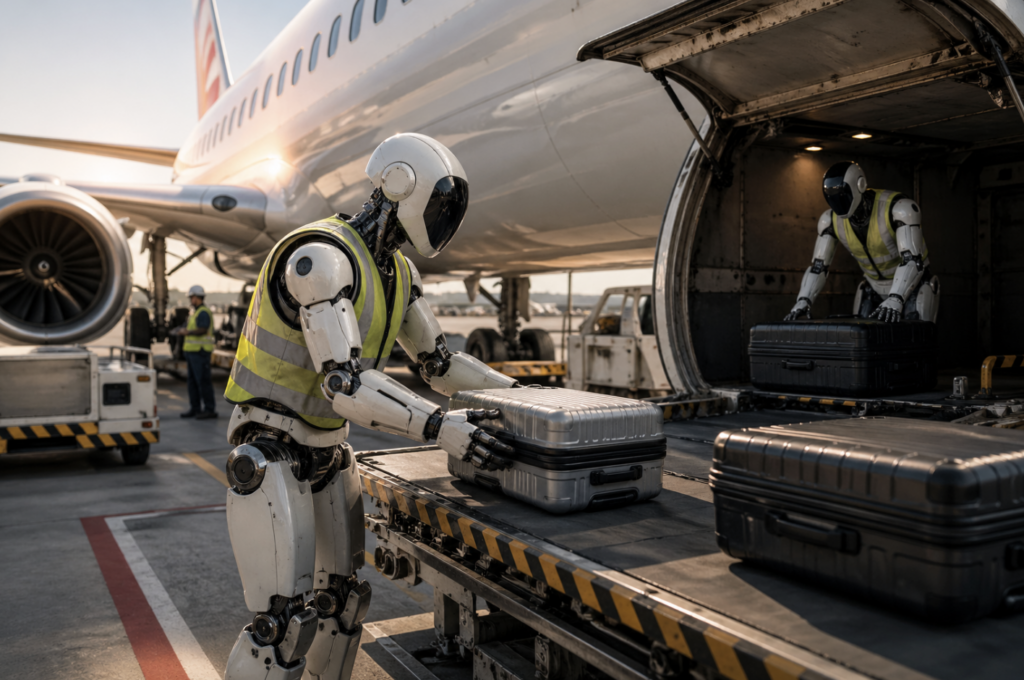
TOKYO, Japan — In a move that underscores both technological ambition and demographic urgency, Japan Airlines and its ground services arm, JAL Ground Service Co., Ltd., announced plans to begin testing humanoid robots in airport operations in May 2026. The initiative, conducted in partnership with GMO AI & Robotics Trading Co., Ltd., marks the first attempt in Japan to deploy human-shaped robots in the highly complex environment of airport ground handling.
A Technological Response to a Shrinking Workforce
Japan’s aviation sector, like much of its economy, is grappling with a tightening labor market driven by a declining working-age population and a surge in inbound tourism. Ground handling—long dependent on physically demanding, precision-based manual labor—has emerged as a critical bottleneck.
Industry analysts note that similar labor shortages are affecting airports globally, from Europe to North America, where airlines have struggled to maintain turnaround efficiency amid staffing constraints. In Japan, the challenge is particularly acute, prompting increased investment in automation and robotics as a structural solution rather than a temporary fix.
Why Humanoid Robots?
Unlike conventional automation systems, which often require costly infrastructure changes, humanoid robots are designed to operate within existing environments. Their human-like mobility and dexterity allow them to handle diverse tasks—from baggage loading and cabin cleaning to operating ground support equipment—without redesigning airport layouts.
“Traditional robotics has struggled in dynamic, space-constrained settings like airport aprons,” said a Tokyo-based aviation technology consultant. “Humanoid systems promise flexibility that mirrors human workers, which could be a game changer if reliability and safety standards are met.”
A Phased, Long-Term Experiment
The project will unfold in stages. Initial efforts will focus on mapping and analyzing airport workflows to identify tasks suitable for robotic assistance. This will be followed by simulation-based testing and gradual real-world deployment under strict safety oversight.
JGS will contribute operational expertise, defining safety benchmarks and practical requirements based on decades of airport experience. Meanwhile, GMO AIR will supply and program the robots, drawing on its research initiatives, including a humanoid robotics development hub in Tokyo.
Global Context: A Race Toward Automation
The initiative aligns with a broader international push toward automation in aviation. Airports in Singapore, South Korea and parts of Europe have already introduced robotic systems for cleaning, security, and limited baggage handling. However, fully humanoid robots capable of multi-functional tasks remain largely experimental.
Experts caution that while the technology is advancing rapidly, widespread adoption will depend on cost efficiency, reliability in harsh outdoor conditions, and regulatory approval.
Toward a Hybrid Workforce
Executives involved in the project emphasize that the goal is not to replace human workers but to augment them—reducing physical strain and improving operational resilience.
The GMO Internet Group has declared 2026 the “First Year of Humanoids,” signaling broader ambitions to integrate robotics across industries. If successful, the airport trial could serve as a model for logistics, manufacturing, and public infrastructure worldwide.
A Test Case for the Future of Work
As airlines seek to balance efficiency, safety and workforce sustainability, Japan’s experiment may offer an early glimpse into the future of labor in high-intensity service industries: one where humans and machines operate side by side.
Whether humanoid robots can meet the rigorous demands of airport operations remains uncertain. But for an industry under pressure to adapt, the trial represents a bold step toward redefining how work gets done on the ground—and possibly far beyond it.