
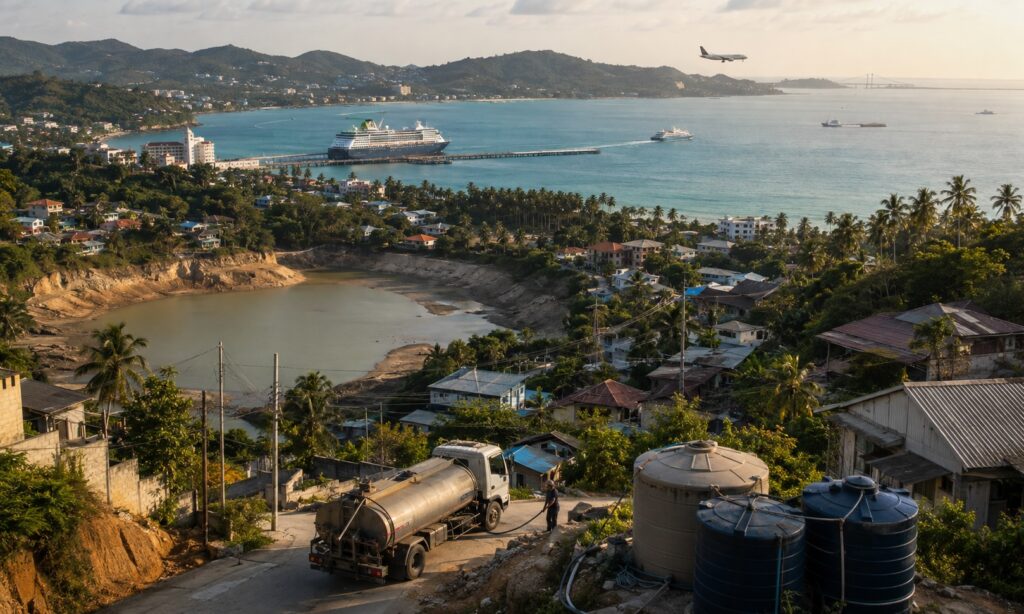
KOH SAMUI, Thailand – Koh Samui’s transformation can be captured in two numbers: three million and 16,000.
The first is the approximate number of passengers handled by Samui Airport in 2025, an 8.7 percent increase from the year before. The second is the number of cubic meters of water that the island was recently able to supply each day through its mainland pipeline — less than half the estimated daily demand of 34,000 cubic meters.
Together, the figures describe the central tension confronting one of Thailand’s most valuable island destinations. Koh Samui has recovered from the pandemic faster than much of the country’s tourism industry. It has attracted affluent European travelers, wellness tourists, villa buyers and fans of “The White Lotus.” Hotel prices have risen, private investment has accelerated and the government is planning transport projects intended to accommodate millions more arrivals.
But the island’s basic services have not expanded at the same pace.
A Recovery Beyond the Old Peak
Measuring tourism on an island served by aircraft, ferries and cruise ships is not straightforward. Airport figures count both arriving and departing passengers, while government visitor statistics attempt to count individual trips. Cruise passengers may spend only a few hours ashore, and ferry statistics include residents and workers as well as tourists.
Even with those qualifications, the direction is unmistakable.
Samui Airport recorded about 2.42 million passenger movements in 2019. After the pandemic collapse, traffic rose to 2.78 million in 2024 — 21 percent more than in 2023 — and reached approximately three million in 2025, according to Bangkok Airways reporting and research by C9 Hotelworks.
Broader tourism estimates put total visitors at roughly 3.54 million in 2023 and 3.8 million in 2024. Of the 2024 total, about 2.3 million were international visitors, according to the Thailand Hotel Investment Guide 2026.
That performance is particularly striking because Thailand as a whole lost momentum in 2025. National foreign arrivals declined from about 35.5 million in 2024 to roughly 33 million, a drop of more than 7 percent, amid weaker Chinese demand, a strong baht and regional competition. Koh Samui, by contrast, continued to expand its air traffic and room rates.
The island’s success does not mean growth will continue in a straight line. National arrivals remained soft into 2026, and tourism is sensitive to exchange rates, geopolitical disruptions and airfares. But Samui now appears less dependent on the short-haul group market than several competing Thai destinations — and more closely tied to long-haul travelers prepared to stay longer and spend more.
Europe Leads the New Visitor Map
Europe accounted for 56 percent of Koh Samui’s international arrivals in 2024. Germany was the largest individual source market, representing approximately 16 percent, followed by the United Kingdom at 11 percent and France at 10 percent. China and Israel each accounted for about 7 percent. Asia as a whole contributed 31 percent, the Americas 7 percent and Oceania 5 percent, according to immigration data compiled by C9 Hotelworks.
This mix helps explain the island’s relative resilience. German, British and French travelers commonly visit during the European winter, stay several nights and buy accommodation, dining, spa and excursion packages. Wellness resorts and private villas have also helped Samui appeal to travelers whose spending is less dependent on bargain airfares.
China remained the leading Asian market in 2024, supported by charter connections from Chengdu, Chongqing and Xi’an. But the island’s direct international network is still limited. International services represented only 14 percent of Samui flights during the first four months of 2025, compared with 22 percent in the same period of 2019. Many foreign visitors still reach the island through Bangkok, Singapore or Hong Kong.
Cruise traffic adds another, quite different, flow. Koh Samui received 50 cruise ships carrying 94,681 passengers in 2024, almost twice the 51,227 passengers recorded in 2023. Germany, the United States, Britain, Canada and Australia were the five leading cruise markets. During the first four months of 2025 alone, 35 ships brought nearly 66,000 passengers.
The Tourism Authority of Thailand has actively encouraged this segment, including a 2025 partnership supporting the Laem Chabang–Koh Samui–Singapore route. But cruise passengers are not equivalent to hotel guests. Their stays are shorter, much of their spending remains aboard ship, and their economic value depends on how effectively local tour operators, restaurants and retailers capture their limited time ashore.
Hotel Rates Rise Faster Than the Wider Cost of Living
Koh Samui’s hotels emerged from the pandemic with unusual pricing power.
Hotel occupancy increased by 12 percent in 2024, while the average daily rate rose by 9 percent. In April 2025, the marketwide daily rate was as much as 21 percent higher than a year earlier. Full-year 2025 data indicated broadly stable occupancy but a further 8.5 percent increase in average rates.
This was not merely a reflection of general inflation. Thailand’s national consumer inflation averaged only 0.4 percent in 2024. Samui’s room prices were being driven by recovering demand, a greater concentration of luxury guests and relatively slow growth in formal hotel supply.
In 2024, the island had 634 registered accommodation establishments offering 24,188 rooms. Supply had expanded at an average annual rate of only about 1 percent over the previous five years. Roughly 34 percent of the registered market was classified as luxury, and the publicly identified pipeline through 2028 contained only 776 additional rooms.
“The White Lotus,” filmed partly at the Four Seasons Resort Koh Samui and other Thai properties, intensified interest in the premium segment. Thailand did not obtain that publicity by accident: its official film incentive offers international productions a cash rebate of up to 30 percent. Government publicity officials subsequently reported sharp increases in searches for Samui accommodation, particularly from the United States.
Yet the island is not a single luxury market. A Thai meal at a roadside restaurant or night market can still cost roughly 60 to 80 baht, while Western-style cafés and restaurants commonly charge 200 to 500 baht per person. Basic guesthouses remain available outside the principal resort zones, although high-season prices vary sharply.
For a visitor, this creates a destination that can still be inexpensive at street level but costly in its largest categories: flights, beachfront accommodation, taxis, private tours and imported food and drink. Consumer travel estimates typically place a midrange Thai vacation at 2,500 to 4,000 baht per person per day, but island destinations such as Samui frequently cost more because of transport, seasonal demand and limited hotel inventory.
Two Cost Structures on One Island
The same tourism economy looks different to the people who staff it.
Koh Samui’s statutory minimum wage is 400 baht a day, the highest tier in Thailand. The government introduced that rate partly in recognition of the elevated costs in major tourism and industrial centers. At 26 paid working days, it amounts to 10,400 baht a month before overtime, service charges or employer-provided accommodation. The current rate is documented by the Thai Ministry of Labour.
A 60-to-80-baht meal therefore consumes 15 to 20 percent of a minimum-wage worker’s daily pay. Housing, fuel, electricity, school expenses and water must be covered from what remains. Employees at large resorts may receive meals, accommodation or service-charge distributions, but workers in smaller restaurants, shops, transport businesses and informal employment do not necessarily receive those benefits.
Reliable island-specific household price indices are not published, making sweeping claims about “the average cost of living” misleading. Online rental averages are particularly distorted by holiday villas marketed to foreigners. But the structural pressures are clear: much of what Samui consumes must arrive by ferry or air; tourism competes with residents for land, housing and water; and foreign demand can push prices in coastal communities far beyond what local wages support.
The water shortage of July and August 2026 made that divide especially visible. Drought reduced local production, leaving the island dependent on approximately 16,000 cubic meters a day from the mainland against demand of about 34,000. The Provincial Waterworks Authority introduced rotating supply zones, while households and businesses purchased additional water from private trucks.
The government ordered emergency transfers, repairs to a damaged reverse-osmosis system, an additional 4,000 cubic meters a day through the undersea network and possible cloud-seeding operations. It also called for a long-term water-security plan. The immediate measures were detailed by the National News Bureau of Thailand and the water rationing was reported by Matichon.
For large resorts with tanks, private wells or purchased water, shortages raise operating costs. For households without those resources, they affect cooking, sanitation and daily life.
Bangkok’s Infrastructure Wager
Thailand’s national government is not simply promoting Koh Samui as a destination. It is attempting to reshape how people reach it.
At the privately owned Samui Airport, regulators have authorized a maximum capacity of up to 73 flights a day under environmental and safety conditions, compared with the former limit of 50. Bangkok Airways is investing in additional gates, check-in facilities, baggage systems and commercial space. The current operating ceiling is set out in the Civil Aviation Authority of Thailand’s capacity notice.
At sea, the Marine Department is advancing a 12.17-billion-baht cruise-terminal project at Laem Hin Khom in Taling Ngam. The proposed 47-rai development would be structured as a public-private partnership, with a private concessionaire responsible for most construction and operating costs over 30 years.
The plans provide for two cruise vessels to berth simultaneously — one large and one medium-size ship — as well as facilities for yachts and ferries. Updated projections suggest capacity for approximately 240 cruise calls and 200,000 to 400,000 passengers annually.
But 2032 is a target, not a guaranteed opening date. As of mid-2026, the project remained under ministerial and PPP review. The preliminary timetable calls for cabinet approval in 2027 and tendering in 2028. Its environmental assessment, land permissions, financing and construction must still be completed. The latest status was reported by Thailand’s Office of Transport and Traffic Policy and Planning and The Nation.
A still larger proposal would connect Samui to the mainland by expressway and sea bridge. The route has been studied by the Expressway Authority of Thailand and is often estimated at around 40 billion baht. Construction has been discussed for the period beginning in 2029, with a possible opening in 2033 or 2034.
Here, too, the operative words are “proposed” and “subject to approval.” Environmental studies, public hearings, route selection and cabinet endorsement remain prerequisites. The Expressway Authority continues to describe the project through its consultation process rather than as an approved construction program.
Water and Waste Before Megaprojects
The government’s challenge is not a lack of ambition. It is the ordering of priorities.
In April 2024, national and provincial officials estimated that roughly 150,000 tons of accumulated waste remained at Samui’s failed incinerator. Removing it to the mainland was expected to cost about 230 million baht. By July 2025, a parliamentary delegation was told that the backlog persisted while the island was generating an additional 180 tons of waste a day. Transporting that material to a mainland disposal center cost 1,530 baht a ton.
The Surat Thani provincial government has acknowledged that future waste generation could reach 300 tons a day as tourism grows. Community waste banks, plastic-reduction campaigns and projects supported by the municipality, UNDP and WWF have expanded, but they do not replace the need for functioning treatment infrastructure. UNDP’s work on Koh Samui has identified waste management as a direct threat to public health, quality of life and the tourism economy.
This is the paradox of Samui’s next decade. The government is preparing infrastructure to deliver more people to the island while still struggling to guarantee water and remove the waste produced by those already there.
What 2032 Could Bring
If the cruise terminal reaches its upper estimate of 400,000 passengers a year, its capacity alone would equal more than one-tenth of Koh Samui’s reported 2024 visitor volume. Two hundred and forty annual cruise calls would be almost five times the 50 ships received in 2024.
Those figures are capacity estimates, not forecasts of guaranteed demand. Some passengers would replace existing offshore calls rather than represent entirely new visitors. Cruise schedules depend on regional economics, fuel costs, geopolitical conditions and decisions made by international operators years in advance.
Still, the direction of government policy is clear. Airport expansion, cruise infrastructure, a possible bridge, film incentives and destination marketing are intended to make Samui more accessible and more valuable.
For the luxury market, the opportunity is considerable. Long-haul European demand, wellness travel, a limited pipeline of new hotel rooms and global media exposure can support high rates and longer stays. Better transport may also open the quieter south and west of the island to new resorts, marinas and residential development.
But luxury tourism ultimately depends on scarcity, environmental quality and a sense of escape. Traffic congestion, water interruptions, polluted beaches or uncontrolled construction would diminish the qualities for which visitors pay a premium.
Koh Samui’s future will therefore be determined less by whether it can attract another 400,000 visitors than by whether it can serve them without making life more precarious for the people already there. The most meaningful measures of progress will not be ship calls or airport movements alone. They will be liters of reliable water per resident, tons of waste properly treated, affordable homes for hospitality workers and the share of tourism income that remains in local communities.
The island has already proved that it can generate demand. Its next test is whether it can build the capacity — physical, environmental and social — to survive its own success.
Sources: National news Bureau of Thailand, Surat Thani provincial government, Office of Transport and Traffic Policy and Planning, Nation Thailand, Civil Aviation Authority of Thailand, Matichon,
Thai Ministry of Labour, Thailand Hotel Investment Guide 2026