
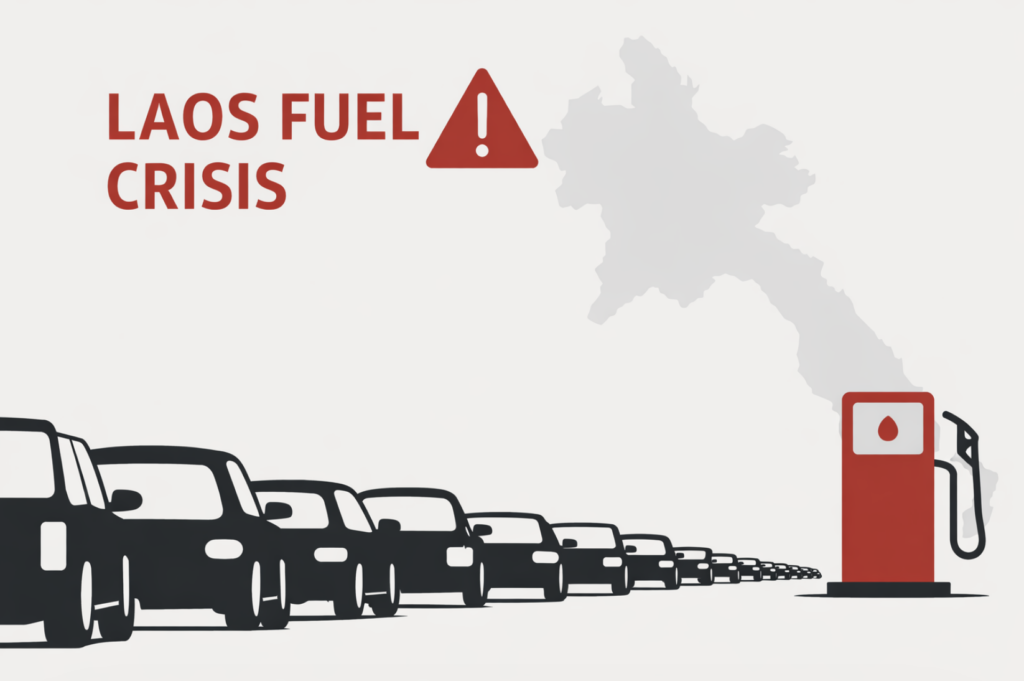
VIENTIANE, Laos — Long queues at petrol stations and the closure of a significant share of fuel outlets across Laos have laid bare the country’s acute vulnerability to global energy disruptions, as geopolitical tensions in the Middle East ripple through Southeast Asia’s tightly linked fuel supply chains.
Supply Disruptions Ripple Through Import-Dependent Economy
The immediate crisis has been driven by a sharp contraction in regional fuel availability. Laos, which imports nearly all of its refined petroleum—primarily from neighboring Thailand—has been hit hard as exports tighten amid global shortages linked to disruptions in key transit routes such as the Strait of Hormuz. The result has been swift and visible: shuttered stations, rationed sales, and wait times stretching for hours in the capital, Vientiane.
Price Surges Intensify Pressure on Households and Businesses
Prices have risen sharply alongside scarcity, with diesel costs surging by as much as 50 percent in recent weeks. The spike has placed additional strain on households and small businesses already coping with inflationary pressures, while analysts note that Laos has experienced one of the steepest fuel price increases globally during this phase of the crisis—underscoring the disproportionate impact on smaller, import-reliant economies.
Government Moves to Stabilize Supply and Contain Public Anxiety
In response, the Lao government has introduced a series of emergency measures aimed at stabilizing supply and easing public concern. Authorities have reduced fuel taxes, deployed subsidy funds, and implemented distribution controls, including mobile fuel deliveries and free public transportation in some areas. Ministries have also been instructed to cut fuel consumption through remote work policies, reduced travel, and energy-saving directives—steps that reflect a broader shift toward crisis management and resilience planning.
Regional Interdependence Amplifies Energy Vulnerabilities
The crisis in Laos is part of a wider regional pattern. Across ASEAN, countries such as Cambodia and Vietnam are facing similar supply constraints or turning to alternative sourcing, highlighting the interconnected nature of regional energy systems. Analysts emphasize that disruptions in one part of the supply chain can quickly cascade across borders, particularly in Southeast Asia, where fuel trade flows are deeply interlinked.
Structural Weaknesses Highlight Need for Long-Term Reform
Energy experts say the current situation exposes deeper structural challenges. As a landlocked country with limited storage capacity and heavy reliance on external suppliers, Laos remains especially vulnerable to external shocks. While the country has positioned itself as a major hydropower exporter, its dependence on imported fossil fuels for transportation continues to be a critical weakness.
Push for Diversification and Energy Transition Gains Urgency
Looking ahead, officials have signaled plans to diversify fuel sources, expand storage infrastructure, and accelerate the adoption of renewable energy and electric mobility. Yet for many citizens, the immediate reality remains uncertain—where access to fuel is no longer guaranteed even for those who can afford it.
The fuel lines stretching across Laos this month are more than a temporary disruption. They reflect how global conflict, regional interdependence, and domestic structural limits can converge—testing the resilience of one of Southeast Asia’s most energy-vulnerable economies.