
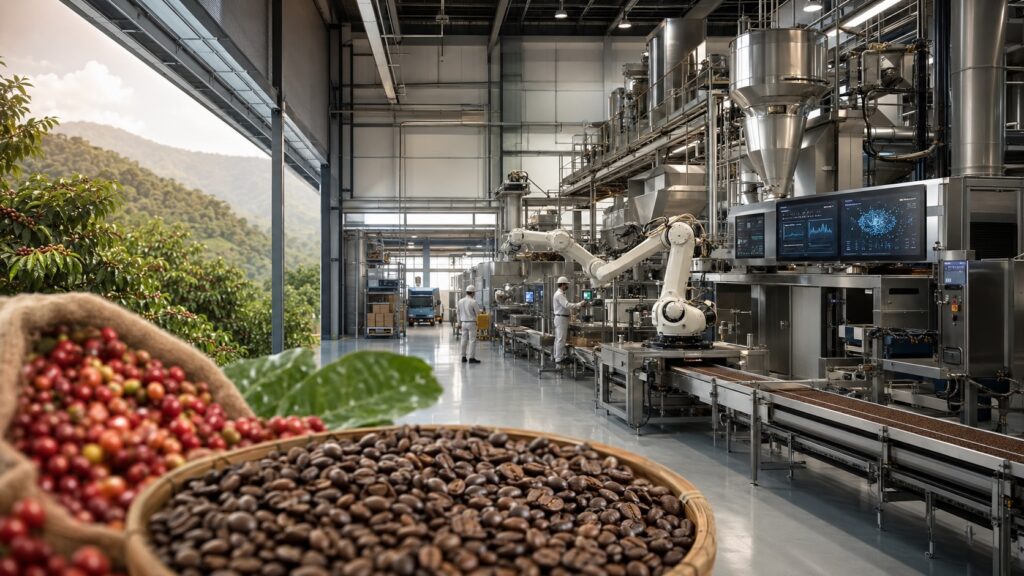
BANGKOK, Thailand — Thailand has approved a 23-billion-baht, or roughly $688 million, investment by Nestlé to build an automated coffee factory and distribution center, one of the country’s largest recent food-manufacturing projects and a significant test of its ambition to move toward higher-value industrial production.
The project, approved by the Board of Investment on July 8, will be built at the Araya Industrial Estate in Samut Prakan Province, southeast of Bangkok. Operations are expected to begin in the fourth quarter of 2028. The complex will serve as a production and logistics hub for Nestlé’s Southeast Asian business, according to the investment board.
The plant will use artificial intelligence, robotic automation and advanced manufacturing systems to produce as much as 170,000 metric tons of Nescafé soluble coffee, coffee mixes and ready-to-drink beverages each year.
Nestlé said the technology would raise efficiency while reducing the facility’s environmental footprint. The project is expected to employ more than 520 Thai engineers and technical specialists.
A Link to Thailand’s Farms
Beyond the factory floor, the investment is intended to reach deeply into Thailand’s agricultural economy.
Nestlé expects to purchase about 4.3 billion baht of Thai-grown coffee, sugar, fresh milk and other raw materials annually. The company also plans to support research into climate-resilient coffee varieties, distribute higher-quality seedlings and provide farmers with training in sustainable cultivation.
“This investment strengthens the entire coffee value chain, from farming and processing to logistics and export,” Narit Therdsteerasukdi, secretary general of the investment board, said in announcing the approval.
Nikhil Chand, chairman and chief executive of Nestlé Indochina, described the project as an expression of the company’s long-term confidence in Thailand and a commitment to its economy, communities and environment.
Thai news organizations have largely emphasized the expected benefits for local farmers and the country’s emergence as an ASEAN coffee-production center. But the extent of those gains will ultimately depend on how much of the plant’s supply chain, technology transfer and skilled employment remains within Thailand.
Part of a Broader Industrial Strategy
The Nestlé project anchors a group of investments worth a combined 66.3 billion baht, or nearly $2 billion, approved as Thailand seeks to capture production being reorganized across Southeast Asia.
Other projects include 14.3 billion baht in aircraft-leasing investments by Thai Airways; a 7.8-billion-baht high-performance computing project by the Thai subsidiary of Japan’s Datasection; advanced electronics manufacturing; and 5.6 billion baht in wind-energy projects.
The package reflects a strategy broader than traditional export manufacturing. Thailand is offering incentives for artificial intelligence infrastructure, advanced electronics, aviation, clean energy and technology-intensive food production. Reuters
Domestic coverage has generally presented the approvals as evidence of renewed investor confidence. The more difficult question is whether highly automated factories will generate sufficiently broad economic benefits. The Nestlé plant’s 520-plus technical jobs are valuable, but relatively modest beside the size of the investment—making agricultural purchasing, employee training and local supplier participation crucial measures of its impact.
Thailand’s Regional Opportunity
The investment arrives as multinational companies reconsider supply chains exposed by geopolitical tensions, shipping disruptions and rising production costs. Thailand is competing with Vietnam, Malaysia and Indonesia for projects that combine regional market access with dependable infrastructure and a skilled industrial work force.
Nestlé’s decision gives Thailand a prominent corporate endorsement. It also places pressure on the country to provide reliable energy, logistics, digital infrastructure and technically trained workers before the factory opens in 2028.
For Thai officials, the project is more than an expansion of coffee production. It is an effort to show that agriculture, automation and regional exports can be joined in a new industrial model—one capable of delivering higher productivity without severing the connection to the farms supplying it.