
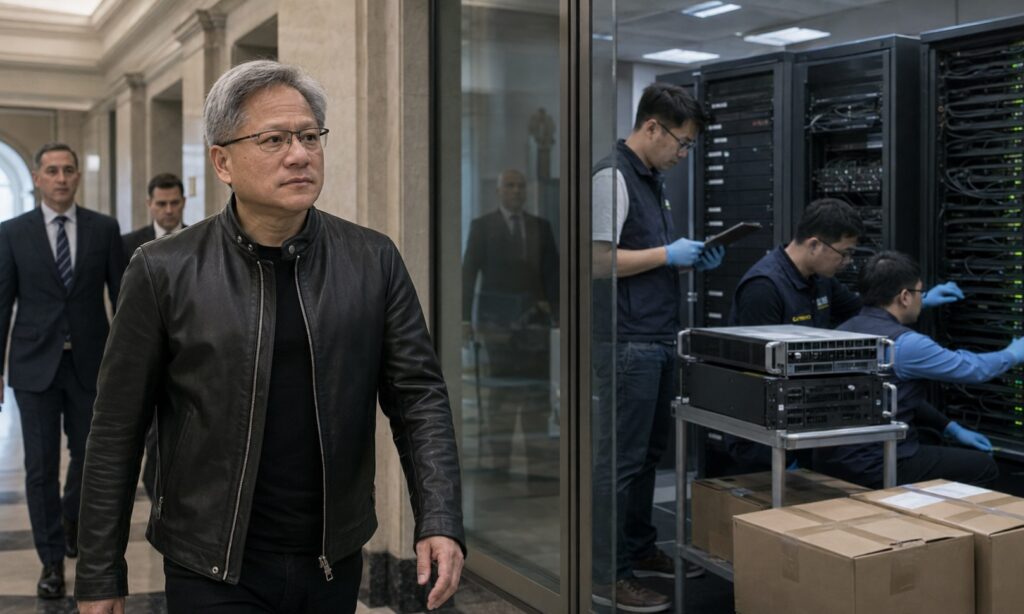
WASHINGTON , USA — Taiwanese prosecutors have detained an Nvidia employee in an expanding investigation into the suspected diversion of advanced artificial-intelligence servers to China, adding a new complication for the chipmaker as its chief executive, Jensen Huang, presses the company’s case with policymakers in Washington.
The arrest was not part of a single operation in which seven Nvidia employees were taken into custody, as some accounts have suggested. Instead, seven people have been detained over several stages of the Taiwanese investigation since May. They include one reported Nvidia employee, two employees of the server manufacturer Super Micro Computer and one employee of the Taiwanese distributor Albatron Technology.
Prosecutors searched the home and workplace of the Nvidia employee, identified only by the surname Chang, on July 24. Taiwanese media reported that the workplace search included his desk at Nvidia’s Taipei office. A court subsequently approved his detention, citing the possibility that he could flee, destroy evidence or coordinate testimony with other suspects. Nvidia itself has not been charged or formally identified as a target of the investigation.
A Shipment Routed Through Japan
The Taiwanese inquiry concerns roughly 50 Super Micro servers containing restricted Nvidia processors. Investigators suspect that false commercial and export documents were used to send some of the equipment through Japan before it reached China.
The hardware was valued at approximately 700 million New Taiwan dollars, or about $22 million. The first servers were seized in May, when prosecutors detained three suspects and searched 12 locations. Later raids targeted Super Micro’s Taiwanese operation, Albatron and the data-center operator Chief Telecom.
Taiwanese authorities are proceeding primarily under allegations of falsifying business records, document forgery and breach of trust. The legal approach reflects an enforcement gap: American export restrictions do not automatically create an equivalent criminal offense under Taiwanese law.
No court has established that the suspects knowingly completed an illegal shipment, and the precise chip configuration of every seized server has not been publicly confirmed. References to GB300 Blackwell processors therefore remain part of the reported allegations rather than a final judicial finding.
Nvidia called smuggling “a nonstarter,” saying it sells mainly through established manufacturers and other partners responsible for observing American export controls. Diverted systems, the company added, would not receive normal support, service or software updates.
Super Micro has said it is cooperating with Taiwanese and international authorities and that the company itself is not a target of the inquiry.
Washington Examines the China Connection
As the Taiwanese investigation widened, Mr. Huang traveled to Washington on July 28 and met Commerce Secretary Howard Lutnick. The meeting came amid American scrutiny of whether restricted Nvidia processors were made available to Chinese artificial-intelligence companies through overseas data centers or intermediary customers.
One line of inquiry concerns Moonshot AI, the Beijing company behind the Kimi K3 open-weight model. American officials have alleged that the company accessed GB300 computing infrastructure in Thailand and have raised separate questions about whether Chinese developers improperly copied capabilities from American models.
Moonshot has disputed the accusations, attributing Kimi K3’s performance to its own architectural and training advances. China’s government has accused Washington of “A.I. hegemonism” and threatened countermeasures if Chinese companies are sanctioned without sufficient evidence.
Treasury Secretary Scott Bessent has said Chinese companies could face financial sanctions or placement on the Commerce Department’s Entity List if large-scale theft of American intellectual property is established. Such measures would further restrict access to American chips, software and business partners.
Chips and Models Become Separate Policy Battles
Mr. Huang also met Senator Mark Warner of Virginia, the leading Democrat on the Senate Intelligence Committee, as Washington debated whether open-weight A.I. systems should face new security restrictions.
Nvidia, Microsoft, Meta and other technology companies have urged policymakers to avoid sweeping limits. Their joint position is that downloadable models encourage competition, research and cybersecurity while reducing dependence on a handful of closed-model providers. Microsoft’s published statement argues that open-weight technology can strengthen both American innovation and technological leadership.
That position broadly aligns with the White House’s existing A.I. Action Plan, which recognizes the economic and geopolitical value of American open-weight models. At the same time, officials are considering more targeted measures against illicit model copying, dangerous capabilities and access to restricted computing infrastructure.
Nvidia and Microsoft have also helped establish the Open Secure AI Alliance, an industry group intended to develop and share security tools for open A.I. systems. The alliance reflects a central argument from the technology industry: openness and security need not be treated as opposites.
A Broader Enforcement Campaign
The Taiwan case forms part of a wider effort to trace advanced processors after they leave authorized manufacturers.
In March, the United States Justice Department charged three people with conspiring to divert approximately $2.5 billion in A.I. servers to Chinese customers. The defendants included Yih-Shyan “Wally” Liaw, a Super Micro co-founder and former senior executive. The allegations remain unproven, and the defendants are entitled to the presumption of innocence.
The newer Taiwanese actions suggest that enforcement is shifting beyond chip designers toward distributors, server manufacturers, freight routes, data-center operators and individual employees. That approach addresses a basic weakness in export controls: a processor may be sold legally to a company in one jurisdiction but later installed in a server, leased through a foreign data center or redirected through several intermediaries.
For Nvidia, the political challenge is particularly delicate. The company must persuade Washington that it can police a sprawling global sales network while simultaneously arguing that American technology should remain available as broadly as national-security rules permit.
The result is a conflict increasingly fought on two fronts: over who may obtain the physical chips that power advanced A.I., and over who may download, modify and build upon the models those chips create.
Sources: Reuters, Keelung District Prosecutors Office, Taipei Times,
U.S. Justice Department, Microsoft, Axios