
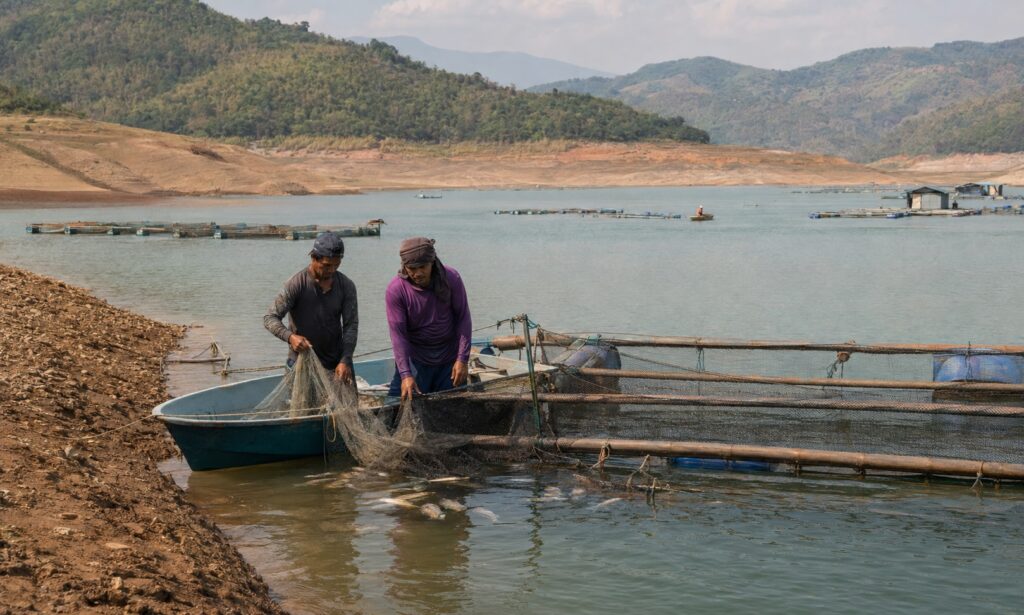
RAMON, Philippines — Along the receding waters of the Magat Reservoir in the northern Philippines, floating cages that once held thousands of market-ready tilapia have become evidence of a livelihood collapsing with the water level.
Weeks of unusually dry and hot conditions have reduced the reservoir’s depth and raised its temperature, contributing to a sharp decline in dissolved oxygen. Unable to escape their cages for cooler or better-oxygenated water, large numbers of fish suffocated during a series of fish kills in late June and July.
The losses have been especially severe in Ramon, a municipality in Isabela Province, and across the reservoir in Alfonso Lista, Ifugao. The Bureau of Fisheries and Aquatic Resources, or BFAR, estimated combined damage at roughly 120 million Philippine pesos, or about $2 million, including approximately 20 million pesos in Ramon and 100 million pesos in Ifugao. Officials said that much of the affected fish stock had been lost.
More than 1,400 fishers and fishing workers were reported affected in and around Ramon, while approximately 30 fish-cage operators suffered substantial direct losses. The figures vary among government and news reports because some assessments count only registered cage owners, while others include laborers, fishing households and related workers.
For families dependent on the reservoir, the disaster is not merely a shortage of fish. It is the sudden disappearance of months of investment in fingerlings, feed, labor and cage maintenance—often just as the fish were approaching harvest.
A Drought in What Should Be the Rainy Season
The crisis has unfolded during a period when much of the Philippines would normally expect regular monsoon rainfall. But rain has been uneven, and parts of northern Luzon have remained hot and dry despite localized storms elsewhere.
PAGASA, the Philippine weather agency, reported in late July that a weak-to-moderate El Niño was present in the tropical Pacific and was likely to intensify and persist into the first half of 2027. The agency estimated a 57 percent probability that El Niño would become strong during the July-to-September season.
An international update released July 31 offered an even more urgent outlook. The World Meteorological Organization said El Niño was steadily intensifying and expected to dominate global climate patterns from August through October, increasing the likelihood of abnormally high temperatures and major shifts in rainfall.
The organization also warned that exceptionally warm oceans and a likely positive Indian Ocean Dipole could amplify drought, flooding and wildfire risks around the Indian Ocean and across parts of Asia.
El Niño does not produce the same conditions everywhere, and individual droughts cannot be attributed to it alone. But in the Philippines, the phenomenon commonly suppresses rainfall, weakens water inflows and raises temperatures—conditions that can be particularly dangerous for reservoirs, fishponds and shallow rivers.
How Heat Turns Water Deadly
The ecological process behind the Magat fish kill is simple but unforgiving.
As reservoir levels fall, the remaining water heats more quickly. Warmer water holds less dissolved oxygen, while reduced circulation allows fish waste, uneaten feed and decomposing organic material to become more concentrated.
Fish crowded in cages consume oxygen continuously but cannot move to deeper water. Oxygen levels often fall lowest during the night and shortly before sunrise, when aquatic plants are no longer producing oxygen through photosynthesis.
“When water levels decrease and temperatures rise, dissolved oxygen also drops,” Jefferson Soriano, head of BFAR Region 2’s Integrated Fish Health Laboratory, explained in a government report. Stressed fish then become more susceptible to disease, parasites and death.
Government figures illustrate the difficulty of measuring a fast-moving disaster. A July 7 assessment said nearly half of the reservoir’s 191 registered cage operators had suffered losses previously estimated at 32 million pesos. A subsequent BFAR assessment covering both the Isabela and Ifugao sections placed damage at 120 million pesos. The difference appears to reflect changing assessment dates and geographic coverage rather than a single settled accounting.
Losses That Spread Beyond the Water
Fish-cage owners bear the most visible financial losses, but the damage extends through the local economy.
Workers hired to feed fish and maintain cages lose their daily wages. Traders and transport operators handle fewer shipments. Market vendors receive less tilapia, while families who combine farming and fishing lose an important source of income at the same time that drought is damaging rice and corn production.
Some operators may be forced to sell surviving fish prematurely and at reduced prices. Others could struggle to repay loans or finance the next production cycle. Restarting the cages will depend not only on replacement fingerlings and capital but also on whether water levels and oxygen conditions become safe.
Large quantities of dead fish can create a second environmental threat. Their decomposition consumes additional oxygen, further degrading water quality and potentially prolonging the period before cages can be restocked.
A Wider Crisis for Philippine Fishing Communities
The effects are not confined to Isabela.
In neighboring Ifugao, communities operating cages on the same reservoir suffered the largest share of the reported financial damage. A separate fish kill struck milkfish farms along the Pata River in Sanchez Mira, Cagayan, where critically low dissolved oxygen was also identified as a likely cause.
By July 21, Cagayan authorities said more than 76,000 hectares of farmland and some local fisheries had been affected by the dry spell, involving nearly 65,000 farmers and agricultural workers.
Elsewhere in the Philippines, inland aquaculture operators face similar risks wherever ponds, rivers and lakes become shallower and warmer. Coastal and marine fishers confront a different version of the crisis: changes in sea temperature, currents and plankton distribution can push fish into deeper waters or farther offshore.
For small-scale fishers using modest boats, following migrating fish means longer trips, greater fuel consumption and higher safety risks—with no guarantee of a larger catch.
The Food and Agriculture Organization has warned that small farmers and fishers typically experience the earliest and most direct effects of El Niño-related drought. It recommends anticipatory measures intended to protect productive assets before losses occur, rather than relying entirely on assistance after a disaster.
Relief Promised, but Prevention Remains Difficult
Philippine officials have promised immediate assistance and longer-term support. House Speaker Faustino Dy III visited Magat Dam in July and met with national agencies, local governments and representatives of affected communities from Isabela and Ifugao. He said their requests had been referred to Agriculture Secretary Francisco Tiu Laurel Jr. and President Ferdinand Marcos Jr. for expedited action.
But the government announcement did not specify the final amount or timetable for financial compensation.
BFAR has stepped up water-quality monitoring and advised operators to harvest marketable fish early, transfer cages to deeper water where possible, reduce stocking density, clean cage nets and avoid excessive feeding. It has also offered water analysis, fish-health investigations, refrigerated transport and connections to institutional buyers so that surviving fish can be sold before they spoil.
Those measures may reduce losses, but they cannot fully overcome a prolonged decline in water levels. Mechanical aeration can restore some oxygen, yet it requires equipment, electricity and money that small operators often lack.
The Magat disaster therefore presents a broader challenge for Philippine climate policy: how to protect food producers whose livelihoods depend on increasingly unstable water systems. Long-term measures would require better early-warning systems, enforceable limits on cage density, emergency harvest protocols, accessible insurance or credit relief, and coordination between irrigation, power-generation and fisheries authorities managing the same reservoir.
For the fishers of Isabela, however, the immediate calculation is much narrower. Their fish are gone, their debts remain, and a strengthening El Niño suggests that the water on which they depend may not recover soon.
Sources: PAGASA, Philippine Information Agency, World Meteorological Organization