
Magnitude-7.8 Tremor Triggers Regional Tsunami Alerts
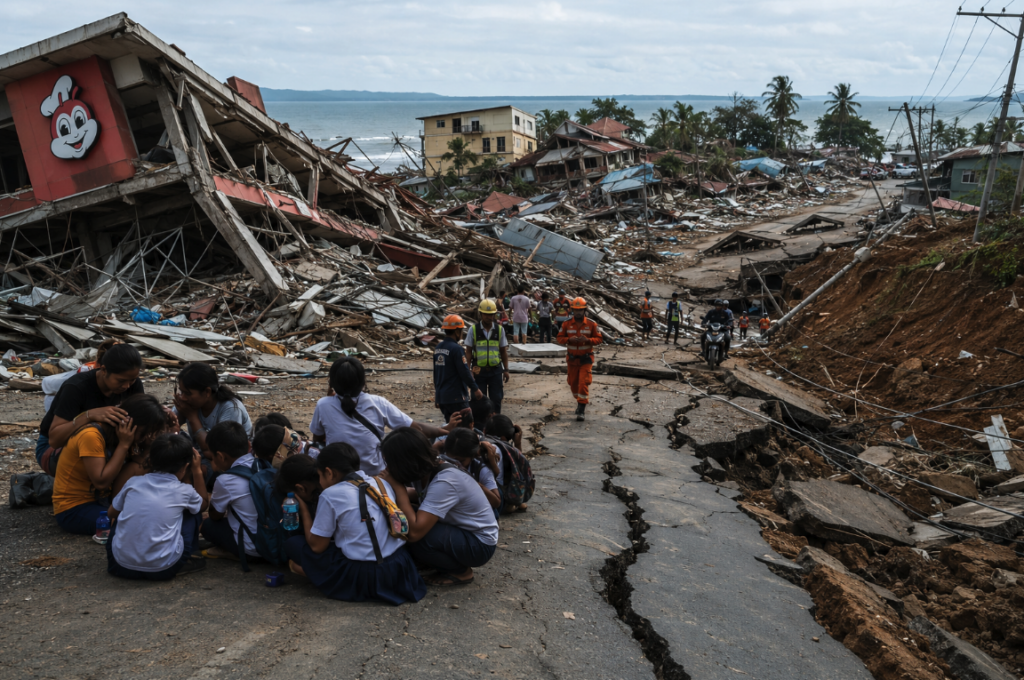
MANILA, Philippines — At least 32 people were killed and more than 100 injured after a powerful magnitude-7.8 earthquake struck off the coast of Mindanao in the southern Philippines early Monday, causing widespread destruction, triggering tsunami warnings across the Asia-Pacific region, and forcing the evacuation of thousands of residents.
The earthquake struck at 7:37 a.m. local time near the southern Philippine island of Mindanao, the country’s second-largest island and home to approximately 26 million people. Authorities reported extensive structural damage, landslides, temporary disruptions to electricity and telecommunications networks, and dozens of aftershocks that continued throughout the day.
Local officials in Sarangani Province, located closest to the epicenter, confirmed at least 17 fatalities, many of them linked to landslides triggered by the seismic event. Across the affected region, nearly two dozen people remain missing, while more than 10,000 residents have been evacuated as a precaution against further geological hazards.
Videos circulating on social media showed buildings collapsing during the quake, including a Jollibee restaurant reduced to rubble. In Davao Occidental, footage from a primary school captured students crouching outdoors as violent shaking rocked the area. A nearby shelter structure collapsed, though school officials reported no injuries.
The earthquake prompted tsunami alerts in the Philippines, Indonesia, Japan, and Australia. While several warnings were later downgraded or cancelled after assessments showed limited tsunami impact, emergency agencies remained on high alert as coastal communities monitored sea-level conditions.
Philippine President Ferdinand Marcos Jr. said national and local authorities were coordinating rescue and relief efforts, pledging that affected communities would receive immediate government support. The president also ordered the suspension of classes in impacted areas, coinciding with the opening day of the new school year.
Seismologists recorded more than 130 aftershocks following the main quake, with magnitudes ranging from 1.3 to 6.7. Experts warned that significant aftershocks could continue for days or weeks, increasing the risk of additional landslides and structural failures.
A Region on the Front Line of Global Seismic Risk
The Philippines sits along the Pacific Ring of Fire, one of the world’s most seismically active zones where several major tectonic plates converge. The country experiences thousands of earthquakes annually, although only a fraction cause significant damage.
Recent years have seen a growing emphasis on disaster preparedness across Southeast Asia as urban populations expand into high-risk coastal and mountainous regions. However, experts note that rapid urbanization, aging infrastructure, and varying building-code enforcement continue to leave many communities vulnerable to major seismic events.
The Mindanao earthquake serves as another reminder of the region’s exposure to large-scale geological hazards. Similar disasters in the Philippines, Indonesia, Japan, and other Pacific nations have demonstrated how earthquakes can quickly evolve into broader humanitarian emergencies when accompanied by landslides, infrastructure failures, and tsunami threats.
International Monitoring and Response
Regional monitoring agencies across the Pacific closely tracked the earthquake and its tsunami potential. Emergency management authorities in neighboring countries issued precautionary advisories as seismic waves propagated across the region.
Disaster-response specialists noted that rapid international coordination and advances in tsunami-warning systems have significantly improved response capabilities compared with previous decades. Nevertheless, the scale of destruction in Mindanao underscores the continuing challenge of protecting vulnerable populations in one of the world’s most earthquake-prone regions.
Philippine disaster authorities are expected to release updated casualty and damage assessments in the coming days as rescue operations continue and access is restored to affected communities.
Key Figures
- Magnitude: 7.8
- Confirmed deaths: At least 32
- Injured: More than 100
- Missing: Nearly 24
- Evacuated residents: Approximately 10,000
- Aftershocks recorded: More than 130
- Strongest aftershock: Magnitude 6.7
- Population of Mindanao: Approximately 26 million
As search-and-rescue teams continue their work, officials warn that casualty figures may rise as assessments reach remote and heavily affected areas. The disaster is likely to renew debate over infrastructure resilience, emergency preparedness, and climate-related disaster management throughout the Asia-Pacific region.