
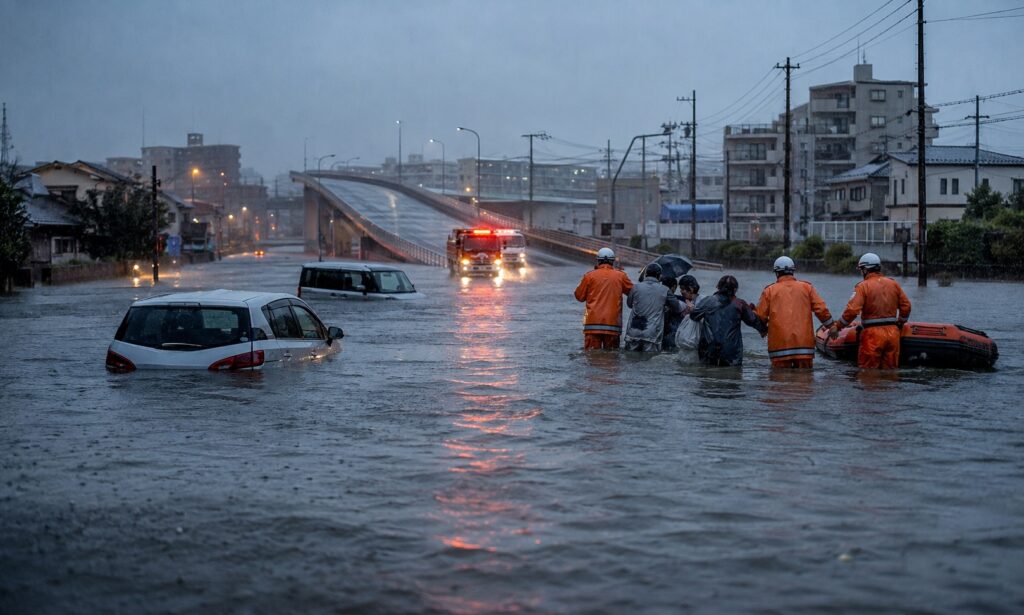
TOKYO, Japan — Record-breaking rain swept across Chiba Prefecture east of Tokyo on Friday, killing at least eight people, cutting power and transport links, and leaving roughly 7,000 travelers stranded at Narita International Airport during Japan’s peak Obon holiday period.
The Japan Meteorological Agency issued its highest-level emergency warning on Thursday, saying the area faced conditions of a scale rarely experienced locally. The alert was later reduced, but officials warned that saturated ground, swollen waterways and disrupted infrastructure still posed serious risks of landslides and further flooding.
More than 360 millimeters of rain fell in parts of Chiba within 24 hours, according to reporting from the region, overwhelming roads, railways and drainage systems. At least one victim was trapped inside a submerged car; others were found in floodwaters or collapsed on streets. Rescue teams, including military personnel, were deployed as evacuation centers filled and electricity and gas service were disrupted.
An Airport Kept Open, but Cut Off
Narita’s runways remained operational, and airlines expected most flights to proceed, though delays were possible. Yet the airport became a symbol of a different vulnerability: a major international hub can continue moving aircraft while passengers remain unable to reach or leave it.
Rail and highway closures severed ground access overnight. Airport staff distributed blankets and supplies, while local government facilities sheltered hundreds more. The episode is likely to sharpen scrutiny of the resilience of transport corridors serving Tokyo’s wider metropolitan region, where dense development and paved surfaces can accelerate runoff when intense rain overwhelms drainage capacity.
A Regional Weather System, Not an Isolated Emergency
Japan’s disaster came after several storms moved across East Asia, affecting Japan, China and the Philippines. Authorities in northern Philippines again suspended classes and government work because of flood risks, while China had earlier evacuated large numbers of residents as Typhoon Dolphin made landfall.
Japan’s meteorological agency attributed the Chiba deluge to a volatile collision of warm, moisture-laden air with colder air aloft — a setup capable of producing sudden, concentrated downpours. The broader regional weather pattern underscores how tropical systems, monsoonal moisture and local atmospheric instability can combine to create disasters far beyond the direct path of a typhoon.
A Warning for Infrastructure in a Warming Asia
No single storm can be attributed to climate change without a formal scientific attribution study. But the event arrives amid a well-established trend: warmer oceans and air increase the moisture available to heavy-rain systems. The World Meteorological Organization says Asia’s climate risks are becoming increasingly interconnected, with record ocean heat and destructive rainfall adding pressure to cities, transport networks and emergency services.
For Chiba, the immediate task remains rescue, restoration and safe evacuation. The longer-term question is whether infrastructure built for yesterday’s weather can withstand the short, violent cloudbursts that are becoming an increasingly central risk across the region.
Source: Japan Meteorological Agency emergency warning information