
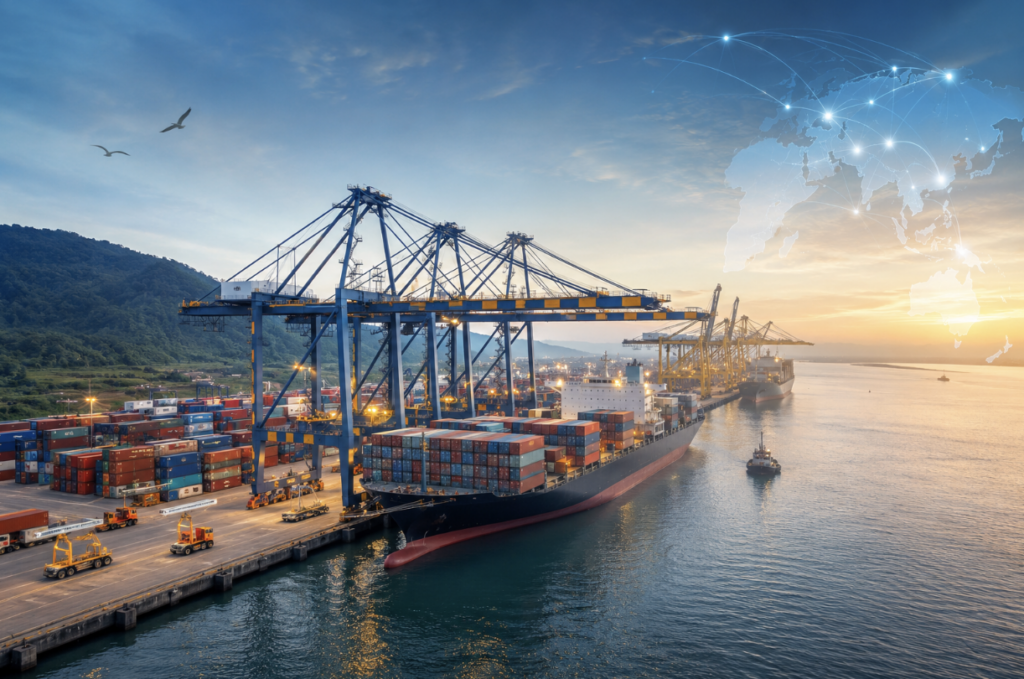
KUCHING, Borneo – Sarawak, the resource-rich Malaysian state on the island of Borneo, is accelerating its transformation into a regional maritime and logistics hub through the development of the modern Tanjung Embang Port and a broader strategy focused on digital infrastructure, automation and ASEAN connectivity.
Speaking at the 65th anniversary celebration of the Kuching Port Authority (KPA), Sarawak Premier Datuk Patinggi Tan Sri Abang Johari Tun Openg said the state’s long-term ambition extends far beyond its domestic population of 2.8 million people. Instead, Sarawak is positioning itself to serve the wider ASEAN market of more than 700 million consumers.
“Geographically, we are at the centre of ASEAN,” Abang Johari said, arguing that Sarawak’s location gives it a strategic advantage over competing ports located farther from the region’s emerging economic corridors.
The remarks come at a time when Southeast Asia is becoming one of the world’s fastest-growing trade and manufacturing regions, driven by supply-chain diversification, rising Chinese investment, and the relocation of industrial production from higher-cost markets.
A Strategic Pivot Toward Regional Trade Leadership
The proposed Tanjung Embang deep-sea port is expected to become a cornerstone of Sarawak’s economic modernization agenda. According to the Premier, the facility will eventually replace operations at Senari Port, which is increasingly constrained by cargo growth linked to industrial expansion and rising trade volumes.
Planned approximately 20 kilometers offshore, the port will feature depths between 13 and 16 meters, allowing large container vessels and bulk carriers to berth directly without tidal or navigational limitations.
Regional analysts say the project reflects a broader trend across Southeast Asia, where governments are investing heavily in maritime infrastructure to capture growing intra-Asian trade flows. ASEAN has become one of the world’s most dynamic economic blocs, with combined GDP projected to surpass several major global economies over the coming decades.
Sarawak’s leadership believes the state can capitalize on several converging advantages:
- Its location between major Northeast Asian economies and Southeast Asian markets;
- Its proximity to China, Hong Kong and South Korea;
- Growing demand for alternative logistics routes amid geopolitical uncertainty;
- Rising investment in energy, manufacturing and digital industries within Borneo.
International logistics experts note that the expansion also aligns with China’s Belt and Road-related regional trade networks, even as ASEAN countries attempt to maintain strategic neutrality amid increasing competition between Washington and Beijing.
Ports of the Future: Digital, Automated and Data-Driven
A central theme of Abang Johari’s speech was the modernization of port management through digitalization and automation.
He emphasized that future port competitiveness will depend not only on physical infrastructure, but also on integrated digital systems capable of processing documentation, customs clearance and cargo tracking before vessels even arrive.
Under the envisioned model, digital transactions and real-time data sharing would reduce turnaround times, improve efficiency and lower logistics costs — a model already being adopted by major global ports in Singapore, Rotterdam, Shanghai and Dubai.
Sarawak officials have increasingly promoted the state’s “digital economy agenda” as part of a broader push to diversify beyond traditional commodities such as timber, oil and gas, and palm oil.
Automation is also expected to play a major role in the future Tanjung Embang ecosystem. According to the Premier, remote-operated cranes, autonomous vehicles and integrated robotics systems are likely to become standard features of port operations in the coming decades.
Industry observers say this reflects the global transition toward “smart ports,” where artificial intelligence, predictive logistics and automated cargo systems are reshaping maritime trade.
Competition and Opportunity in ASEAN’s Maritime Race
Sarawak’s ambitions emerge amid intense regional competition. Singapore remains Southeast Asia’s dominant shipping and transshipment center, while Malaysia, Indonesia, Thailand and Vietnam are all aggressively expanding their own port capacities.
Yet analysts argue Sarawak occupies a unique niche.
Unlike the congested Strait of Malacca corridor, Borneo offers relatively untapped maritime space and direct access to East Asian shipping lanes. The state also benefits from abundant renewable energy resources, particularly hydropower, which could support future industrial parks, green manufacturing and data-center investments linked to port development.
Domestic business groups in Malaysia have largely welcomed the initiative, viewing it as a catalyst for job creation, industrial expansion and foreign direct investment.
However, economists caution that major infrastructure projects carry risks. Large-scale port developments require sustained cargo demand, extensive hinterland connectivity and careful financial planning to avoid underutilized facilities.
Environmental groups have also raised concerns about offshore dredging, coastal ecosystems and the long-term ecological impact of large maritime construction projects around Borneo’s sensitive marine environments.
Sarawak’s Long-Term Vision
For Sarawak’s leadership, the Tanjung Embang project represents more than a transport upgrade. It is part of a larger vision to reposition the state as a strategic gateway between ASEAN and Northeast Asia.
As global supply chains become increasingly fragmented and governments seek resilient alternative trade routes, Sarawak is betting that geography — combined with digital infrastructure and modern logistics — can elevate the state into a more influential role within Southeast Asia’s evolving economic order.
Whether Tanjung Embang ultimately becomes a transformative regional hub will depend on execution, regional integration and the pace of ASEAN’s economic expansion. But the message from Kuching is increasingly clear: Sarawak intends to compete not only within Malaysia, but on the wider stage of Asian trade and maritime commerce.