
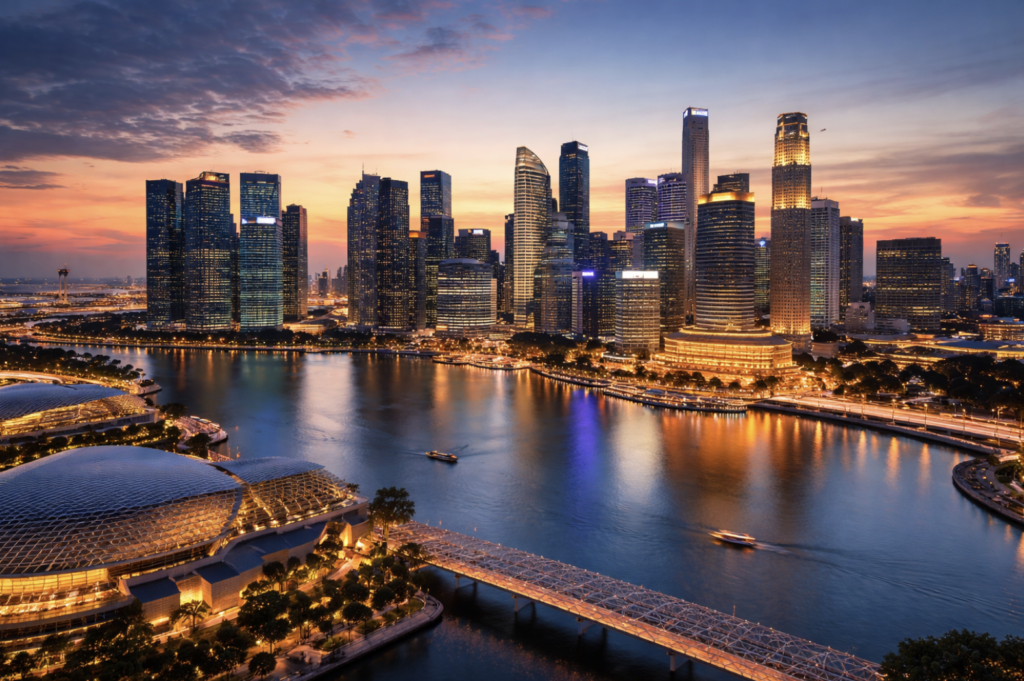
SINGAPORE — As global markets reel from energy volatility and geopolitical fragmentation, Singapore is reaffirming its position as Southeast Asia’s indispensable financial and diplomatic hub, leveraging its role at the crossroads of trade, energy and regional governance.
On April 9, the city-state stood at the center of high-level economic and business engagements within ASEAN, even as it became a focal point of urgent international diplomacy. Australia’s prime minister arrived in Singapore for emergency talks on fuel security, underscoring the country’s critical role as one of the world’s leading refining and energy-trading centers.
A Financial Hub Under Pressure — and Opportunity
Singapore’s economic strength remains rooted in its global connectivity, but recent developments highlight both resilience and vulnerability. The government this week unveiled a nearly $780 million support package to cushion households and businesses from rising energy costs tied to the Middle East conflict.
Officials have warned that growth forecasts of 2 to 4 percent in 2026 could face downward pressure as external shocks intensify, reflecting broader concerns that Singapore’s trade-dependent economy is increasingly exposed to geopolitical disruptions.
Yet analysts note that Singapore’s position as a “bellwether” for global trade — supported by advanced infrastructure, financial services and multinational investment — continues to anchor its influence across ASEAN and beyond.
Aviation and Sustainability Take Center Stage
At the same time, Singapore is positioning itself at the forefront of aviation decarbonization, a sector central to both its economy and its status as a global transit hub.
Authorities are advancing a sustainable aviation fuel (SAF) framework, including a planned levy tied to emissions targets, part of a broader regional push to scale up cleaner fuel production.
Major industry events such as the Singapore Airshow and energy forums continue to reinforce the city’s role as a convening point for global aviation and energy leaders, sustaining a robust Meetings, Incentives, Conferences and Exhibitions (MICE) sector even amid uncertainty.
Travel and MICE: A Strategic Advantage
Singapore’s travel and conference industries remain among the strongest in Asia, supported by liberal aviation policies, extensive air agreements and its reputation for stability and efficiency.
New regulatory adjustments — including updated aviation safety rules — reflect efforts to maintain operational reliability while adapting to evolving international standards.
These sectors are not merely economic drivers but strategic tools, reinforcing Singapore’s role as a neutral meeting ground for governments, corporations and multilateral institutions.
Balancing China, the U.S., and a Fragmenting World
Perhaps most consequential is Singapore’s diplomatic posture. As tensions deepen between major powers, the country continues to pursue a carefully calibrated strategy — maintaining strong economic ties with China while preserving longstanding security and institutional links with the United States.
China remains Singapore’s largest trading partner, and cooperation spans infrastructure, finance and technology, including participation in initiatives like the Belt and Road.
At the same time, Singapore has sought to preserve strategic autonomy, engaging across competing blocs while avoiding formal alignment — a stance increasingly tested as global supply chains, energy flows and security arrangements become more politicized.
A Hub in an Uncertain Era
The convergence of energy insecurity, climate transition and geopolitical rivalry is reshaping the environment in which Singapore operates. Yet these same pressures are reinforcing its relevance.
From anchoring regional finance and hosting high-stakes diplomacy to driving sustainability initiatives in aviation, Singapore is navigating a narrow path — one that demands both adaptability and neutrality in a rapidly changing world.
In that balancing act, the city-state is not merely responding to global shifts; it is helping to define how Southeast Asia engages with them.