
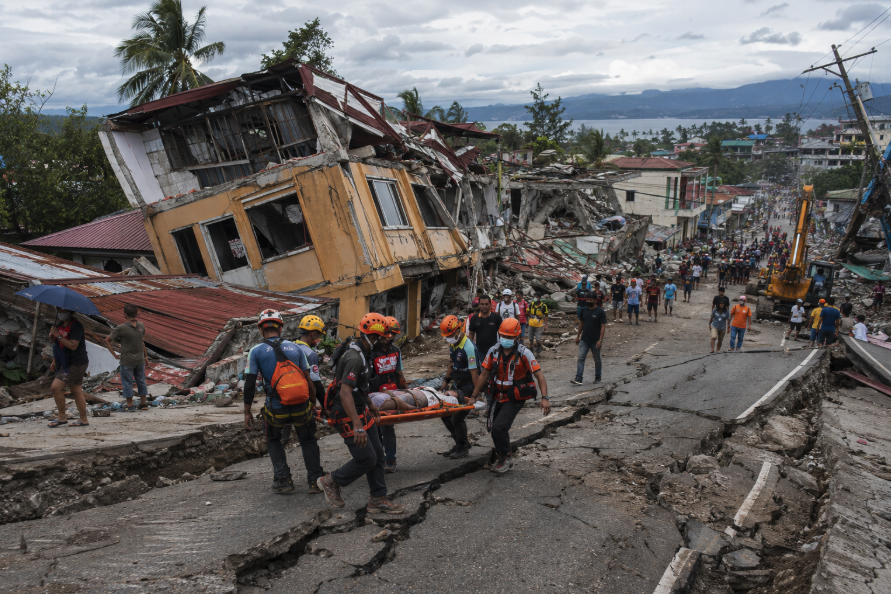
Hundreds of Aftershocks Hamper Rescue Efforts
MANILA, Philippines – The powerful magnitude 7.8 earthquake that struck the southern Philippines on Monday, killed at least 37 people, injuring nearly 500 others, and leaving vast areas of Mindanao struggling with damaged infrastructure, disrupted communications, and ongoing aftershocks.
Emergency crews continued search-and-rescue operations on Tuesday as officials warned that the death toll could rise. More than 500 aftershocks have rattled the region since the main quake, complicating relief efforts and increasing concerns about additional building collapses and landslides.
“We hope the death toll does not increase further, but we are expecting it to move,” Bernardo Alejandro, assistant secretary of the government agency overseeing disaster response, said in a radio interview. “Our priority today is search and rescue.”
Communities Cut Off as Infrastructure Suffers Heavy Damage
The full scale of the disaster is only beginning to emerge as emergency responders gain access to remote coastal towns and cities across Mindanao, the Philippines’ second-largest island.
Authorities estimate that nearly 2,000 homes and approximately 6,000 public schools have sustained damage. Roads have cracked, bridges have been weakened, and landslides have buried key transportation routes. Large sections of the island remain without electricity, mobile communications, or internet access.
Videos captured by residents and surveillance cameras showed buildings collapsing, streets shaking violently, and frightened residents fleeing into open spaces as the earthquake struck during the morning hours.
Tsunami Alerts Trigger Regional Response Across Asia-Pacific
The earthquake also triggered tsunami warnings and coastal evacuations across parts of the Asia-Pacific region. Authorities in Indonesia and Japan issued precautionary alerts, prompting tens of thousands of residents to move to higher ground before warnings were later downgraded.
Regional disaster agencies praised the effectiveness of early-warning systems, which experts say have significantly improved since the catastrophic Indian Ocean tsunami of 2004. While no major tsunami ultimately materialized, the event served as a reminder of the interconnected seismic risks facing countries along the Pacific basin.
A Nation Living on the Ring of Fire
The Philippines remains one of the world’s most disaster-prone countries due to its location on the Pacific Ring of Fire, a vast zone of tectonic activity stretching around the Pacific Ocean. The country experiences thousands of earthquakes annually, along with frequent volcanic eruptions and tropical cyclones.
According to seismologists, Monday’s earthquake was caused by movement along the Cotabato Trench, a major subduction zone located off the southern coast of Mindanao. Such tectonic boundaries are capable of generating some of the world’s strongest earthquakes and tsunamis.
Experts note that while building standards have improved in urban centers, many rural communities remain vulnerable due to aging infrastructure, informal housing construction, and limited disaster-preparedness resources.
International Support Expected as Recovery Begins
Humanitarian organizations and regional governments are closely monitoring the situation as the Philippines enters what could be a prolonged recovery phase. Disaster specialists warn that the economic impact may extend well beyond immediate physical damage, particularly if transportation networks, schools, and public services remain disrupted for an extended period.
The disaster once again highlights the growing importance of resilient infrastructure, modern early-warning systems, and regional cooperation in responding to increasingly complex natural hazards across the Asia-Pacific region.
For residents of Mindanao, however, the immediate challenge remains survival and recovery. As aftershocks continue to shake the island, thousands of families are spending nights in temporary shelters, uncertain when they will be able to return safely to their homes.