
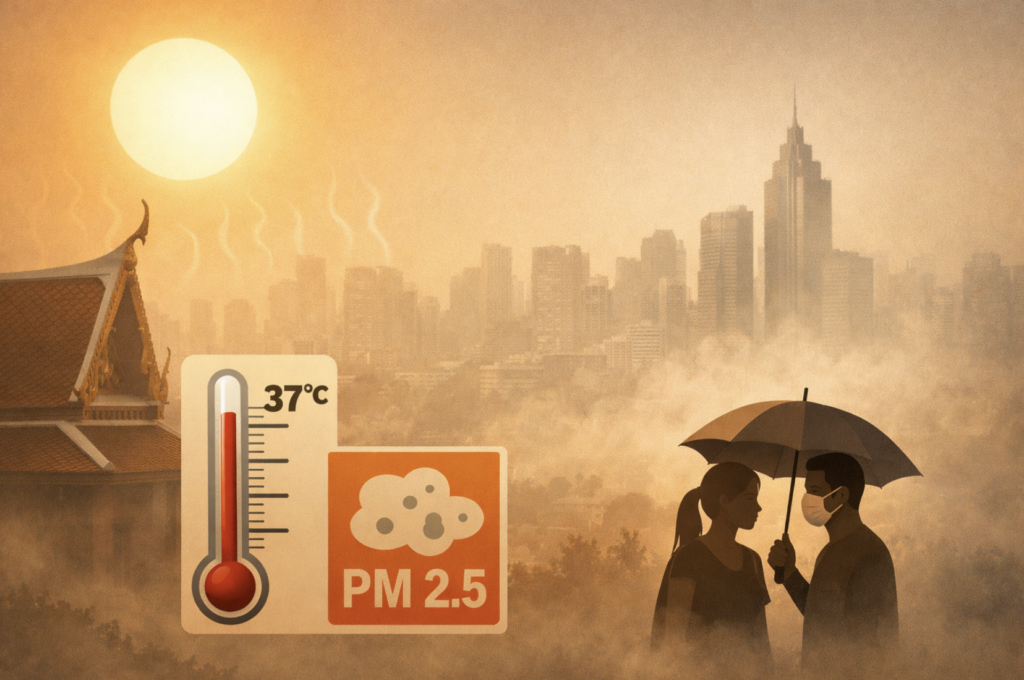
BANGKOK, Thailand – Thailand is confronting an intensifying early-season heat wave that is pushing daytime temperatures close to 37 degrees Celsius across much of the country, while air quality in the Bangkok metropolitan region has begun to deteriorate under elevated fine particulate pollution.
The Thai Meteorological Department (TMD) warned on Monday that extreme heat conditions are expected to persist across large parts of the north, the central plains and eastern Thailand. Meteorologists attribute the surge in temperatures to weakening easterly winds and the influence of a weak high-pressure system extending from China over the northeastern region.
Heat Intensifies Across Northern and Central Thailand
According to the agency’s latest domestic weather analysis, provinces across the northern region — including Chiang Mai, Chiang Rai and Lampang — are experiencing particularly intense daytime heat. Maximum temperatures in several areas are forecast to approach 37°C, with hot conditions extending through the central plains and eastern provinces.
Meteorologists noted that isolated thunderstorms may develop across roughly 10 percent of the northern region. While brief, these storms could bring sudden gusts and localized turbulence, offering only temporary relief from the oppressive heat.
Officials have urged residents to avoid prolonged outdoor exposure during peak afternoon hours and to remain hydrated as the country transitions into what is traditionally the hottest period of the year ahead of the monsoon season.
Bangkok Air Pollution Adds to Health Concerns
At the same time, air quality monitoring indicates that particulate pollution has risen in parts of Bangkok. Data from the government’s Air Quality Information Center recorded PM2.5 concentrations reaching as high as 39.7 micrograms per cubic meter on March 16, levels that fall into the “orange” category of Thailand’s air quality index.
The highest readings were observed in the eastern outskirts of the capital, including the districts of Nong Chok and Lat Krabang. At these levels, health authorities warn that sensitive groups — including children, the elderly and those with respiratory conditions — may begin to experience mild health effects.
The haze has also reduced visibility across parts of the city, adding to concerns that stagnant atmospheric conditions tied to the regional high-pressure system may allow pollution to accumulate in the coming days.
Authorities Monitor Conditions
Thai environmental and meteorological agencies say they are continuing to monitor both heat and pollution levels closely. Officials have encouraged residents to limit outdoor activities when pollution spikes, wear protective masks in affected areas and follow official updates as weather patterns evolve.
Seasonal heat waves are common in Thailand during March and April, but meteorologists note that the combination of high temperatures and worsening particulate pollution can amplify public health risks, particularly in densely populated urban areas.
Authorities say additional advisories will be issued should temperatures or pollution levels rise further in the coming days.