
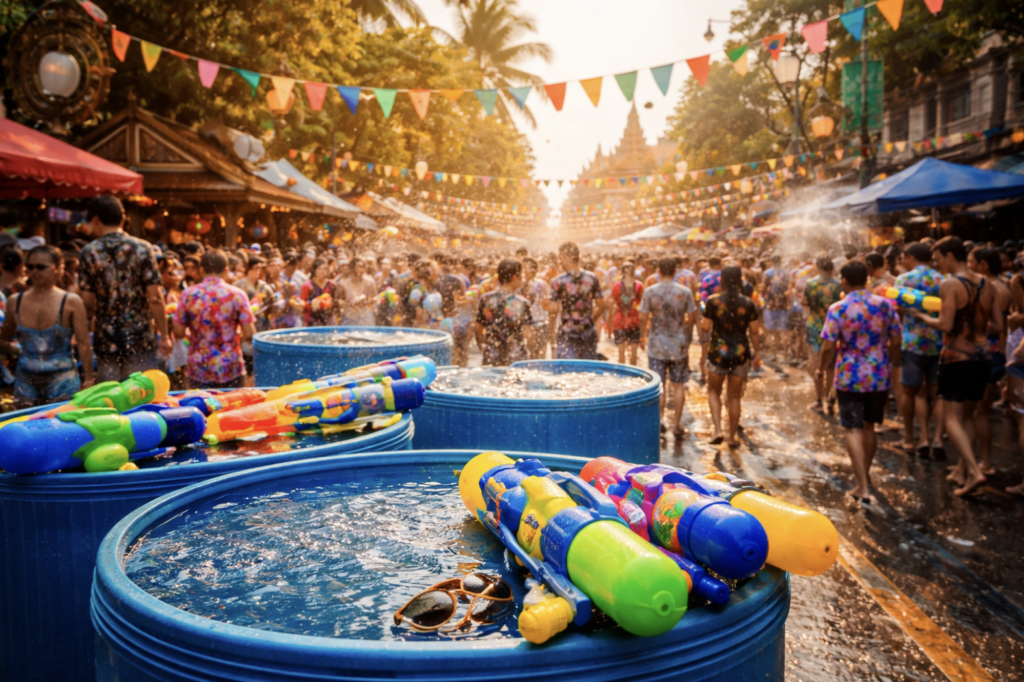
PATTAYA, Thailand – As Thailand approaches the start of Songkran, its world-renowned water festival, anticipation is building across cities from Bangkok to Phuket, where streets are already lined with water tanks and brightly colored water guns. For many, the celebrations have begun early—long before the official start of the three-day holiday on April 13.
In tourist hubs such as Pattaya, spontaneous water fights have erupted days in advance, signaling the arrival of what is often described as the world’s largest water festival. Visitors and locals alike are preparing for days of exuberant street celebrations, where no passerby is spared from a playful soaking.
A Festival of Renewal, Not Just Revelry
Despite its global reputation for high-energy water battles, Songkran is rooted in centuries-old spiritual traditions. Marking the Thai New Year, the festival symbolizes cleansing, renewal, and the washing away of misfortune.
Its origins trace back to ancient Hindu and Buddhist customs tied to seasonal change and solar movement, later evolving into a distinctly Thai celebration of family, respect, and merit-making.
Mornings during Songkran are traditionally reserved for temple visits, offerings to monks, and rituals such as gently pouring water over Buddha statues and elders’ hands—acts meant to bring blessings for the year ahead. By afternoon, however, streets transform into arenas of joyous, large-scale water play.
Nationwide Celebrations With Regional Character
While the festival is officially observed from April 13 to 15, celebrations often extend beyond those dates, particularly in coastal and tourist regions.
Bangkok’s Khao San Road and Silom district draw massive crowds, while Chiang Mai offers a blend of traditional rituals and vibrant street festivities. Pattaya and other areas in Chon Buri province extend celebrations well into late April, attracting visitors seeking prolonged festivities.
Tourism authorities note that Songkran remains one of Thailand’s most significant cultural and economic events, drawing millions of international visitors annually and generating substantial revenue across hospitality and retail sectors.

In Pattaya the water containers are ready for the Songkran festival to start on Monday. Photo: AT/hz

Economic Pressures Temper 2026 Outlook
Yet this year’s festival arrives under more complex circumstances.
Recent international reporting indicates that rising travel costs linked to global energy disruptions may dampen participation and spending. A forecast suggests festival-related expenditure could decline for the first time since the pandemic, with many travelers scaling back plans.
Some regions, including major tourist islands, have reported reduced bookings, particularly among European visitors affected by higher airfare and living costs.
Still, Thai authorities have moved to stabilize the situation—freezing public transport fares and securing fuel supplies to ensure smooth travel during the peak holiday period.
Industry leaders also emphasize that, despite online speculation, festival operations remain fully intact, with infrastructure and tourism services functioning normally.
A Global Celebration Balancing Culture and Commerce
For first-time visitors, Songkran represents a rare convergence of cultural heritage and global tourism spectacle. It is a festival where sacred rituals coexist with exuberant street celebrations—where temple courtyards and neon-lit party zones exist side by side.
Even amid economic uncertainties, the enduring appeal of Songkran lies in that duality: a deeply rooted cultural tradition that has evolved into one of the world’s most recognizable and participatory festivals.
As the countdown begins, one certainty remains: whether in quiet temples or crowded streets, Thailand is preparing once again to welcome the world—with water, tradition, and celebration. (AT/hz)