
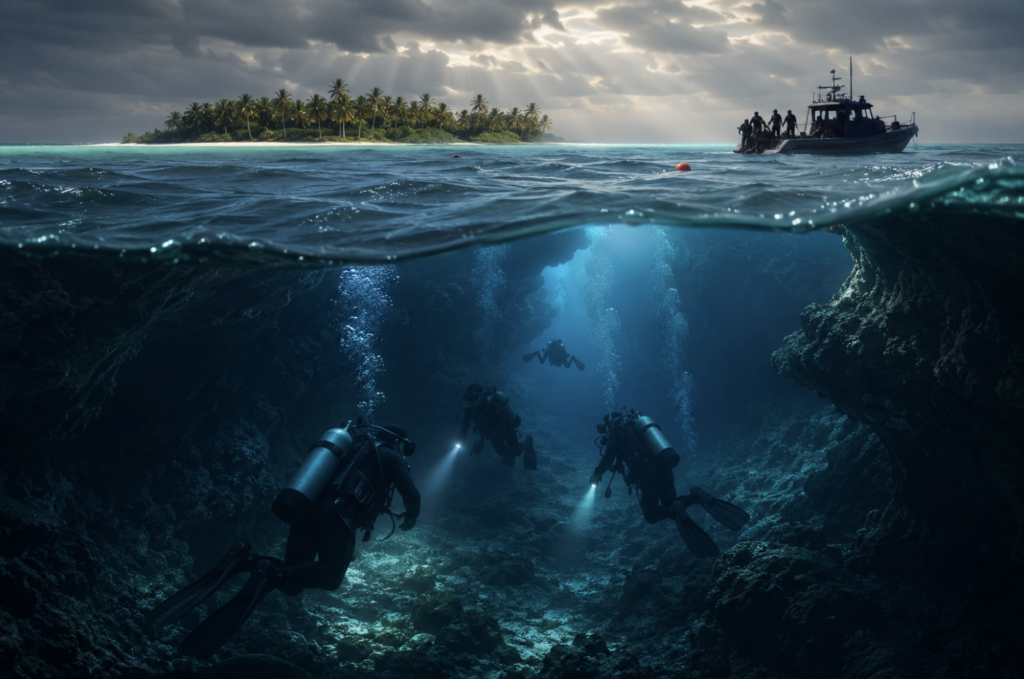
MALÉ, Maldives – What began as a scientific and recreational diving expedition in the turquoise waters of the Maldives has evolved into an international recovery operation marked by technical danger, diplomatic coordination and mounting questions about safety standards in extreme underwater exploration.
Five Italian divers died last week after entering a deep underwater cave system near Vaavu Atoll, southeast of Malé, in what officials now describe as the deadliest diving accident in the history of the Indian Ocean archipelago. A sixth fatality followed when a Maldivian military diver died during recovery efforts after suffering decompression sickness.
On Monday, Maldivian authorities confirmed that the bodies of the remaining four Italian divers had finally been located deep inside the cave’s third chamber following an international search operation assisted by elite Finnish cave-diving specialists.
The tragedy has sent shockwaves through both the global diving community and the Maldives’ tourism industry, where scuba tourism represents a major pillar of the national economy.
A Dive Beyond Recreational Limits
According to Maldivian and Italian officials, the group entered the underwater cave system near Alimathaa Island at depths approaching 50 meters (164 feet), far beyond the Maldives’ official recreational diving limit of 30 meters.
The victims included:
- Monica Montefalcone, an ecology professor from the University of Genoa,
- her daughter Giorgia Sommacal,
- marine biologist Federico Gualtieri,
- researcher Muriel Oddenino,
- and diving instructor Gianluca Benedetti.
Authorities say the divers entered a complex cave network composed of three connected chambers marked by narrow passages, low visibility and powerful currents. Experts involved in the operation described the environment as technically unforgiving even for experienced cave divers.
Benedetti’s body was recovered near the cave entrance shortly after the incident, but the remaining four were discovered much deeper inside the system several days later.
Recovery Mission Turns Into a Second Tragedy
The recovery effort itself quickly became perilous.
Sergeant Major Mohamed Mahudhee of the Maldives National Defence Force died during the mission after suffering decompression illness, forcing authorities to temporarily suspend operations.
His death transformed the incident from a tourism disaster into a national tragedy inside the Maldives. President Mohamed Muizzu attended Mahudhee’s funeral, where the diver was buried with military honors.
International diving analysts have since questioned whether local teams possessed the specialized cave-diving equipment and gas systems necessary for such an operation. Several reports noted that cave recovery missions at those depths typically require trimix gas blends, propulsion systems and advanced decompression planning.
Finnish Specialists Brought Into the Maldives
As conditions worsened, the Maldives requested assistance from highly specialized Finnish cave divers associated with Divers Alert Network Europe (DAN Europe).
The team — equipped with underwater scooters, advanced breathing systems and technical cave-recovery expertise — ultimately located the missing bodies after navigating through the cave’s inner sections during a three-hour dive operation.
Officials say rough seas and strong currents repeatedly delayed recovery attempts. Yellow weather warnings had already been issued for maritime traffic in the region on the day of the dive.
Investigators Examine Possible Causes
With no survivors from the original dive team, investigators are attempting to reconstruct the final moments through dive profiles, equipment analysis and cave mapping.
Several theories have emerged from international diving experts:
Oxygen Toxicity and Gas Mix Concerns
Italian diving specialists suggested oxygen toxicity may have played a role if the divers used enriched-air nitrox mixtures at unsafe depths. At around 50 meters, elevated oxygen partial pressures can trigger seizures, confusion and unconsciousness underwater.
Panic and Zero Visibility
Underwater medicine experts also pointed to the possibility of panic or disorientation within the cave system. In confined environments, a single equipment issue or stress reaction can rapidly cloud visibility through disturbed sediment, trapping divers in darkness.
Strong Indian Ocean Currents
Unlike calmer Mediterranean dive conditions familiar to many European divers, the Indian Ocean’s currents around Vaavu Atoll are known to shift rapidly and intensify during unstable weather.
Licensing and Operational Questions
Authorities are additionally investigating whether the dive vessel involved in the expedition possessed authorization for technical deep-cave operations. Several reports indicate the vessel’s operating permissions may not have covered dives beyond standard recreational depth limits.
A Shock to the Global Diving Community
The deaths have resonated far beyond the Maldives because many of the victims were experienced divers and researchers involved in marine science and environmental work. Greenpeace Italia and academic institutions in Italy issued tributes following confirmation of the fatalities.
Within the international diving world, the incident has reignited debate over:
- the growing popularity of technical cave tourism,
- the commercialization of extreme dives,
- safety oversight in remote destinations,
- and the risks of deep exploration in tropical tourism zones increasingly marketed to advanced divers.
For the Maldives — a nation globally associated with luxury tourism, coral reefs and idyllic diving holidays — the disaster represents an unusually dark moment beneath waters more often linked to postcard imagery than international recovery operations.
As recovery teams prepare the final extraction of the victims, investigators continue piecing together how a routine dive excursion evolved into a catastrophe that claimed six lives and exposed the unforgiving realities hidden beneath one of the world’s most celebrated tourist destinations.