
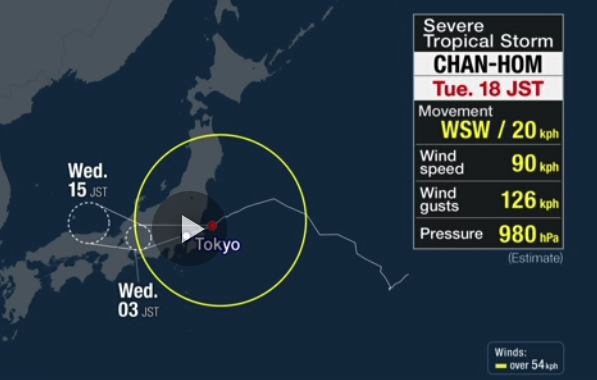
TOKYO, Japan — Typhoon Chan-hom made landfall in Ibaraki Prefecture on Tuesday night after moving westward across the Pacific toward Japan’s Kanto region, an unusual track that prompted warnings of heavy rain, damaging winds and dangerous seas around Tokyo and northeastern Honshu.
The Japan Meteorological Agency said Chan-hom — Japan’s 15th named typhoon of the year — had been about 230 to 260 kilometres east of Iwaki, Fukushima Prefecture, on Tuesday morning. It carried sustained winds near its centre of roughly 83 kilometres an hour, with gusts up to 126 kilometres an hour, and a central pressure of 985 hectopascals.
By late Tuesday, the storm had crossed Ibaraki, north-east of the Tokyo metropolitan area. The agency expected it to weaken as it moved west across Honshu and toward the Sea of Japan.
A Rare Route Toward the Kanto Coast
Tropical cyclones that threaten Japan more commonly curve north-eastward under prevailing westerly winds. Chan-hom instead travelled from east to west, raising the prospect of abrupt changes in wind direction and rapidly building waves along the Pacific coast.
The landfall was historically unusual: Japan’s weather agency said it was the first typhoon known to make landfall in Ibaraki since comparable records began in 1951. The broader lesson for authorities is that a storm need not be exceptionally intense to create serious local hazards when its path is unfamiliar and its rain bands interact with Japan’s mountainous terrain and densely populated coastal corridor.
Rain, Waves and Transport Risks
Forecasters warned that eastern and northeastern Japan could receive intense rainfall through Wednesday, with further rain possible into Thursday. Earlier forecasts put potential 24-hour totals as high as 180 millimetres in Tohoku and 150 millimetres in Kanto-Koshin, while waves off the Pacific coast were expected to reach roughly seven metres.
The principal dangers were landslides, overflowing rivers, urban flooding in low-lying districts, lightning and sudden gusts. Officials also cautioned that summer-holiday travellers could face rail, road and air disruptions and urged them to review local hazard maps and alter plans where necessary.
More than 19,000 households in the Kanto region reportedly lost electricity during the storm, largely in Ibaraki, with additional outages in Tochigi, Gunma and Chiba prefectures.
Part of a Wider East Asian Weather Emergency
Chan-hom’s arrival came as East Asia was already dealing with disruption from Typhoon Dolphin, which brought severe flooding to parts of eastern and central China and caused major transport cancellations in Shanghai. The overlap illustrates the regional challenge of managing multiple rain-producing systems during the Northwest Pacific typhoon season: even storms that weaken quickly can retain broad, hazardous rain fields.
For Japan, the immediate concern is less the storm’s peak wind strength than the combined effect of heavy rainfall, rough seas and infrastructure disruption across the country’s most populous economic region.
Sources: Japan Meteorological Agency
Map: NHK