
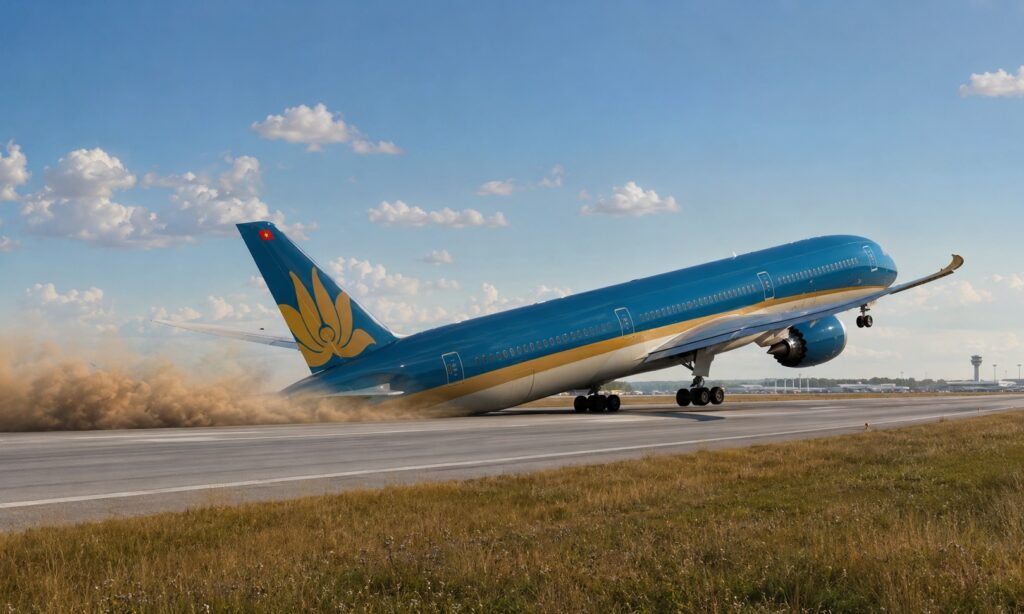
MUNICH, Germany — A Vietnam Airlines Boeing 787-9 bound for Hanoi returned safely to Munich Airport on Saturday after an exceptionally long takeoff was followed by warnings involving the aircraft’s tail and tire pressure, according to the latest official account.
Flight VN34, operated by the aircraft VN-A867, departed Munich’s southern runway, 26L, at 1:57 p.m. local time. The jet did not become airborne until it had reached a portion of the runway rarely used during departures, an airport spokesman said. Videos showed a large cloud of dust rising behind it near the runway’s end.
The Civil Aviation Authority of Vietnam subsequently said the cockpit received a warning indicating possible contact between the aircraft’s tail and the runway, as well as tire-pressure alerts. That statement is the clearest official acknowledgment so far of a potential tail strike, although it does not establish precisely what the aircraft hit or confirm that it left the paved surface. Reports of a runway overrun and damage to equipment beyond the runway remain unverified.
A Long Hold Before the Return
After takeoff, the crew informed air-traffic controllers of the warnings and abandoned the flight to Hanoi. The aircraft remained near Munich for more than two hours, generally at about 9,000 feet, before returning.
The extended hold would have reduced the landing weight of a jet fueled for a flight of more than 10 hours. Video and passenger accounts appeared to show fuel being released from the wings, but neither the airport nor the airline had officially confirmed a fuel jettison as of Monday.
Recordings also appeared to show the crew making two low passes over runway 26R, apparently so that personnel on the ground could inspect the landing gear before touchdown. The procedure has been described in local reporting but not formally detailed by investigators.
Smoke and tire debris were visible when the aircraft landed. The airport confirmed damage to the tires and landing gear, and the Dreamliner was unable to leave the northern runway under its own power. Passengers disembarked by mobile stairs and were taken to the terminal. None of the 271 passengers or 16 crew members was injured.
The disabled aircraft temporarily closed the northern runway, forcing other traffic onto the southern runway. It was later towed to a hangar. Airport crews collected tire fragments and repaired damaged pavement, and normal operations resumed Sunday morning after limited overnight delays.
Airline Arranges Replacement Travel
Vietnam Airlines said the crew followed prescribed procedures and landed safely. The carrier described the event only as a “technical issue” and said it was cooperating with the authorities.
By late Sunday afternoon in Vietnam, all affected passengers had been offered alternative travel on Vietnam Airlines or other carriers, according to the airline. Accommodation, meals and ground transportation were provided while travelers waited, and additional assistance was offered to those who needed to revise their itineraries.
Passengers interviewed by Vietnamese news organizations described an unusually long acceleration, followed by a loud noise, vibration and a tense wait in the air. Cabin crews reviewed emergency procedures and instructed passengers on protective positions before the return, according to those accounts.
Why the Aircraft Needed So Much Runway
The cause remains unknown, and the available videos do not show whether the problem arose from an aircraft malfunction, incorrect takeoff data, an abnormal rolling resistance or another factor.
Investigators are likely to examine the aircraft’s actual weight and center of gravity; the takeoff speeds entered by the crew; the flap and thrust settings; engine performance; braking and wheel behavior; and whether foreign objects or damage affected the landing gear. The flight-data and cockpit-voice recorders could establish how quickly the jet accelerated and when the crew began rotating the aircraft for takeoff.
Conditions at Munich were demanding but not extraordinary. The temperature was about 33 degrees Celsius, with variable winds of only three knots. Heat reduces air density, while the absence of a meaningful headwind increases the required ground speed. Both conditions can lengthen a takeoff, but they are standard inputs in the performance calculation made before every departure. They therefore cannot, by themselves, explain the exceptional takeoff roll.
Nor does the video establish that the pilots simply waited too long to act. Once an aircraft passes its calculated decision speed, known as V1, rejecting the takeoff can be more dangerous than continuing because insufficient runway may remain for the aircraft to stop. Investigators will need the calculated V1 and rotation speeds, together with recorded acceleration data, before assessing the crew’s decisions.
Incorrect takeoff parameters are a recognized industry hazard. In 2025, the European Union Aviation Safety Agency proposed requiring takeoff-performance monitoring systems on some large aircraft to alert crews when erroneous data or an incorrect starting position produces unsafe acceleration. There is no evidence so far that either problem occurred on VN34.
German Investigators to Lead
A representative of Germany’s Federal Bureau of Aircraft Accident Investigation, or BFU, was called in, according to the airport. The agency had not publicly identified a cause or released a preliminary report by Monday.
Because the event occurred in Germany, German authorities are responsible for leading the investigation under international aviation rules. Vietnam’s aviation authority said it was seeking information from its German counterpart and would participate in the inquiry.
For now, the confirmed record is limited but serious: an exceptionally long takeoff, cockpit warnings involving the tail and tires, a precautionary return and substantial tire and landing-gear damage. Whether the jet overran the runway, physically struck its tail or sustained additional damage to its composite fuselage will depend on the technical examination — not the dramatic images circulating online.
Sources: ICAO, EASA, VDI, VietNamNet, Münchner Merkur, CAA,
BR24
Picture: AI generated