
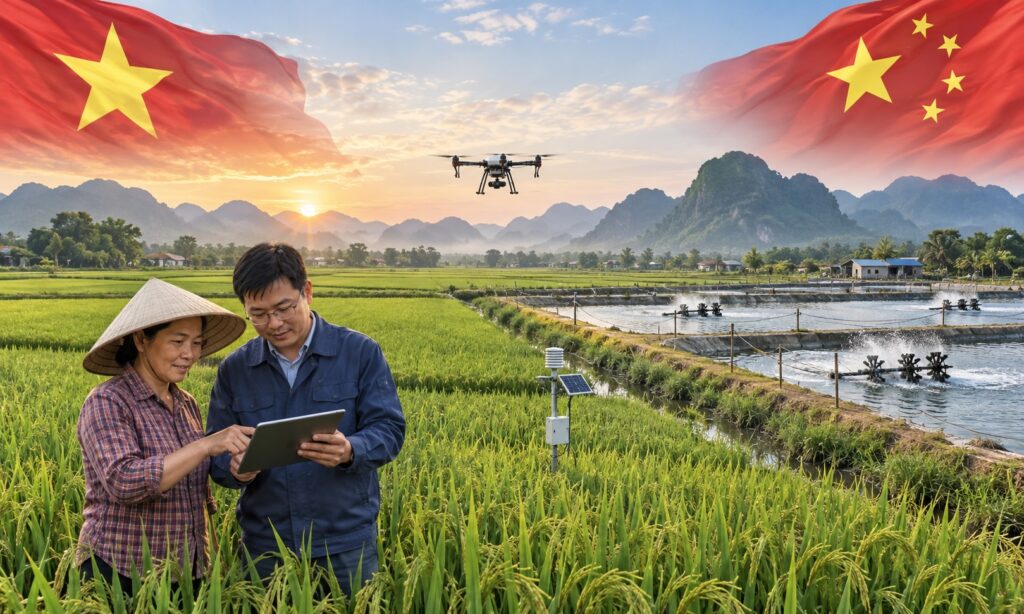
HANOI, Vietnam – Vietnam and China are seeking to extend their agricultural relationship beyond food shipments into the technologies that determine how food is grown. The opportunity spans automated irrigation, crop monitoring and intelligent aquaculture. The harder task is turning those capabilities into dependable gains for Vietnam’s small farmers.
In a September 15 interview, Wei Longbao, an agricultural economist at Zhejiang University, outlined the potential match: Vietnam needs practical tools to modernize fragmented production, while China has developed extensive capabilities in agricultural machinery, digital management and breeding. He also identified obstacles, including uneven infrastructure, limited technical expertise and differences in standards.
From Trade to Joint Production
Recent diplomacy gives the proposals a concrete foundation. Meeting in Hangzhou on August 24, the two countries’ agriculture ministers agreed to strengthen scientific cooperation, facilitate trade and pursue access for additional products. China expressed readiness to cooperate on artificial breeding of ornate spiny lobster, connecting research with sustainable production and export requirements. Another joint agricultural committee meeting is planned during Vietnam’s APEC activities in 2027.
Vietnamese and Chinese officials have emphasized complementary priorities. At a bilateral forum in June, Vietnamese representatives called for stronger processing, traceability and logistics. Chinese Ambassador He Wei advocated closer cooperation across agricultural supply chains and greater use of digital technology. Together, those positions suggest an ambition to coordinate production and distribution more closely.
For Vietnam, the potential benefit is greater value from its agricultural exports. For Chinese suppliers, the emerging opportunity includes equipment, technical services and partnerships extending beyond individual sales.
The Small-Farm Economics
The Chinese projects cited by Wei offer an indication of what technology might achieve. A precision maize project in Shanxi reportedly increased average yields by 15.5 percent while reducing irrigation water use by 40 percent. A smart shrimp-farming project in Jiangsu reportedly raised output by about 20 percent and lowered production costs by more than 15 percent. These remain reported project results, rather than independently established forecasts for Vietnamese farms.
The economics of adoption may prove more consequential than the sophistication of the machinery. Wei proposed shared services: cooperatives or specialist operators could purchase drones, equipment and management systems, allowing farmers to pay for their use. Such arrangements could spread investment costs, improve equipment utilization and concentrate operational expertise.
That approach would still require reliable maintenance, accessible training and trials across Vietnam’s different ecological regions. Higher yields alone would be an incomplete measure of success; farmers would need to retain additional income after service charges, financing and repairs.
Infrastructure Will Shape the Outcome
International investment highlights the importance of the systems surrounding farms. On September 14, the World Bank announced three approved projects totaling $666.74 million for Vietnamese transport, urban resilience and fisheries. The package includes $155.52 million for sustainable fisheries, with plans to modernize nine fishing ports. Mariam J. Sherman, the bank’s regional division director, emphasized the connection between lower transport costs, competitiveness and employment.
A separate partnership between CABI and Vietnamese and Chinese agricultural research institutions offers a model for building local expertise. Its biological pest-control program combines research, training and field demonstrations, with techniques adapted to Vietnamese farming conditions.
These parallel efforts suggest that durable progress will depend on connecting technology with institutions farmers can use. Locally tested equipment, functioning service networks and credible quality controls would give the bilateral partnership a stronger foundation—and make its benefits visible in rural incomes.
Sources: Vietnam Plus, CABI, World Bank