
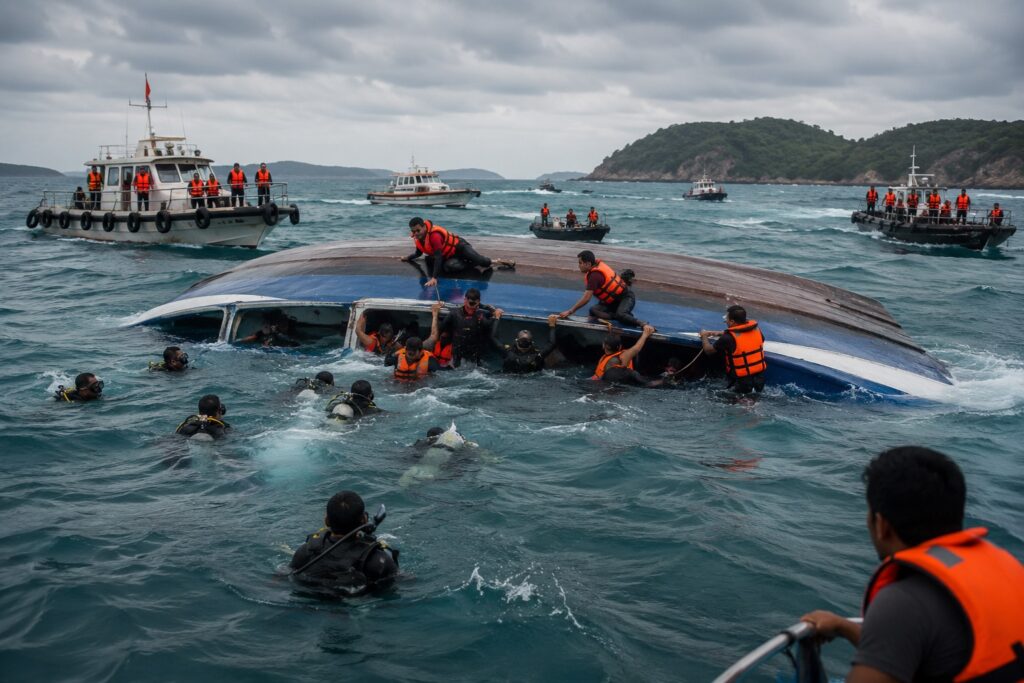
PHU QUOC, Vietnam — A sightseeing excursion off Vietnam’s southern resort island of Phu Quoc turned tragic on Saturday after a tourist speedboat carrying 32 Indian visitors and four crew members capsized approximately 400 meters from shore, leaving 15 Indian tourists dead and 21 others rescued, according to Vietnamese authorities.
The vessel overturned while returning from Hon May Rut Ngoai Island to An Thoi Port, an increasingly popular route among international visitors exploring the island archipelago surrounding Phu Quoc. Witnesses described strong winds and heavy swells despite the absence of rainfall, with the boat reportedly rolling over within moments, leaving many passengers little time to escape.
Victims Trapped Beneath Overturned Hull
The rescue operation began almost immediately as nearby tourist boats rushed toward the scene before border guards, coast guard personnel, naval units and emergency responders arrived.
Rescuers said one of the greatest challenges was that multiple passengers became trapped inside the overturned vessel, forcing emergency teams to conduct difficult underwater recovery operations while waves continued to batter the area. Several survivors were hospitalized, with some reported in critical condition.
Vietnamese authorities confirmed that all 15 fatalities were Indian nationals.
Preliminary Findings Point to Rough Seas
Officials have not yet released a final cause of the accident.
Initial assessments indicate that rough sea conditions, large waves and strong winds likely played a central role in the capsize. Authorities emphasized that investigations remain ongoing and have not attributed the tragedy to mechanical failure, operator negligence or regulatory violations.
Prime Minister Pham Minh Chinh ordered an immediate investigation and instructed relevant agencies to review operational safety procedures governing tourist vessels, emergency preparedness and weather-related sailing decisions.
India Activates Emergency Response
The Embassy of India in Vietnam established dedicated emergency control rooms in both Hanoi and Ho Chi Minh City, working alongside Vietnamese authorities to identify victims, assist survivors and provide support to affected families.
Several Indian state governments also activated assistance mechanisms after learning that many passengers originated from southern India. Indian media reported that the deceased included tourists from Tamil Nadu, Andhra Pradesh and Kerala. Domestic Analysis: Renewed Focus on Tourist Boat Safety
Vietnamese media and maritime observers have noted that the accident is likely to intensify scrutiny of safety management within the country’s rapidly expanding marine tourism sector.
Among the issues expected to receive attention are:
- Voyage decisions during deteriorating sea conditions.
- Real-time weather monitoring for tourist operators.
- Passenger evacuation procedures.
- Enforcement of life-jacket regulations.
- Emergency rescue coordination near popular island destinations.
The tragedy also revives broader concerns following previous high-profile maritime tourism accidents in Vietnam, prompting renewed discussion over whether existing safety protocols are sufficient as international tourism continues to rebound.
A Growing Tourism Market Faces New Questions
Phu Quoc has become one of Southeast Asia’s fastest-growing island destinations, aided by expanded international air connections and rising visitor numbers from India.
The accident has cast a shadow over one of Vietnam’s flagship tourism regions and raised fresh questions about balancing tourism growth with maritime safety, particularly during periods of unpredictable coastal weather.
As investigators continue examining the vessel, weather records and operational procedures, authorities in both Vietnam and India say their immediate priority remains supporting survivors, assisting bereaved families and determining precisely how a sightseeing trip so close to shore ended in tragedy.
Photo: AI Generated