
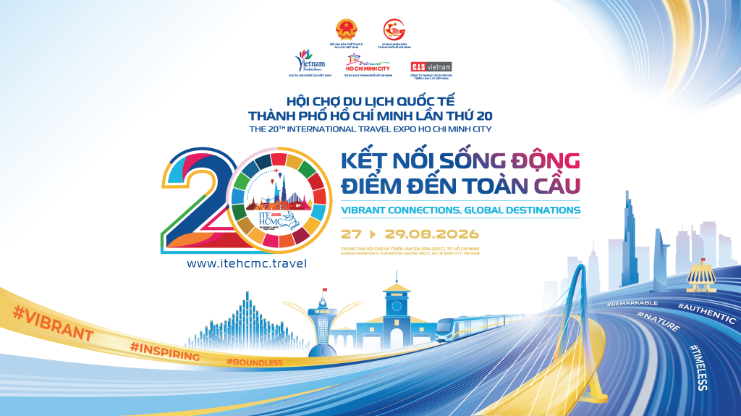
HO CHI MINH CITY, Vietnam — Vietnam will use the 20th Ho Chi Minh City International Travel Expo, scheduled for Aug. 27–29 at the Saigon Exhibition and Convention Center, as more than a showcase for hotels, airlines and tour operators. It is being positioned as a forum for tourism diplomacy, technology investment and regional cooperation at a moment when Vietnam is seeking to convert a powerful post-pandemic recovery into longer-term economic influence.
Organizers expect more than 520 exhibitors and brands, 260 hosted international buyers from over 40 markets, roughly 21,000 pre-arranged business meetings and about 30,000 visitors. The scale remains a projection ahead of the event, but the official program confirms the dates, venue and participation of Vietnam’s tourism authorities.
From Visitor Growth to Commercial Value
The expo arrives after a landmark year for Vietnamese tourism. The country received an estimated 21.5 million foreign visitors in 2025, exceeding its pre-pandemic peak, and has set a 2026 target of 25 million international arrivals, 150 million domestic trips and about $45 billion in tourism revenue.
That backdrop gives ITE HCMC a strategic purpose. Vietnam is no longer merely promoting itself as a low-cost destination; it is trying to sell higher-value travel, including meetings and incentives, medical tourism, cultural experiences and digitally enabled journeys. Its proposed forums on artificial intelligence, destination-brand management and sustainability reflect the shift from simple visitor-count marketing toward a broader competition for spending, investment and international visibility.
The country’s momentum is notable when compared with the global market. International tourism grew 4 percent worldwide in 2025, while Vietnam reported substantially faster growth. Yet the global outlook has become less certain: UN Tourism said international arrivals rose only 2 percent in the first quarter of 2026, as geopolitical disruption and higher travel costs tempered demand.
A Mekong Meeting Point
The most consequential element of the event may be outside the exhibition hall. Ho Chi Minh City is set to host tourism ministers from the Cambodia–Laos–Vietnam, ACMECS and Cambodia–Laos–Myanmar–Vietnam cooperation frameworks. Such meetings could advance joint routes, cross-border products and coordinated promotion across the Mekong region — areas where fragmented transport links and differing visa policies still limit tourism’s potential.
For Vietnam, the diplomatic calendar also reinforces Ho Chi Minh City’s claim to be a regional MICE hub. The city is seeking to combine business events, cultural programming and public tourism promotion into an economic-development strategy, supported by public-private partnerships with airlines, technology companies and international travel groups.
The Measure Will Be What Happens After the Expo
ITE HCMC’s hosted-buyer model — in which qualified overseas buyers are matched with local sellers before the fair — is designed to create transactions, not just publicity. The real test, however, will be whether the planned meetings lead to contracts, new routes, repeat visitors and stronger spending per traveler.
With global travel growth slowing from its rebound years, Vietnam’s challenge is increasingly one of quality: protecting destinations, improving infrastructure and ensuring that tourism’s gains reach local communities. ITE HCMC 2026 may offer a useful measure of how far the country has progressed — from recovering demand to shaping it.