
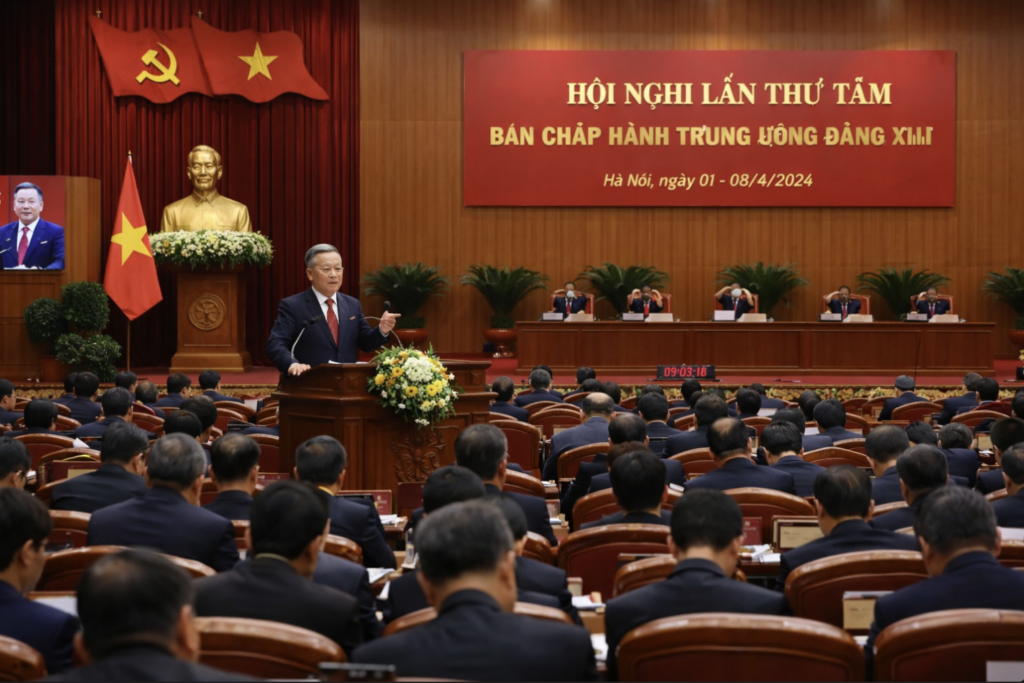
HANOI, Vietnam — Vietnam’s ruling Communist Party opened a pivotal weeklong plenum on Monday that is expected to shape the country’s top state leadership for the 2026–2031 term, while also confronting a harsher external environment marked by geopolitical conflict, volatile energy prices and growing pressure on export-led economies. Party chief To Lam is widely expected to be nominated for the presidency, a move that would place the country’s most powerful political post and the largely ceremonial head of state role in the hands of one leader. Parliament is expected to take up final confirmations when it convenes on April 6.
In opening remarks carried by the government, Mr. Lam said the plenum would review personnel for senior state posts and consider broader questions of governance, anti-corruption enforcement and Vietnam’s next five-year socio-economic plan. The meeting, which runs through Friday, comes just two months after Mr. Lam was reappointed as Communist Party general secretary, further cementing his dominance over Vietnam’s political system. Reuters has reported that his bid to also become president has been widely read by analysts as a step toward a more centralized model of rule, one that some compare to China’s consolidation of top party and state offices.
The political choreography is unfolding against an unusually difficult economic backdrop. Vietnam’s leadership has set a striking target of more than 10 percent annual growth for 2026–2030, presenting it as the foundation for a faster climb up the industrial value chain. But outside economists have treated that goal with caution. Reuters reported in January that the World Bank was then forecasting average growth of about 6.5 percent this year and next, far below Hanoi’s aspiration; other published projections cited by Vietnamese policy reporting similarly place 2026 growth closer to the 6 to 7 percent range unless reforms, infrastructure spending and private investment accelerate sharply.
That gap between political ambition and market expectations has become more pronounced as the widening war involving Iran has driven up energy costs. Reuters reported that Vietnam’s gasoline prices have risen about 50 percent and diesel about 70 percent since the conflict began, prompting Hanoi to fast-track a shift to E10 ethanol-blended gasoline, encourage fuel-saving measures and push incentives for electric vehicles and renewable energy. The government has framed those steps not only as climate policy, but as a response to mounting energy-security risks for an import-dependent economy.
International institutions have issued broader warnings that reinforce those concerns. The International Monetary Fund said last week that a prolonged rise in oil and gas prices could lift inflation and reduce global output, noting that every sustained 10 percent increase in energy prices can add roughly 0.4 percentage points to inflation and shave 0.1 to 0.2 percent from output. With Brent crude above $100 a barrel and transport and fertilizer costs also under strain, the IMF said the duration and severity of the conflict could materially alter the global outlook in its next update. For Vietnam, whose growth model remains heavily tied to trade, manufacturing and imported energy, those risks are especially acute.
Domestic officials have argued that the answer lies in deeper structural change rather than retrenchment. Vietnamese policy planning documents and state-linked analysis have emphasized institutional reform, public investment, science and technology, and stronger private-sector participation as the engines needed to close the distance between current growth and the party’s long-term goals. That argument has gained urgency as Mr. Lam’s government tries to reassure investors that political consolidation will be matched by administrative streamlining and business-friendly reform, rather than simply tighter central control.
At the same time, the anti-corruption campaign remains central to the party’s political message. Supporters inside Vietnam present it as an effort to improve discipline and restore faith in public institutions; critics and some outside analysts have long argued that such campaigns can also serve to remove rivals and unsettle bureaucratic decision-making. The question for investors and diplomats is whether the next phase under Mr. Lam will produce cleaner, more predictable governance — or whether fear of scrutiny will continue to slow approvals and complicate investment execution in sectors from infrastructure to energy. Reuters reported in January that some analysts saw Mr. Lam’s reappointment as a sign of continuity and stability for foreign investors, even as they warned that dual office-holding could weaken Vietnam’s tradition of collective leadership and internal checks.
For now, the plenum is less a routine party meeting than a test of how Vietnam intends to govern through a more dangerous decade. The leadership is trying to present a unified formula: tighter political control, continued anti-corruption pressure, administrative reform and a growth strategy bold enough to keep Vietnam attractive to manufacturers and investors looking for an alternative production base in Asia. Whether that formula can withstand a worsening external shock — and whether Parliament’s expected confirmations next month will formalize a new concentration of power around Mr. Lam — may determine not just who governs Vietnam, but how resilient its economic model proves to be.