
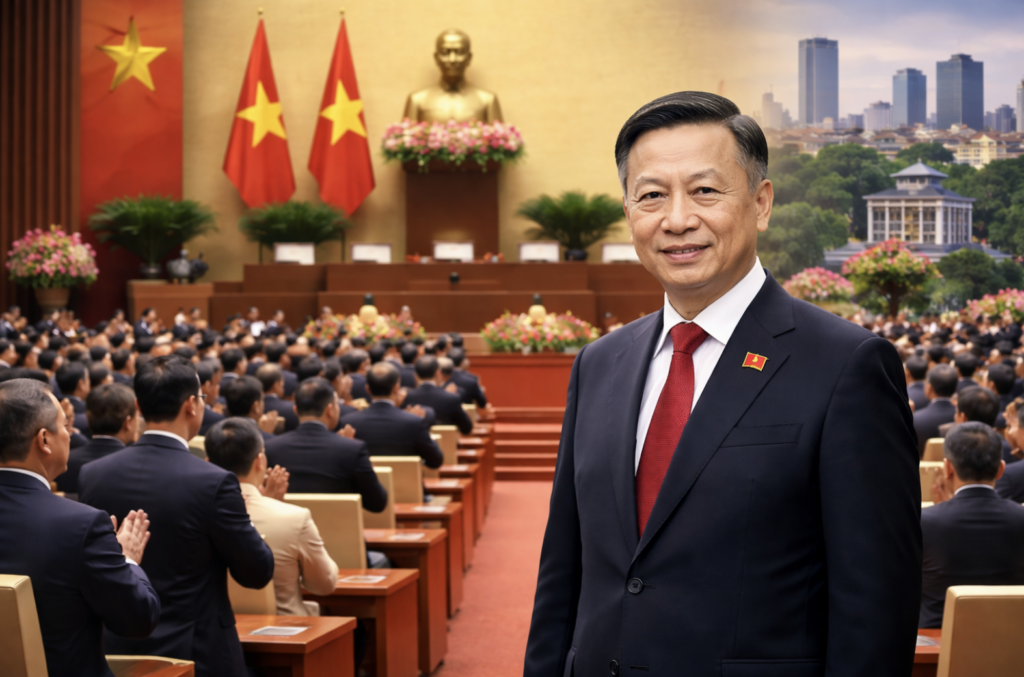
HANOI, Vietnam -Vietnam’s National Assembly has formally elected To Lam as president, consolidating his authority as both head of state and general secretary of the Communist Party — a rare concentration of power that marks a notable departure from the country’s long-standing model of collective leadership.
The unanimous vote by the 500-member legislature follows January’s party congress, where key political decisions are traditionally finalized. With this appointment, Mr. To emerges as Vietnam’s most powerful leader in decades, reshaping the balance of authority within one of Asia’s fastest-growing economies.
A Break From Collective Leadership
For years, Vietnam has operated under a “four pillars” — recently expanded to five — system, distributing power among top party and state roles to prevent dominance by any single figure. Mr. To’s dual role signals a shift toward a more centralized structure, drawing cautious comparisons to governance trends in neighboring China under Xi Jinping.
Yet analysts emphasize that Vietnam’s system still retains internal checks. The Communist Party’s Politburo and Central Committee continue to exert influence, limiting the scope of unilateral decision-making.
“While To Lam is clearly first among equals, he remains accountable to the broader party leadership,” noted regional experts, pointing to Vietnam’s tradition of consensus-building within its 19-member Politburo.
Rise Through Anti-Corruption Campaign
Mr. To’s ascent has been closely tied to his tenure as minister of public security, where he oversaw an expansive anti-corruption campaign. The effort, widely popular with the public, led to the removal or prosecution of numerous high-ranking officials, including potential political rivals.
His consolidation of power accelerated in 2024 after political upheaval, including the resignation of President Vo Van Thuong and the death of long-serving party chief Nguyen Phu Trong. Mr. To temporarily assumed both top roles before securing them formally this year.
Domestic Tensions and Institutional Limits
Despite his strengthened position, reports suggest unease within certain elite circles, including elements of the military, over the merging of the party and state’s highest offices. These concerns reflect broader sensitivities about preserving institutional balance within Vietnam’s political system.
Still, Mr. To has demonstrated an ability to build alliances across factions — a critical factor in his rise and continued authority.
Strategic Balancing: China, Growth, and Reform
Internationally, Mr. To’s leadership comes at a time of delicate geopolitical positioning. Vietnam maintains close party-to-party ties with China, even as public sentiment remains wary of its northern neighbor due to historical tensions.
In January, President Xi congratulated Mr. To and reaffirmed bilateral cooperation, signaling continuity in diplomatic relations between the two socialist states.
At the same time, Vietnam continues to deepen ties with Western economies and regional partners, seeking to diversify supply chains and attract foreign investment amid global uncertainty.
Economic Ambitions Face Global Headwinds
The defining test of Mr. To’s leadership may ultimately be economic. His government has set ambitious targets to elevate Vietnam to upper-middle-income status within two decades, backed by planned structural reforms, industrial upgrading, and digital transformation.
However, analysts warn that achieving these goals will require navigating a volatile global economy, shifting trade dynamics, and domestic structural challenges.
Outlook
Mr. To Lam’s consolidation of power marks a pivotal moment in Vietnam’s political evolution. While it signals stronger centralized leadership, the durability of Vietnam’s consensus-driven governance model — and the country’s ability to sustain rapid economic growth — will determine whether this shift strengthens or strains its long-term trajectory.