
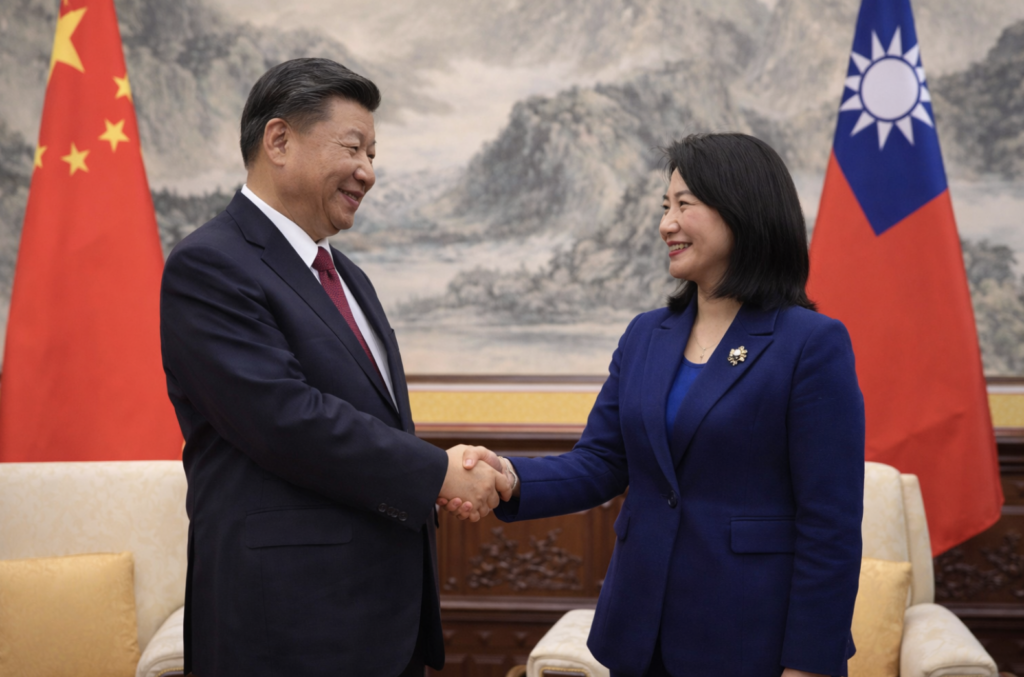
BEIJING, China — In a rare and politically charged encounter, China’s President Xi Jinping met with Cheng Li-wun, the newly appointed leader of Taiwan’s largest opposition party, the Kuomintang (KMT), marking the first such high-level exchange in nearly a decade.
During the meeting, broadcast live by Chinese state media, Mr. Xi reiterated Beijing’s longstanding position that Taiwan’s reunification with mainland China is historically “inevitable.” He emphasized that, regardless of shifting international dynamics, the “trend” of closer ties between people on both sides of the Taiwan Strait would not change.
Ms. Cheng, who assumed leadership of the KMT in November, framed the visit as a step toward stabilizing cross-strait relations. She called for institutionalized mechanisms to promote peace and reduce the risk of conflict, advocating expanded dialogue and cooperation with Beijing. After the meeting, she said that war could be avoided if both sides opposed formal Taiwanese independence — a stance aligned with Beijing’s core demands.
Her visit, however, has drawn criticism at home in Taiwan, where some accuse her of being overly conciliatory toward China. The trip comes ahead of a planned visit to the United States, adding to its political sensitivity.
A Return to Dialogue After Years of Silence
High-level communication between Beijing and Taipei effectively ceased in 2016 after the election of Tsai Ing-wen of the Democratic Progressive Party (DPP), which rejects China’s territorial claims over Taiwan. Since then, tensions have escalated, with Beijing increasing military pressure and diplomatic isolation efforts against the island.
China continues to view Taiwan as part of its sovereign territory and has repeatedly stated it would not rule out the use of force to achieve reunification. Taiwan, meanwhile, operates as a self-governing democracy with strong public support for maintaining its de facto independence.
Global Implications and Strategic Calculations
The timing of Ms. Cheng’s visit carries broader geopolitical implications. Analysts note that Beijing may be seeking to cultivate ties with Taiwan’s opposition as a counterweight to the DPP, particularly ahead of future elections on the island. For the KMT, engagement with China is part of a long-standing platform favoring reduced tensions and economic cooperation.
In Washington, the meeting is being closely monitored. The United States remains Taiwan’s primary security partner and has continued to supply defensive arms to the island. Officials are also watching the visit in the context of an anticipated trip by Donald Trump to China, which could reshape diplomatic dynamics in the region.
Recent international analysis suggests that cross-strait relations are entering a more complex phase. While Beijing’s rhetoric on reunification has hardened, it is also experimenting with selective engagement strategies. Meanwhile, Taiwan’s internal political divisions — particularly between the KMT and DPP — are becoming increasingly relevant to regional stability.
Balancing Peace and Pressure
Ms. Cheng’s call for dialogue reflects a broader concern shared by many in the region: the risk of miscalculation leading to conflict. Yet critics argue that framing peace as contingent on opposing Taiwanese independence aligns too closely with Beijing’s narrative and may undermine Taiwan’s democratic autonomy.
Experts say the meeting underscores a central paradox in cross-strait relations: even as military tensions rise, political channels — however limited — remain crucial for managing risk.
For now, the encounter signals a tentative reopening of dialogue, but also highlights the deep divisions — within Taiwan and between global powers — that continue to define one of the world’s most sensitive geopolitical flashpoints.