
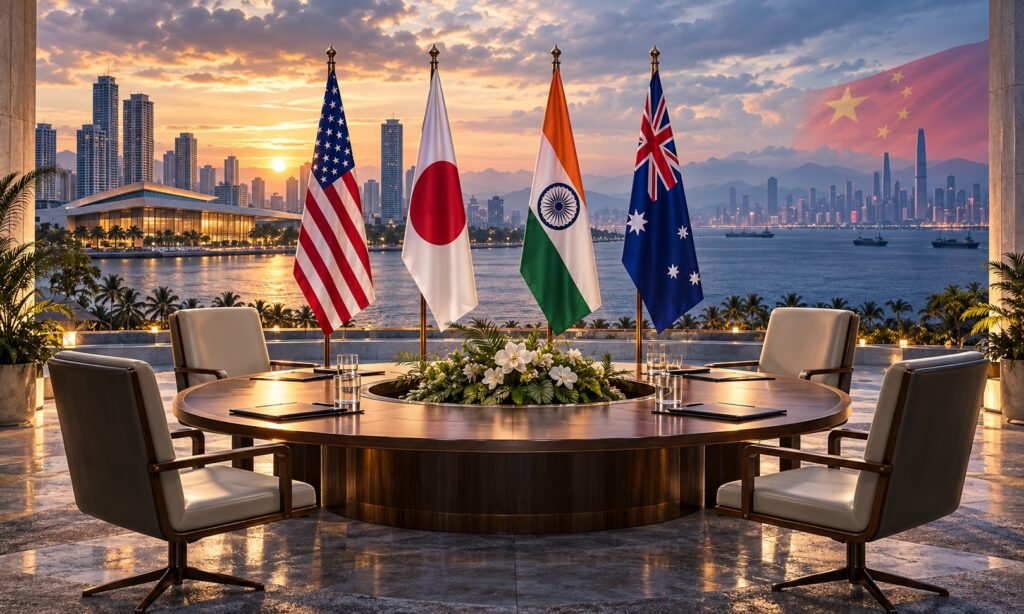
MANILA, Philippines – The United States, Japan, Australia and India are preparing to hold a Quad summit in Manila next month, Secretary of State Marco Rubio said, setting up a consequential diplomatic sequence: consultations with Washington’s Indo-Pacific partners before President Trump’s expected meeting with China’s leader, Xi Jinping. The gathering would be the Quad’s first leaders’ summit since September 2024 and the first of Trump’s second term.
Speaking to India’s Network18 on October 20, Rubio said the four countries had agreed to meet alongside the ASEAN summit, scheduled for November 16–18. The precise date remained unsettled. Trump is subsequently expected in Shenzhen for the November 18–19 Asia-Pacific Economic Cooperation summit.
Repairing the Relationship With India
The Manila meeting would follow the failure to convene a planned summit in India in 2025. That interruption unfolded amid deteriorating U.S.-Indian relations, including friction over trade and New Delhi’s purchases of Russian oil. In a May assessment, Akriti Vasudeva Kalyankar of Washington’s Stimson Center identified the bilateral downturn as a likely contributor to the summit’s collapse—an analytical judgment rather than an established, single explanation.
Rubio now presents the relationship as improving. In a separate interview with The Indian Express, he said a trade agreement was nearly complete and could be finalized within weeks. But he also acknowledged the competing pressures on Washington: measures intended to influence Russia could damage relations with India, while Trump’s decision to waive penalties had drawn criticism at home.
India’s response has been more restrained. On October 22, Foreign Minister S. Jaishankar confirmed progress but warned that negotiations remained unfinished. “It’s never done till it’s done,” he said. His caution suggests that renewed strategic engagement should not yet be mistaken for a settled economic relationship.
Reassurance Before the China Talks
The summit’s timing gives Washington an opportunity to strengthen coordination before engaging Beijing. Japan’s Jiji Press interpreted the sequence as potentially improving Trump’s diplomatic position ahead of his expected talks with Xi. Rubio, meanwhile, has defended an approach to China that combines resistance to policies Washington considers harmful with efforts to prevent destabilizing confrontation.
For regional partners, that balance has immediate security implications. Japan’s July account of Quad ministerial talks emphasized opposition to coercion and concerns about restrictions on critical minerals. Australia describes the partnership as a central element of its foreign policy, with practical work spanning maritime surveillance, supply chains and disaster response. These are established priorities; November’s specific commitments remain to be announced.
The Philippine setting adds urgency. On October 19, Manila summoned China’s ambassador over remarks it regarded as threatening force. Beijing rejected that interpretation, saying the envoy had been selectively quoted. Separately, Philippine Ambassador Jose Manuel Romualdez signaled possible meetings of the “Squad”—the United States, Japan, Australia and the Philippines—underscoring Manila’s interest in stronger security coordination. That grouping is distinct from the Quad, which includes India and is not a formal military alliance.
The Test Is What the Summit Delivers
Despite the interruption in leaders’ meetings, Quad cooperation has continued: foreign ministers met in May and July, and programs cover maritime information-sharing, critical minerals, energy security and emergency assistance. Rubio has promised substantive announcements in Manila.
The central test will be whether the leaders attach durable commitments to that work. A successful gathering could demonstrate that cooperation survives bilateral disputes and shifting relations with China. Its significance will depend on implementation long after the summit photographs.