
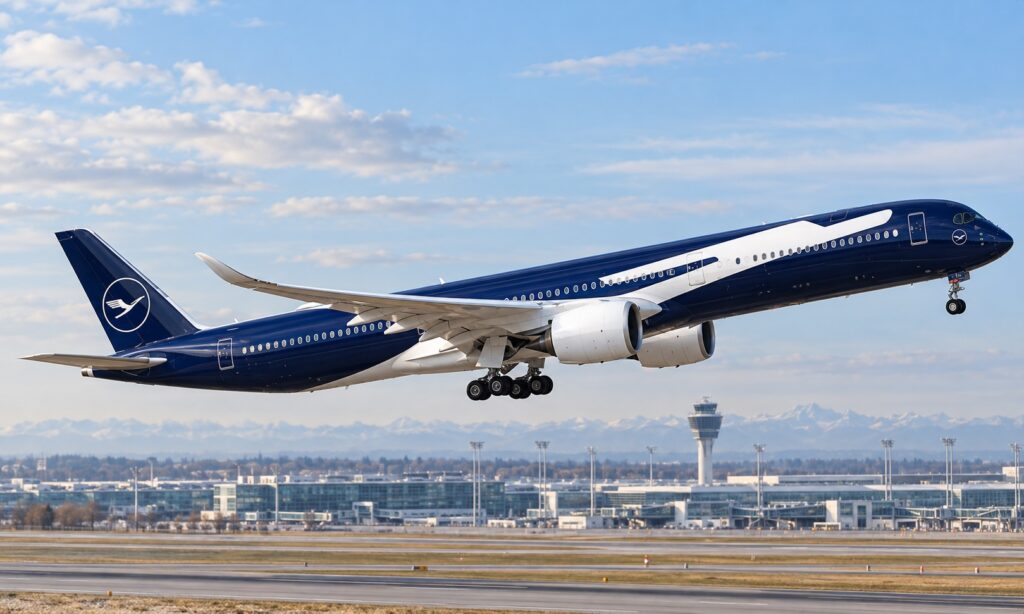
FRANKFURT, Germany – Lufthansa’s first Airbus A350-1000 is scheduled to enter passenger service on December 3, flying from Munich to Tokyo Haneda before expanding to Shanghai and Singapore. Announced on October 15, the launch gives the German airline a larger platform for its Allegris cabins — and a test of whether additional premium seating can translate into stronger commercial performance.
The aircraft, registered D-AIFA and named Deutschland, is expected to arrive from Toulouse in mid-November. Wearing Lufthansa’s centenary livery, it will mark Airbus’s 700th delivery to the group. Lufthansa Group has ordered 15 A350-1000s for delivery by 2030; the first ten will be based in Munich.
A Bigger Bet on Premium Seats
The cabin reveals the strategy. Lufthansa’s configuration accommodates up to 300 passengers: 212 in economy, 35 in premium economy, 49 in business and up to four across three first-class suites. Eight business-class seats are in suites, while the central first-class Suite Plus can accommodate two travelers.
German news agency dpa highlighted the aircraft’s 33-seat increase over Lufthansa’s Allegris-equipped A350-900. The commercial significance lies in where the additional capacity goes: business and premium economy gain 11 seats each, giving those cabins two-thirds of the increase. That allocation points to a deliberate emphasis on higher-paying passengers.
Heiko Reitz, Lufthansa’s Munich hub manager, said the aircraft “strengthens our premium hub in Munich.” The investment reinforces Munich’s position within the group, while raising the stakes for selling a more spacious, differentiated cabin at attractive fares.
Progress, With a Booking Caveat
Recent German commentary offers a qualified welcome. In an October 13 assessment, Frankfurtflyer described Allegris as a substantial improvement, particularly for privacy, while emphasizing the continuing inconsistency across Lufthansa’s A350 fleet. Different cabin generations still make the aircraft designation alone an unreliable guide to the onboard experience.
International coverage makes a related distinction. Denmark’s Highend Rewards noted that the larger aircraft expands access to Allegris rather than introducing an entirely new business-class product. Lufthansa says its three launch routes will alternate between Allegris-equipped A350-1000s and A350-900s, so booking one of those destinations will not guarantee the larger jet.
The inaugural flight also commands substantial advertised fares. T-online reported on October 16 that one-way tickets started at €1,685 in economy, €4,827 in business and €12,232 in first class. Those are reported booking snapshots, not fixed prices or evidence of sustained demand.
Efficiency in a More Expensive Market
The A350-1000 brings established technology to Lufthansa: the variant entered commercial service in 2018. Airbus estimates fuel consumption and carbon-dioxide emissions about 25 percent below previous-generation aircraft. That benchmark should not be interpreted as a 25 percent improvement over Lufthansa’s existing A350-900s, or as a forecast for the group’s overall emissions.
Fuel efficiency has acquired greater commercial urgency. In an October 7 analysis of the wider aviation industry, Reuters Breakingviews described elevated fuel costs as a growing constraint on airlines’ schedules and spending. Against that backdrop, more efficient aircraft can strengthen operating economics, although they cannot ensure profitable demand.
For Lufthansa, the decisive measure will be what follows the inaugural flight: filling the additional premium seats at rewarding fares and delivering the consistent experience those prices promise.