
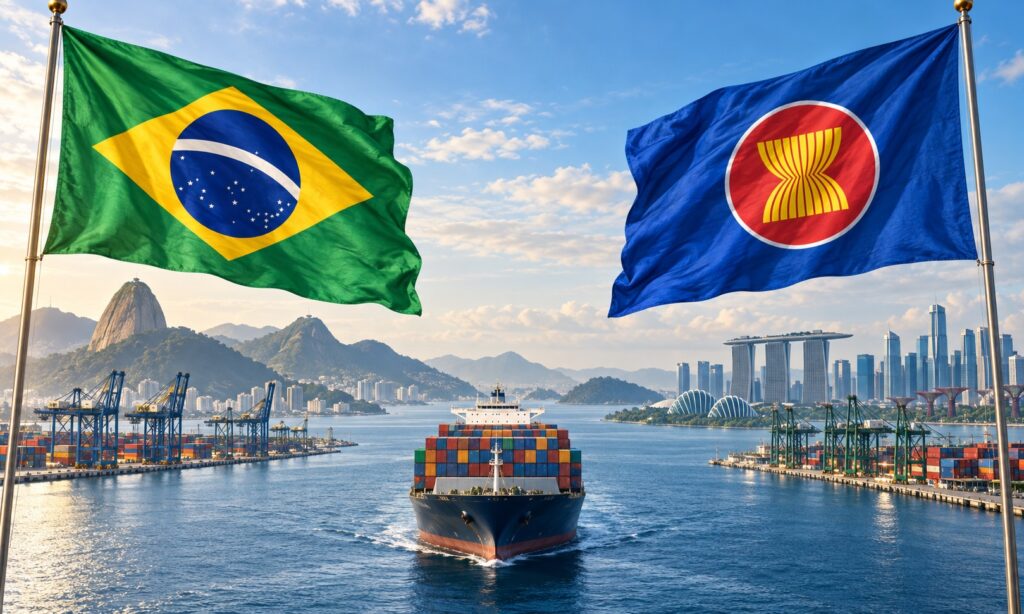
SINGAPORE – Brazil’s campaign for a stronger relationship with Southeast Asia is gaining diplomatic traction as its exporters confront uncertainty in Western markets. Foreign Minister Mauro Vieira’s visits to Singapore and Thailand this week combined a strategic ambition—securing full dialogue-partner status with ASEAN—with the immediate commercial objective of reopening Thailand’s market to Brazilian meat.
The distinction matters: Brazil is seeking an upgrade in its external partnership, not membership of ASEAN. It has been a sectoral dialogue partner since 2022. The proposed change would broaden its institutional relationship with the association while leaving it outside the Southeast Asian bloc.
A Commercial Strategy With Growing Urgency
ASEAN countries collectively traded roughly $38 billion with Brazil in 2025, making the grouping its fifth-largest trading partner. Brasília hopes an upgraded partnership could be secured around November’s summit in the Philippines or during Singapore’s chairmanship beginning in January 2027. That remains a Brazilian expectation, rather than an announced ASEAN timetable.
The pressure extends beyond President Trump’s tariffs. On September 3, European restrictions on certain Brazilian animal products took effect over antimicrobial-compliance concerns. Brazil threatened reciprocal measures, while its beef exporters’ association warned that other destinations could not automatically replace the European market because buyers demand different products and cuts.
That warning exposes the limits of diplomatic diversification: new relationships can create opportunities, but regulatory approvals, logistics and customer demand determine whether exports follow. Brazilian diplomat Eugenia Barthelmess made a related argument in a late-2025 CEBRI analysis, identifying sanitary standards, transport barriers and manufacturing competition as practical challenges to closer ASEAN ties.
Singapore offers a concrete advance. Its government confirmed that the Mercosur–Singapore free-trade agreement entered into force between Singapore and Brazil on August 1. Thailand’s September 11 account of Vieira’s visit, meanwhile, announced broader cooperation but no reopening of its meat market.
ASEAN Is Open to the Bid. A Clear Opposition Camp Has Not Emerged.
The strongest evidence of regional receptiveness comes from ASEAN itself. In remarks delivered in Brasília on August 18, Secretary-General Kao Kim Hourn confirmed that all 11 members had endorsed a full assessment of Brazil’s application. Agreement to examine the request, however, does not constitute agreement to grant it.
Public statements reveal differing degrees of engagement:
| ASEAN member | Documented position |
|---|---|
| Singapore | Welcomes deeper engagement, emphasizing trade, food security, digitalization and sustainability. Its September statement contains no explicit commitment to approve the upgrade. |
| Thailand | Supports expanded bilateral and multilateral cooperation, including agriculture, aviation and tourism. Its latest statement does not explicitly endorse full dialogue-partner status. |
| Philippines | As ASEAN chair, hosted July discussions on strengthening the existing partnership; the published account does not promise an upgrade. |
| Other eight members | Included in the collective endorsement of an assessment. That alone does not establish their final positions. |
No publicly documented opponent was identified in the sources reviewed. Assigning countries to a “contra” camp—or attributing hidden objections to them—would therefore go beyond the evidence.
The attraction is understandable: Brazil offers opportunities in food, energy and Latin American markets, alongside support for ASEAN’s central role in regional diplomacy. The analytical question is whether those opportunities justify a broader institutional commitment. ASEAN’s consensus principle makes collective agreement essential; the chair cannot simply deliver an upgrade alone.
Regional Coverage Emphasizes Opportunity, With Limited Editorial Verdicts
The coverage reviewed is receptive or explanatory, but it does not establish a region-wide editorial consensus.
Indonesian media presented the assessment as diplomatic progress, emphasizing trade, energy and sustainable development. Its favorable framing remained conditional on the application succeeding.
Singapore’s The Straits Times focused on Vieira’s rejection of an anti-Western interpretation of BRICS, placing his visit within Brazil’s wider diplomacy.
Thailand’s Bangkok Post published Vieira’s own argument for closer relations. Providing that platform demonstrates interest in Brazil’s case; it should not be represented as the newspaper’s endorsement.
The broader regional context favors diversification. A January 2026 study from Malaysia’s IDEAS think tank advocated deeper partnerships and stronger regional coordination in response to American trade pressure. That supports the strategic logic of engagement with Brazil, without constituting a position on its application.
What Travelers Should Know
The diplomatic bid creates no new travel entitlement. Visitors should continue checking national entry requirements and official advisories.
The most directly relevant risk is fraudulent recruitment. British guidance warns that purported high-paying jobs in Cambodia can lead to confinement and passport confiscation. Verify employers independently before traveling and contact your embassy if a recruiter changes the destination or restricts your movement.
For overland itineraries, Australia’s advisory reports Thailand–Cambodia border crossings closed and warns against travel within designated areas 10 kilometers from the border. Confirm routes before departure and check insurance coverage. These security restrictions are separate from Brazil’s diplomatic initiative.
Sources: Singapore Foreign Ministry, Thailand Foreign Ministry,
UK Government, IDEAS, ASEAN.org