
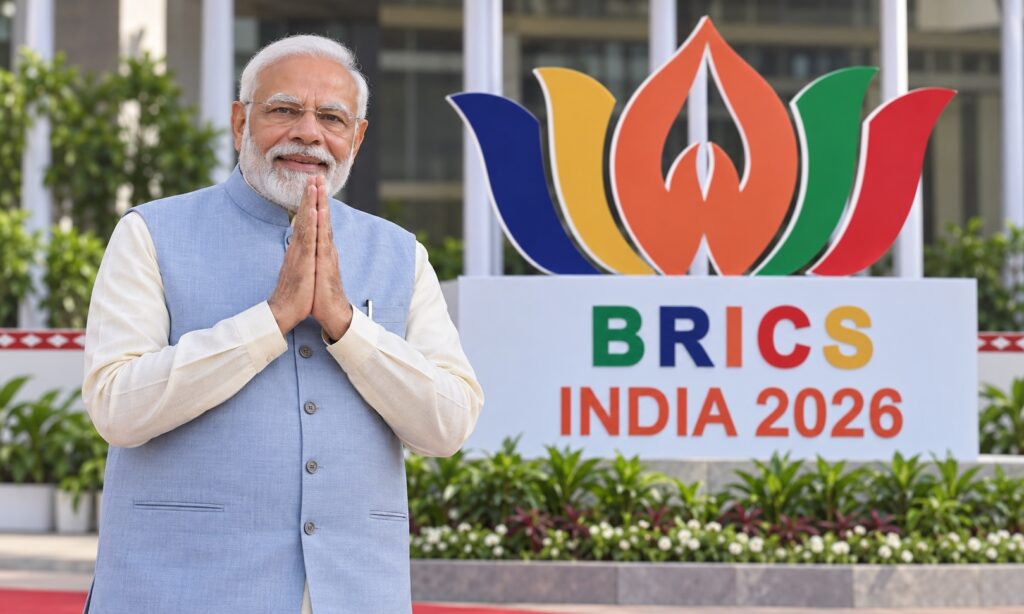
NEW DELHI, India — BRICS leaders gathering in India face a test of whether growing economic influence can translate into collective action. President Trump’s tariff threats and the war involving Iran have sharpened their interest in a less vulnerable international order. They have also exposed profound disagreements over how to build one.
The September 12–13 summit offers Prime Minister Narendra Modi an opportunity to strengthen India’s standing among developing countries. Its success will depend on securing useful agreements among governments with markedly different relationships with Washington.
Shared concerns, competing interests
Russia and Iran have strong incentives to seek a firmer challenge to American power. India must protect its commercial and strategic relationship with the United States. The United Arab Emirates, exposed to Iranian attacks and tied to Washington through security cooperation, approaches the conflict from a different position again.
Michael Kugelman, a senior fellow at the Atlantic Council, told the BBC that India could not afford a declaration openly attacking Washington. His assessment points to a central weakness of expansion: broader representation brings more competing interests into negotiations conducted by consensus.
India’s immediate priorities were evident on September 11. In talks with Iranian President Masoud Pezeshkian, Modi emphasized safe shipping, freedom of navigation and the protection of seafarers. Pezeshkian, addressing the business forum, urged BRICS to resist economic pressures that obstruct legitimate trade. Those responses suggest agreement on protecting commerce, with substantial differences over responsibility for its disruption.
Financial cooperation gains ground
There is already evidence of progress below the leaders’ level. A finance ministers’ and central bank governors’ statement, issued late September 10, called for stronger developing-country representation at the International Monetary Fund and World Bank. It also criticized unilateral trade restrictions and supported more efficient cross-border payments. This agreement gives India a concrete achievement, although it does not resolve the summit’s political divisions.
Work on connecting payment systems and expanding settlement in national currencies remains exploratory. The measures described so far do not establish a common BRICS currency. Their practical value will depend on implementation, adoption and the cost of moving money across borders.
The New Development Bank provides a firmer institutional foundation. Its 2025 annual report recorded 115 projects in its year-end portfolio, with approved financing of about $35.6 billion. These are financing approvals, rather than a measure of money already disbursed or projects completed.
India’s test extends beyond the declaration
Beijing said on September 11 that arrangements were being made for a meeting between President Xi Jinping and Modi, emphasizing cooperation and the management of differences. The encounter will help indicate how far their cautious rapprochement can advance alongside continuing competition for influence.
Indian reporting also identifies proposed cooperation on startup financing, incubators and logistics. These initiatives remain prospective summit outcomes. For Delhi, securing clear commitments and a credible timetable would strengthen its claim to leadership more durably than a declaration whose ambiguities merely conceal disagreement.
What travelers should know
New Delhi, September 11–13: Police have announced summit traffic restrictions and diversions. Allow extra time for airport and railway transfers, confirm vehicle access with your hotel and check the latest route advice before departure.
Travel through the Gulf: Check every flight segment and transit country’s advice. Britain’s current UAE guidance warns of possible cancellations and short-notice airspace closures. Keep bookings flexible where possible and review insurance coverage for disruption.
Sources: Reuters, India Times, China’s Foreign Ministry, NDB