
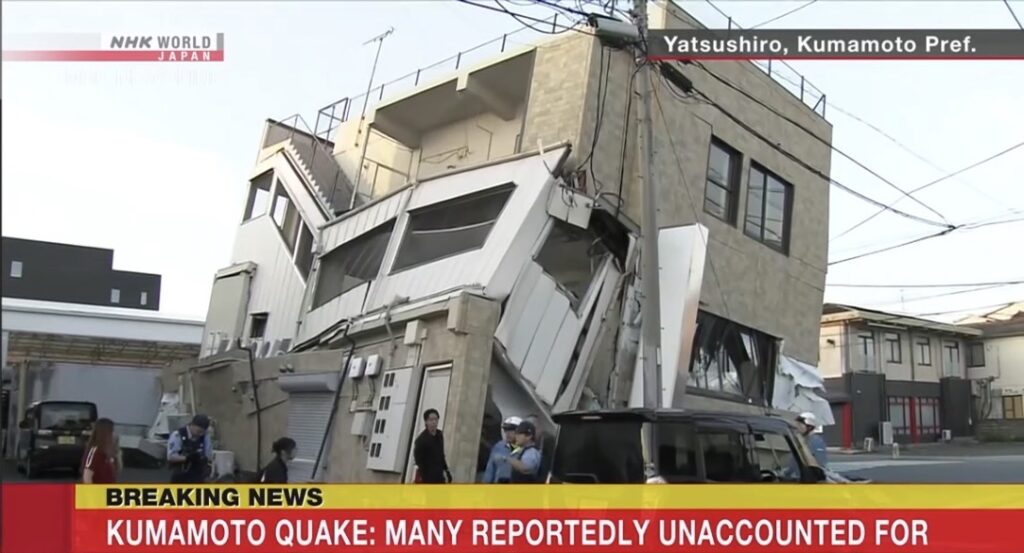
KUMAMOTO, Japan — A powerful, shallow earthquake struck Kumamoto Prefecture on Tuesday afternoon, severely damaging buildings and roads, igniting fires and leaving an uncertain number of people trapped or missing at a shopping center and a paper factory.
The earthquake occurred at approximately 4:27 p.m. local time, with its epicenter in the Kumamoto region about 20 kilometers south of Kumamoto City and at a depth of roughly 10 kilometers. Japan’s Meteorological Agency initially assigned it a magnitude of 7.1, while its moment-magnitude calculation was Mw 6.8. The earthquake produced the maximum reading of 7 on Japan’s seismic-intensity scale in Uki City and Hikawa Town.
It is therefore more accurate to describe the event as a JMA magnitude 7.1 earthquake, with seismic intensity 7, rather than a “7.0 Richter-scale” earthquake. Magnitude measures the energy released; Japan’s intensity scale measures the severity of shaking at particular locations.

An Explosion and Collapse at Aeon Mall Kumamoto
The most serious known rescue operation was unfolding at Aeon Mall Kumamoto in Kashima Town.
Japan’s Fire and Disaster Management Agency said the mall’s second-floor section had collapsed and that “many” people were trapped. Emergency Fire Response Teams from Fukuoka Prefecture were working at the scene. This is the latest nationally consolidated official description available at the time of writing.
Japanese broadcasters and international news agencies reported that:
- Customers and employees were initially evacuated after the earthquake.
- At about 6 p.m., an explosion caused extensive additional damage, tearing away part of the building and exposing its steel framework.
- Approximately 20 to 30 employees were reported unaccounted for.
- At least three people were reportedly transported from the site.
- Police sources cited by Japanese media said several deaths had been confirmed or were feared, although these accounts had not yet been incorporated into the national Fire and Disaster Management Agency’s casualty total.
- Investigators were examining a possible earthquake-related gas leak, but the precise cause of the explosion remained undetermined.

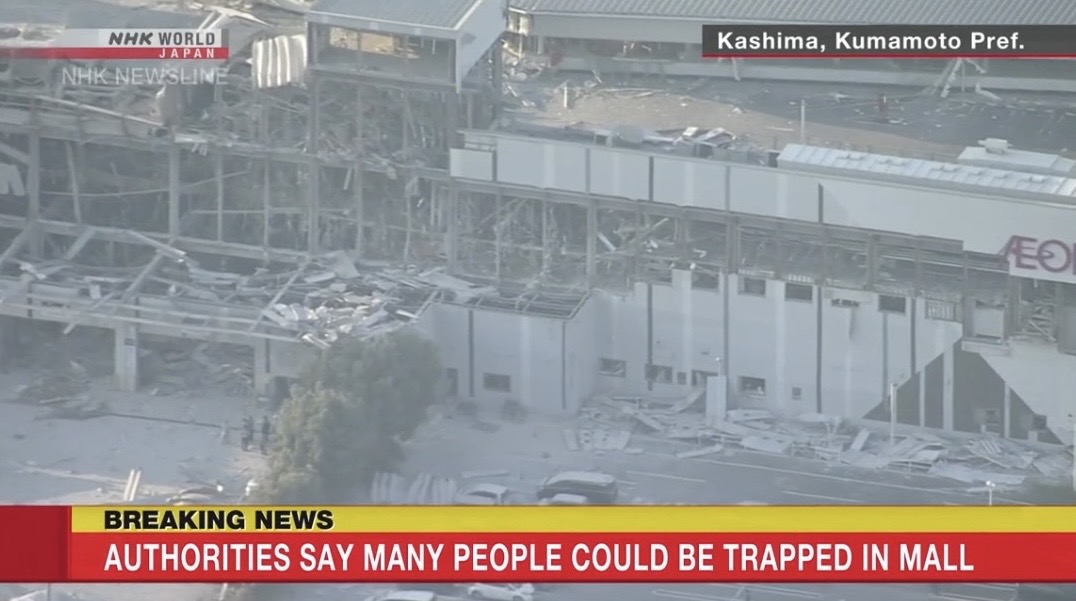
Aeon told Reuters that customers and employees had been evacuated immediately after the initial shaking and that it could not yet explain the explosion. The company had not released a verified final count of everyone inside the complex. Reuters, TV Asahi
The distinction between “trapped,” “missing” and “presumed dead” remains important. The Fire and Disaster Management Agency confirmed a mass-entrapment incident, but some of the more specific fatality reports remained preliminary.
Workers Missing at the Nippon Paper Mill
At the Nippon Paper Industries Yatsushiro Mill, a large industrial chimney broke and collapsed during the earthquake.
Police and Japanese broadcasters reported that several workers could not be contacted afterward. Firefighters were still responding at the mill late Tuesday, according to the national emergency report. Nippon Paper had not published a definitive casualty or missing-person count by the reporting cutoff.
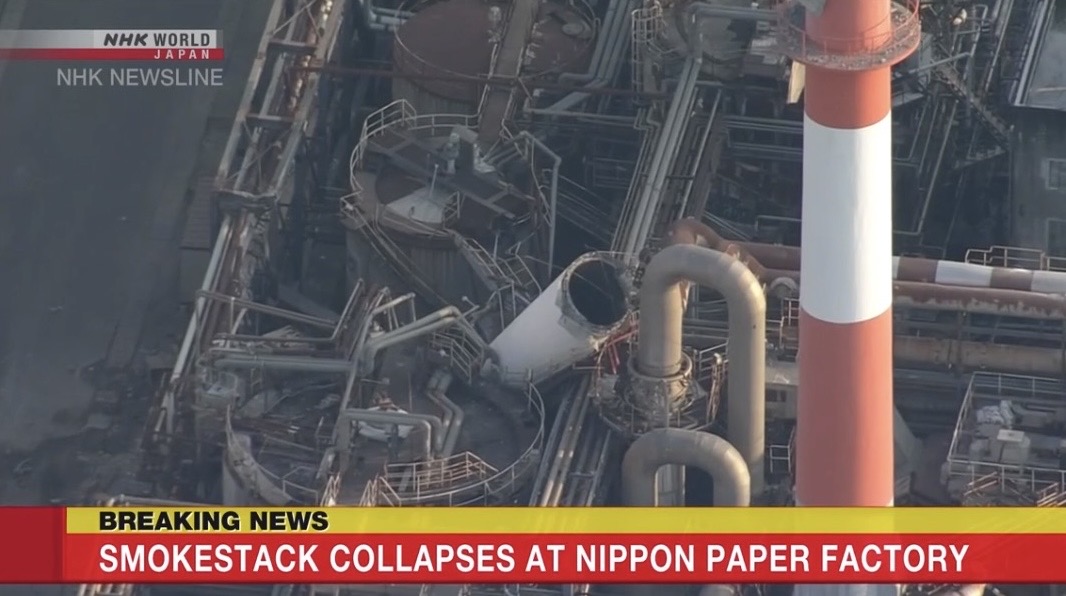
Images distributed by Kyodo and Reuters showed the chimney broken across the industrial site. It was not yet clear whether workers were directly beneath the structure, elsewhere in inaccessible areas, or simply unreachable because of disrupted communications.
Injuries and Fatalities Remained Uncertain
The casualty picture was highly fluid and contained major differences between official and hospital-based reporting.
As of 11:50 p.m., the Fire and Disaster Management Agency’s consolidated report formally listed only one minor injury in Oita City. That figure clearly did not yet include numerous emergency cases being reported inside Kumamoto Prefecture.
Reuters and Japanese news organizations reported:
- Two hospitals were each treating approximately 50 people, some reportedly in serious condition.
- Saiseikai Kumamoto Hospital had received about 50 patients, including at least one person reported to be in cardiac arrest.
- Passengers on trains were also injured.
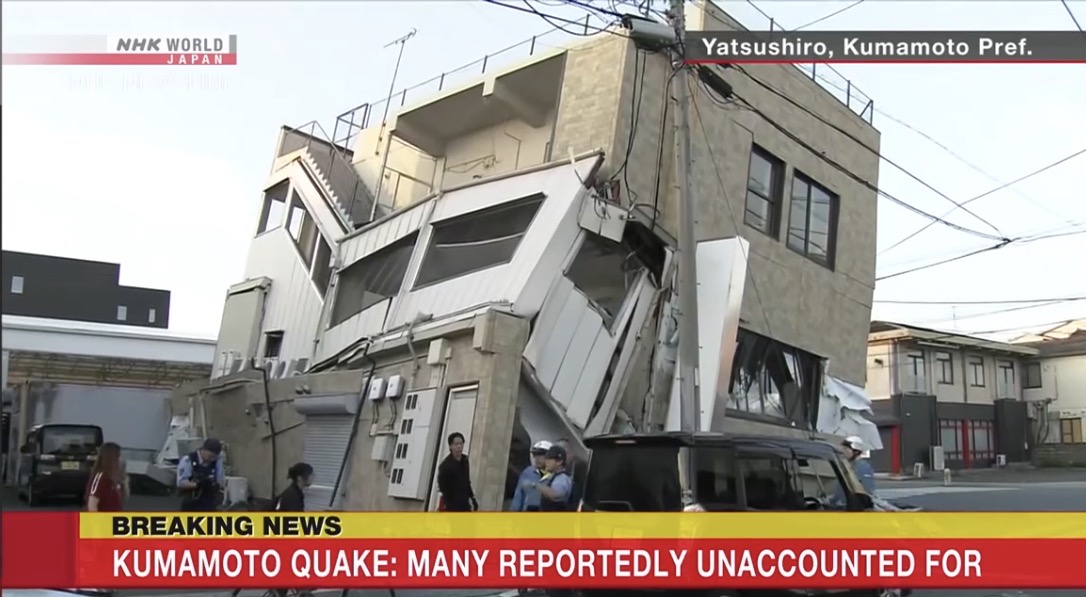
- One person was reportedly found dead in a collapsed house in Yatsushiro.
- Further deaths were feared at Aeon Mall.
These numbers should be treated as preliminary hospital and media reports, not a final official toll. Damage to the Yatsushiro area’s emergency-call dispatch system also complicated the collection of reliable figures.
Homes, Roads, Bridges and Kumamoto Castle Damaged
Emergency authorities recorded at least nine fires in Kumamoto Prefecture—two each in Uki and Yatsushiro and four in Kumamoto City—along with numerous rescue operations. Most reported fires had been extinguished or brought under control by late evening.
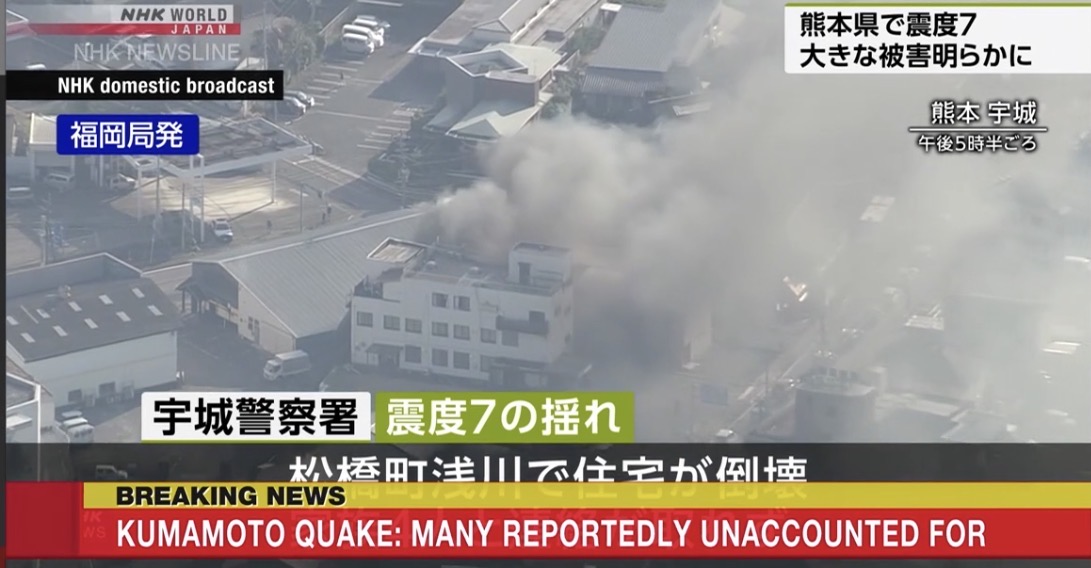
Footage and local reports showed:
- Collapsed or partially collapsed homes near the epicenter.
- Deep fractures and displacement along major roads.
- Damage to at least one bridge.
- Railway derailment or track damage in the Yatsushiro area.
- Damage to shrines and other historic structures.
- Fresh collapses in portions of Kumamoto Castle’s stone walls, which were still undergoing restoration after the destructive 2016 earthquakes.
- Power and telecommunications interruptions affecting tens of thousands of households.
The earthquake also generated Japan’s highest category of long-period ground motion in the Kumamoto region, a type of movement that can cause upper floors of large buildings to sway for prolonged periods.
Transport and Industrial Disruption
Rail service across Kyushu was widely suspended, including portions of the Shinkansen network. Flights were halted or diverted, and operations at Aso Kumamoto Airport were disrupted.
Major manufacturers evacuated workers or temporarily stopped production, including:
- TSMC
- Sony
- Fujifilm
- Tokyo Electron
- Honda
- Toyota-related operations in the region
TSMC subsequently said its site had not suffered significant damage and that operations were gradually resuming. Tokyo Electron and Honda planned temporary shutdowns while facilities were inspected.
Japan’s nuclear regulator and the International Atomic Energy Agency reported no safety abnormalities at nearby nuclear facilities, including the Sendai plant.
Tsunami Advisory Lifted
The Meteorological Agency issued a tsunami advisory for the Ariake and Yatsushiro seas at 4:29 p.m. It was lifted at 6:10 p.m.
No destructive tsunami was reported. Authorities nevertheless warned that water can move through narrow bays and rivers in complicated ways and initially instructed residents to stay away from coastal areas.
Government Mobilizes National Response
Prime Minister Sanae Takaichi ordered the government to gather damage information urgently, coordinate closely with local authorities and place the protection of life above all other priorities.

The government’s actions included:
- Establishing an emergency office at the Prime Minister’s crisis-management center.
- Convening an interministerial Emergency Assembly Team.
- Establishing a national headquarters for major-disaster response.
- Deploying Self-Defense Forces for rescue, aerial reconnaissance and logistical support.
- Mobilizing Emergency Fire Response Teams from Fukuoka, Oita, Miyazaki, Saga, Okayama, Hiroshima, Yamaguchi and Kagoshima.
- Sending additional firefighting and disaster-management aircraft.
- Applying the Disaster Relief Act to 10 cities, 10 towns and one village in Kumamoto Prefecture.
- Directing authorities to provide the public with timely information and assist people stranded by transport interruptions.
Kumamoto Prefecture automatically activated its disaster headquarters at 4:27 p.m. Governor Takashi Kimura said police, firefighters and the Self-Defense Forces were coordinating rescue efforts, with human safety taking priority.
Evacuation or emergency-safety instructions covered roughly 261,000 people in Kumamoto and Nagasaki prefectures by late evening. International reports placed the broader number told to use evacuation centers at around 300,000.
The Risk Has Not Passed
The Meteorological Agency issued an unusually serious warning because large earthquakes in Kumamoto have previously occurred in sequences.
Residents in the hardest-hit areas were advised to prepare for another earthquake producing shaking of intensity 7 for approximately one week, with the greatest danger during the first two to three days. Thus, reports of a “three-to-four-day risk” are broadly consistent with the period of greatest immediate concern, but the official caution extends for about seven days.
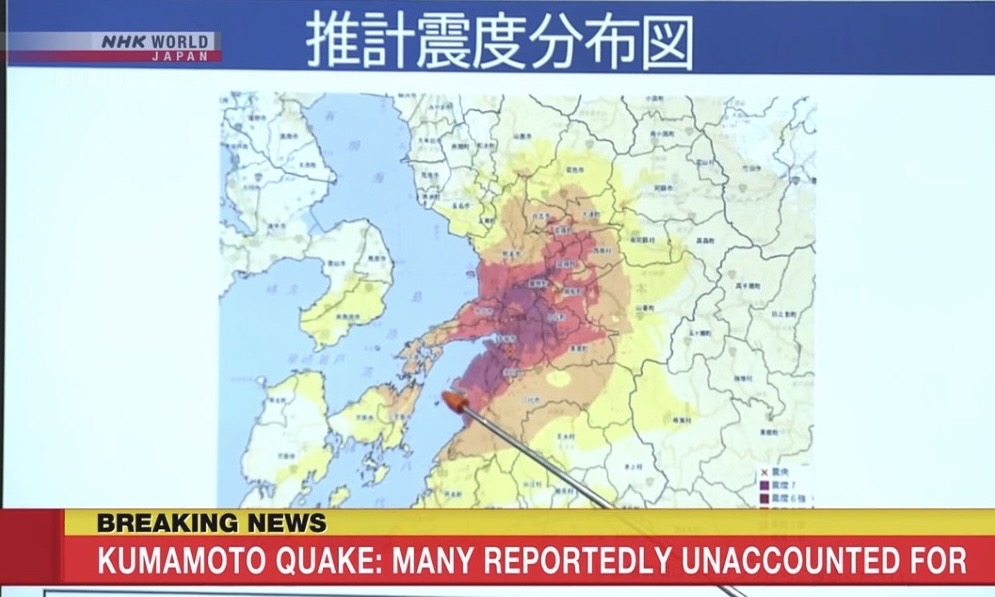
More than 100 smaller aftershocks had reportedly occurred by late Tuesday. Several reached intensity 5-lower, including shocks at 4:29 p.m., 5:08 p.m. and 7:03 p.m.
The warning does not mean that scientists are predicting another major earthquake on a particular day. It means that the statistical likelihood is significantly elevated after a large shallow earthquake. Aftershocks generally become less frequent over time, but a later shock can occasionally equal or exceed the first event. The 2016 Kumamoto sequence demonstrated that danger: a strong initial earthquake was followed about 28 hours later by a larger main shock.
International Seismic Assessment
International reporting commonly described the earthquake as magnitude 6.8, reflecting the moment-magnitude estimate, while Japan continued to use the preliminary JMA magnitude of 7.1. The two numbers are not necessarily contradictory; they come from different measurement methods and data-processing stages.
The earthquake’s preliminary focal mechanism indicated shallow strike-slip faulting, with an east-northeast to west-southwest compression axis. This is consistent with the complex network of active faults running across central Kyushu. Its shallow depth intensified surface shaking and helps explain why damage was severe even though its moment magnitude was below 7.0.
International coverage focused on three broader concerns:
- The similarities with the 2016 Kumamoto earthquake sequence.
- The possibility that damaged structures could collapse during strong aftershocks.
- The economic exposure of Kyushu’s semiconductor, automotive and manufacturing corridor.
Reuters, The Associated Press, The Guardian and the Financial Times all emphasized that rescue and casualty information remained provisional. Their reports generally agreed on the scale of the mall collapse, the damaged Nippon Paper chimney, major transport disruption and the continuing aftershock threat, but differed on injury and fatality totals because they were drawing on hospitals, police, broadcasters and emergency agencies at different reporting times.
What remains unconfirmed
At the reporting cutoff, authorities had not produced a definitive answer to several critical questions:
- How many people remained inside Aeon Mall.
- Whether all 20 to 30 unaccounted-for employees were actually trapped.
- The confirmed death toll at the mall.
- The number and condition of missing Nippon Paper workers.
- The complete prefecture-wide injury total.
- The precise cause of the mall explosion.
- The full extent of damage to homes, bridges, factories and cultural properties.
Those figures are likely to change substantially as rescue teams reach damaged buildings and local reports are incorporated into the national count.
Sources: Japan Meteorological Agency, Reuters, TV Asahi, Prime Minister’s Office, Kumamoto Prefecture
Photos: NHK TV