
By Staff Writer
SHENZHEN, China – For decades, the label “Made in China” evoked images of inexpensive, mass-produced goods flowing from vast factory networks to Western consumers. Today, that image is being rewritten—not in industrial parks, but in shopping malls, on social media feeds and across global markets where Chinese brands are increasingly setting trends rather than following them.
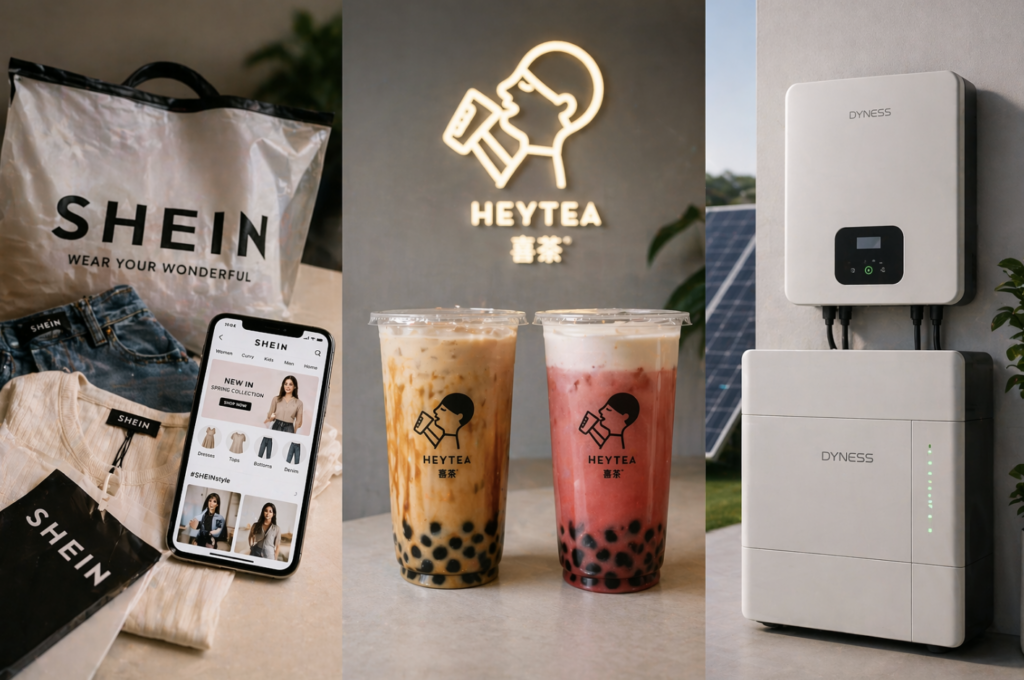
A new generation of companies—spanning fast fashion, food chains, electric vehicles and energy systems—is reshaping China’s role in the global economy. Their rise reflects not only a shift in production, but a deeper transformation toward branding, innovation and cultural influence.
A Shift From Production to Identity
Companies like Shein illustrate the change. Founded in China but operating globally, Shein has become one of the world’s largest fashion retailers, driven by data-driven design and rapid production cycles that can turn trends into products within days.
Unlike earlier exporters, these firms are not merely suppliers; they are consumer-facing brands. Their success is tied to marketing, storytelling and digital engagement as much as manufacturing efficiency.
Analysts note that Chinese companies are now moving “from feature-driven products to brand-building,” a transition seen across sectors as competition intensifies domestically and pushes firms outward.
Exporting Lifestyle, Not Just Goods
In food and retail, companies such as the beverage chain Mixue and hotpot giant Haidilao are exporting not only products but experiences. Mixue, known for its low-cost drinks and viral branding, has become the world’s largest food-and-beverage chain by store count, surpassing McDonald’s and Starbucks.
Its expansion into markets like Southeast Asia and Latin America underscores a broader shift: Chinese investment is increasingly targeting consumer markets rather than infrastructure, reflecting a strategic pivot toward global consumption.
This trend is reinforced by localization strategies—adapting menus, pricing and branding to local tastes—helping Chinese brands gain traction abroad, particularly among younger consumers.
Technology and Scale Drive Global Reach
In higher-value industries, companies like BYD are redefining competition. The automaker has expanded rapidly beyond China, targeting Europe, Latin America and Asia as it seeks to rival global giants.
BYD’s rise reflects a broader industrial upgrade. Chinese firms are no longer competing primarily on cost, but on technology, vertical integration and speed to market—particularly in sectors like electric vehicles and energy storage.
Recent international events, including global sports sponsorships, have also become platforms for Chinese brands to increase visibility and legitimacy abroad, signaling a coordinated push into global branding.
Domestic Strength Fuels Global Ambition
The international expansion of these companies is rooted in a fiercely competitive domestic market. In China, local brands have steadily gained ground against multinational corporations, often offering lower prices and tailoring products more closely to consumer preferences.
This environment has forced companies to innovate rapidly—developing digital marketing expertise, agile supply chains and strong brand identities before expanding overseas.
As one industry observer noted, Chinese brands may follow a trajectory similar to Japanese and South Korean companies, evolving from imitators into global leaders over the coming decade.
A New Phase of Globalization
The implications extend beyond individual companies. China’s role in global trade is shifting from that of a manufacturing hub to a source of consumer culture, technology and branded experiences.
In regions such as Southeast Asia and Brazil, Chinese firms are gaining ground by combining affordability with innovation. In Europe, they are making inroads in high-value sectors like electric vehicles. In the United States, progress remains uneven, constrained by regulatory and political challenges, but digital-first brands continue to find footholds.
The Emerging Narrative
What emerges is not simply a story of export growth, but of transformation. Chinese companies are increasingly defining what they sell—and how they are perceived—on their own terms.
The evolution from “Made in China” to “Created in China” signals a broader rebalancing of global influence, one in which branding, culture and technology carry as much weight as production capacity.
And as these brands expand, they are not just entering global markets. They are helping to reshape them.