
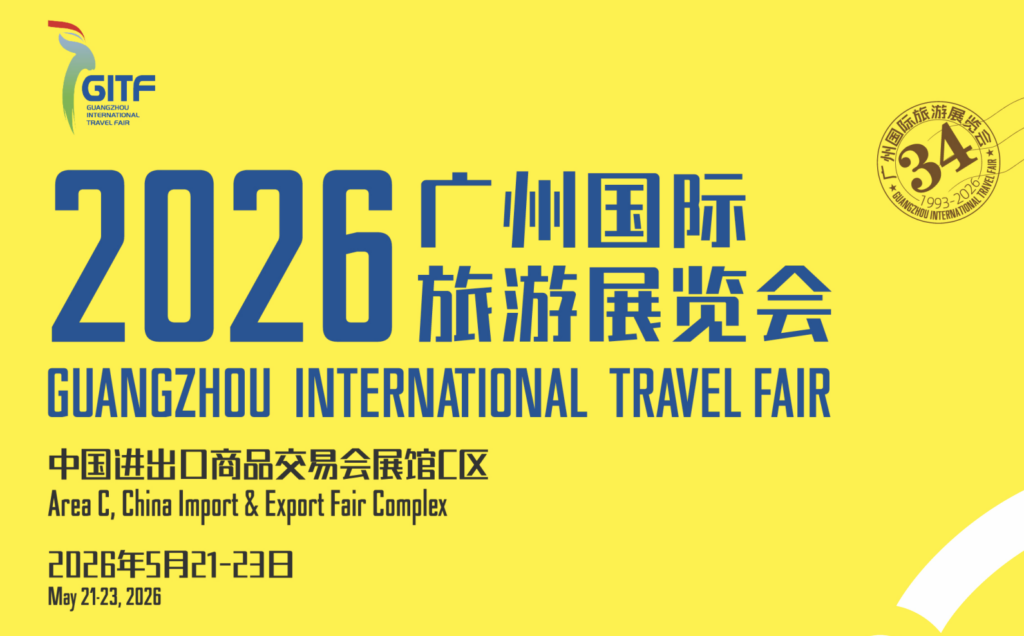
GUANGZHOU, China – For more than three decades, the Guangzhou International Travel Fair — widely known as GITF — has served as a barometer of China’s tourism ambitions. Founded in 1993, the exhibition began as a regional showcase in southern China. Today, it has evolved into one of Asia’s most influential travel industry gatherings, linking tourism boards, airlines, hotels, cruise operators and technology companies from around the world.
From Regional Showcase to International Tourism Platform
The 34th edition of the fair, scheduled for May 21–23, 2026, at the Canton Fair Complex in Guangzhou, arrives at a pivotal moment for global tourism. China’s outbound travel market is recovering rapidly, Southeast Asia is competing aggressively for Chinese visitors, and the tourism sector is increasingly shaped by artificial intelligence, sustainability goals and premium travel experiences.
Organizers expect more than 1,000 exhibitors from over 55 countries and regions to participate this year, alongside approximately 40,000 professional visitors and thousands of pre-arranged business meetings. The fair’s scale reflects Guangzhou’s growing role as a gateway city for both domestic and international tourism, particularly within the Guangdong-Hong Kong-Macao Greater Bay Area.
The exhibition’s official theme for 2026, “Meaningful Tourism, Enduring Connections”, signals a shift away from mass tourism toward experience-driven travel. Organizers say the event will place stronger emphasis on cultural exchange, sustainable tourism, wellness travel and digital innovation.
A Different Chinese Traveler Emerges
In many ways, the fair mirrors broader changes inside China itself. Before the pandemic, Chinese tourists were the world’s highest spenders abroad, transforming destinations from Bangkok to Paris. But the market returning in 2026 is different.
Chinese travelers are increasingly seeking independent itineraries, niche cultural experiences and smaller-group luxury travel instead of traditional package tours. Younger consumers, in particular, are prioritizing personalization, authenticity and social-media-driven travel discovery.
That evolution has reshaped the profile of exhibitors attending GITF. Alongside national tourism boards and airlines, the exhibition floor now includes smart tourism companies, digital booking platforms, wellness resorts, cultural heritage destinations and travel technology providers.
ASEAN and Asia Remain at the Center
Asian destinations continue to dominate the fair. Thailand, Japan, South Korea, Vietnam, Malaysia and Singapore are expected to maintain strong national pavilions as competition intensifies for Chinese outbound travelers.
The relationship between China and Southeast Asia has become especially important in the post-pandemic tourism recovery. Many ASEAN countries now see Chinese tourism as a critical pillar of economic growth and are investing heavily in marketing campaigns, visa facilitation and direct air connectivity.
Middle Eastern tourism authorities, particularly from the United Arab Emirates and Saudi Arabia, have also expanded their presence in recent years, hoping to capitalize on China’s growing luxury and transit-travel segments.
Europe Rebuilds Its Position in the Chinese Market
European tourism boards continue to regard GITF as strategically important as Chinese outbound tourism gradually rebounds.
Tourism agencies from Germany, France, Italy, Spain and Switzerland are expected to promote cultural tourism, shopping, winter travel and high-end hospitality products to Chinese buyers and travel operators. European exhibitors are also emphasizing sustainability, heritage tourism and premium rail travel experiences as they compete for higher-spending Chinese travelers.
For many European destinations, the Guangzhou fair represents not only a business opportunity but also a chance to rebuild long-term relationships with Chinese travel agencies and airlines after years of reduced travel flows.
China’s Domestic Tourism Boom
Domestic Chinese tourism, however, may be the fair’s biggest story. China’s internal travel market has become one of the world’s largest economic engines, driven by high-speed rail expansion, digital payment ecosystems and rising middle-class spending.
Regional governments across China are increasingly using cultural tourism and heritage branding as tools for economic development. Smaller cities and rural destinations are investing heavily in tourism infrastructure, eco-tourism projects and immersive cultural experiences to attract younger travelers.
Industry analysts say Guangzhou is particularly well positioned to host such discussions. The city has long been one of China’s most internationally connected commercial centers, with strong aviation links, manufacturing infrastructure and proximity to Hong Kong.
Unlike Beijing or Shanghai, Guangzhou also serves as a bridge between mainland China and Southeast Asia, a relationship that has grown increasingly important in post-pandemic tourism recovery.
Tourism Diplomacy and Business Expansion
The fair is also becoming a platform for tourism diplomacy. In recent years, Chinese and international tourism authorities have used the event to deepen bilateral cooperation agreements, expand airline partnerships and negotiate new travel routes.
Hosted buyer programs and matchmaking systems now form a central part of the exhibition’s business strategy. Organizers expect more than 5,000 formal business matchmaking sessions during the 2026 edition, reflecting the event’s growing influence as a B2B marketplace.
For many travel companies, participation in GITF is no longer simply about brand exposure. It has become an important venue for strategic partnerships, regional expansion and long-term market positioning in Asia.
Artificial Intelligence and Sustainable Travel
Technology is expected to dominate much of this year’s conversation. Travel companies are racing to integrate artificial intelligence into booking systems, translation tools, customer service and destination marketing.
Chinese digital travel platforms are increasingly using AI-driven personalization to target travelers based on spending habits, social media behavior and travel preferences. Industry executives believe AI could fundamentally transform how travel products are marketed and consumed over the next decade.
At the same time, sustainability has become an unavoidable issue for the global tourism industry. Chinese consumers, particularly younger travelers, are showing growing interest in eco-tourism, wellness retreats and environmentally conscious travel experiences.
Organizers say discussions around sustainable tourism infrastructure, green hotels and responsible destination management will feature prominently throughout the event.
China’s Expanding Influence in Global Tourism
Despite global economic uncertainty, the outlook surrounding GITF 2026 remains optimistic. The fair’s continued growth suggests that international tourism businesses still view China as one of the most important long-term travel markets in the world.
More than a trade exhibition, the Guangzhou International Travel Fair has become a reflection of how China sees its place in the global tourism economy: not only as a source of travelers, but increasingly as a central architect of travel trends, tourism technology and international cultural exchange in Asia and beyond.