
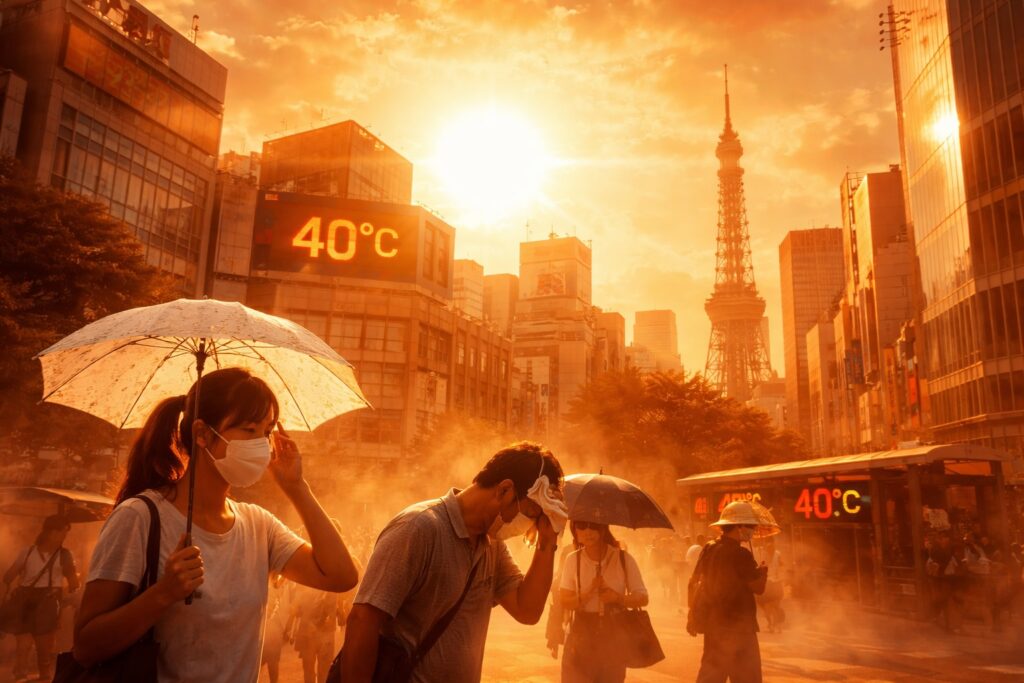
TOKYO, Japan – Japan has introduced a new meteorological term for days when temperatures exceed 40°C (104°F), reflecting both scientific urgency and public sentiment as the country confronts intensifying heat.
The word, kokushobi—loosely translated as “cruelly” or “brutally hot day”—was selected through a nationwide survey conducted by the Japan Meteorological Agency (JMA), drawing nearly 478,000 responses. The winning term underscores how language itself is evolving to capture the severity of climate extremes.
The designation extends Japan’s existing system for classifying hot weather, which already includes terms for days surpassing 25°C, 30°C and 35°C. By formalizing a category for the most extreme temperatures, officials aim to sharpen public awareness and improve risk communication as heat becomes more dangerous and persistent.
Record Heat and Rising Risks
The move follows a historic summer. In 2025, Japan recorded its hottest season since modern measurements began in 1898, with average national temperatures rising 2.36°C above baseline levels. Cities across the country experienced prolonged and unprecedented heat. Tokyo logged 25 days above 35°C—more than five times its historical average—while Kyoto endured 52 such days, nearly tripling its norm.
Temperatures surpassed 40°C on multiple occasions, including a national record of 41.8°C in Isesaki. The frequency of these extremes has accelerated, with consecutive years breaking records for cumulative “dangerously hot” days.
The JMA has warned that the trend is unlikely to abate. Seasonal forecasts indicate a high probability of above-normal temperatures again this summer, raising concerns over public health, energy demand and infrastructure resilience.
A Global Pattern of Escalation
Japan’s experience mirrors a broader international pattern. Climate scientists widely attribute the increasing intensity and frequency of heatwaves to human-driven warming, primarily from greenhouse gas emissions linked to fossil fuel use. According to recent analyses from organizations such as the Intergovernmental Panel on Climate Change and the World Meteorological Organization, extreme heat events that were once rare are becoming commonplace across Asia, Europe and North America.
In 2024 and 2025, multiple countries reported record-breaking temperatures, with heatwaves straining healthcare systems and prompting governments to revise emergency response strategies. Urban centers, in particular, face heightened risk due to the “heat island” effect, where built environments trap heat and exacerbate temperature extremes.
From Vocabulary to Policy
Experts say Japan’s introduction of kokushobi is more than symbolic. By clearly defining the most severe category of heat, authorities hope to encourage behavioral changes—such as limiting outdoor activity, increasing hydration and expanding the use of cooling shelters—while also guiding policy decisions around labor safety and urban planning.
Public engagement in selecting the term suggests a growing awareness of climate risks among citizens. Yet analysts caution that language alone cannot mitigate the impacts. Without deeper structural changes—including emissions reductions, energy transition and climate adaptation measures—the conditions that necessitated the term are expected to intensify.
A Warning in a Word
As Japan prepares for another potentially sweltering summer, kokushobi stands as both a linguistic innovation and a warning. It captures, in a single expression, the reality of a warming world—where extremes are no longer anomalies, but an emerging norm.